
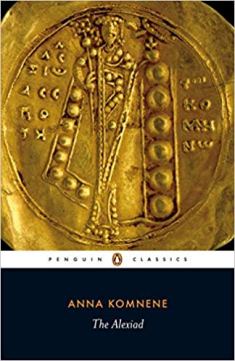
I’ve talked about my struggles with The Alexiad before. Though it took me an embarrassing amount of time to make it to the last page, I deem the journey well worth it. I still don’t trust everything Anna Komnene wrote. Ultimately, however, I feel that far more of the story she tells is authentic and important than it is self-justifying or intentionally embellished. She speaks about a crucial period in world history from a primary-source perspective. There are sections of the book that are clearly from Anna’s direct point of view, written in first person. I found those sections of the book to be most compelling, imbuing the account of that time — Alexios’ reign, from 1081-1118 CE — with urgency.
Her insights and immediacy to the events recounted bring them to life in a way that is unique. There are times when she apologizes for “straying from the history” with personal interjections. I understand her concerns. As she tries to present an objective recounting of events, she is likely resisting what she has been taught: that adding personal details affects the integrity of a classically-told history. But the beauty of her work is greatly enhanced by her presence in these pages, even as it brings into question the purity of her recounting.
Anna lived in a convent the last 30 years of her life, her husband dead. It is suspected that she tried to take the throne from her brother John II Komnenos, but failed. The 15 books of the Alexiad were written over the last ten years of her life, and apparently finished as Anna herself was dying. My suspicion is that she knew she was dying for the last book and a half, based on a change of tone and focus that begins in Book XIV, at times shifting away from a recounting of events in and around the Empire and focusing more on her own situation. Here again, however, she is not explicit. She tells us that she is not free, but she doesn’t explain why.
In my estimation, an estimation backed by numerous other historians, Anna Komnene was brilliant. I once saw Ted Kennedy speak at Lesley, and he was a bright light and a very astute politician. He was whip-smart, a very fast thinker. He spoke in the Marran Theater at Lesley, and the force of his personality filled that stage in a way that I have seen no one else manage.
My sense of her is that Anna was easily as bright as Ted.
If Anna was brilliant, she clearly follows upon the brilliance of her father. His reign was a titanic struggle to revive the Byzantine (Eastern Roman) Empire. Anna claims all of this in the beginning of her book, but when you first read it in Anna’s voice, you think “this is just the great man’s daughter’s bias.”
But by the end, she has made her case, as far as I’m concerned. When Alexios I Komnenos made his putsch, the Byzantine Empire was on the ropes. Anna doesn’t say this explicitly, but based on the sheer number of fires Alexios immediately has to put out, it seems clear to me that the Empire wouldn’t have lasted very much longer if he hadn’t seized power. Its coffers were empty and there were several invasions of the Empire just in the offing. Alexios met each challenge in turn, and though it was at times in doubt that he would be able to meet those challenges, I believe he extended the life of the empire for another 300 out of the next 350 years, barring an interregnum from 1204-1261 CE, when the Latins — the Catholics of the Holy Roman Empire — held the city. (Those dates represent the second and third sackings of Constantinople.)
Still, it’s a question worth pondering: did Alexios save the Empire or destroy it? He extended its life, certainly, but nobody came along after him and completed the work he began. Some of the measures he took, I have learned elsewhere, are considered to have weakened the Empire’s long-term prospects irreversibly. Constantinople fell to Mehmet II on June 4th, 1453, and was sacked for the fourth time. For the next 470 years, it was the capitol of the Ottoman Empire.
Alexios was, arguably, both its savior and its doom. His army was the first to sack Constantinople, proving that such a thing was possible, when the city had previously been thought to be impregnable. A deal made with the Venetians to enlist the aid of their navy against the invader Robert Guiscard ultimately curtailed the Empire’s ability to fund itself. I’m sure that Anna knew this, but glosses over it in her recounting. We learn nothing from her about concessions to the Venetians, only that some were made.
Much of the book is a litany of the many battles her father fought. So. Many. Battles. The Empire was beleaguered on all sides, including from within. Constantinople was the prize every pirate wanted to take, the job of Emperor many a man’s dream. There were many willing to take it, and some of them had armies. Alexios’s time as Emperor was battle after battle, and battle of wits after battle of wits, and he almost always won. His brilliance is most evident to me in Anna’s accounting of his conduct during the First Crusade, which happened in the latter half of Alexios’s reign. I won’t recount his actions in any detail here, but I will refer you to the book Anna wrote.
The very beginning, the Prologue (which annoyed me when I read it, for reasons I’ve detailed elsewhere), the last chapter and a half (which more than justifies the Prologue), and a few different points in the course of The Alexiad is most vivid. Those are the places where Anna reveals herself, and in doing so elevates her telling of her father’s story.
It must be said that not everything in the book will meet modern eyes and sensibilities with a heroic luster. She details two genocides that Alexios and the Romans committed during his reign; a heretical sect called the Bogomils, all of whom either recanted, died in prison, or were burned, and the Patzinaks, a tribe of Scythian nomads who invaded the empire and were “wiped out in a single day.” In the former case, Anna casts the wiping out of the Bogomils as Alexios’ last great victory. She presents the destruction of the Patzinaks as a tragedy.
People talk about American Exceptionalism, but the American version of this attitude is slight when compared to medieval Roman Exceptionalism. Anna writes about every people but her own as various sorts of barbarians, and in each case gives her reasons why. It’s true that the Empire was beleaguered, and that peoples in every direction were trying to destroy it. How much did Roman attitudes contribute to those who sought its destruction’s motivations?
The Alexiad is one of the greatest books I’ve ever read, but I also had problems with it, as I’ve noted. As Anna is writing her book, she is engaged in realpolitik, and conscious of her influence. In spite of that, she is very honest about a number of things she could have glossed over easily: she told of her father’s failings in the same matter-of-fact tone that she applied to his successes. Her lively, clear mind balance her great love for and admiration of her father.
 Broadcast From the Brain Radio
You must be logged in to post a comment.