Diane is a writer of Fantasy, an intermittent blogger, and a generator of nonsense.
Mom is dead and my brother inherited her dog old herself now at eighteen.
Hips crippled up thick cataracts in her eyes nearly deaf coat that was once richly reddish-brown enough to inspire the name Cinnamon now almost entirely white.
Everybody looks at her and thinks “It won’t be long now.”
And at Cindy’s end Is another part of Mom gone Another link to the old days broken Because Cindy remembers her And we have loving her in common.
But Cindy’s still here. Still with us Still gets the zoomies (Although 18-year-old Chihuahua zoomies are A very different affair from Puppy zoomies) Still eats her kibble With dignified spice girl entheusiasm.
And all I want Is to keep her with us And keep her comfortable And wanting to be with us until she can’t anymore.
And saying goodbye to her Becomes another way To say goodbye To Mom.
The day after Memorial Day, I am alive and so are you
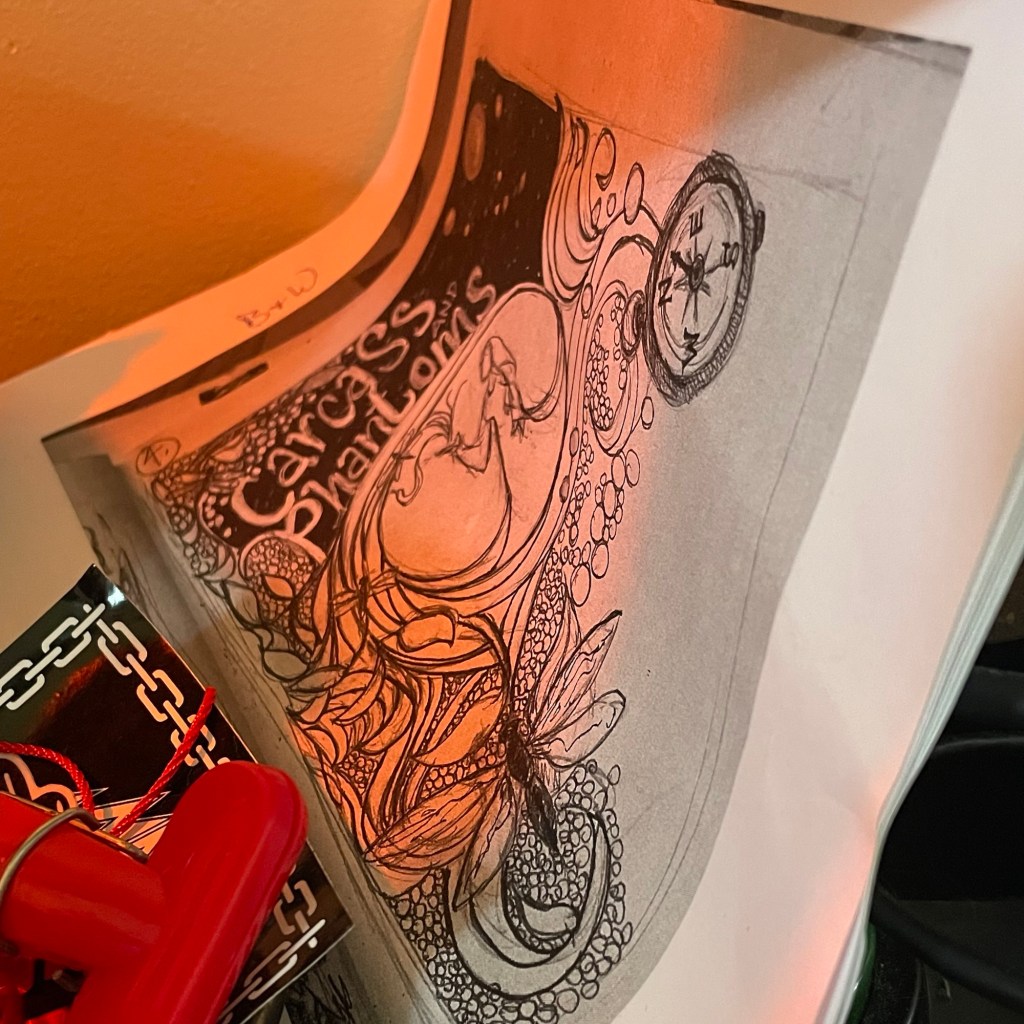
random image meant to intrigue you with its randomness. Photo by me.
Y’know, I sure do like good coffee. I’m sitting here slurping on my second cup, and my mind is full of yum. Many things give me yum. What gives you yum? I’d like to know. I find your opinions yummy.
–
You know who has some really yummy opinions? Graham Platner.
Graham Platner on a boat. Photo from the Graham for Senate campaign.
I generally don’t provide full context for these things I reference, so I won’t here. You may know who he is, you may not. If you don’t, fire up your favorite search engine and learn. But I don’t think you’ll need to do that.
I keep watching videos of the man talking. I find that I already agree with most of what he says, but I also learn things. The fact that this street-level guy who would be my kids’ age if I had any kids (who weren’t felines) has been so dedicated to the well-being of this country, is so well-read, and is willing to go through the BS of a senatorial campaign in these greed-crazy times is absolutely admirable, especially since he’s doing it based on small-dollar donations and fighting against The Big Money. If I lived in Maine, I’d want to volunteer for his campaign. And if it turns out that Trumpo the Clown and his band of idiots put ICE or the National Guard or whatever between the citizens of Maine and their polling places, I hope that they will consider what Graham Platner would do in their place.
–
It’s planting time here in climate zone 5b, and Karen has been hard at work growing seedlings in her office and in plastic jugs outside (winter sowing) and this week and upcoming weekend is when all the little planties will go into the ground. Then in a little while, we’ll have beautiful heirloom tomatoes and many other crunchy and yummy garden goodies. I’m very excited for the yield and glad to help out a bit with bringing the things to life. My window overlooks the little garden from the second floor, and on summer days, I will look down from here and watch her water and weed and do all of the various activities while I WFH. The warm months are my favorite.
–
I bought a copy of the Rhino High Fidelity remastered copy of Nevermind the Bollocks, Here’s the Sex Pistols. It comes in a glossy gatefold tip on jacket (yes, I’m aware — the original was neither glossy nor gatefold!) but this version is exciting to me. My old copy (which I stupidly got rid of at some point) was an original UK pressing that sounded about ten times better than the US pressing. I’ve heard that US pressing and it’s quite disappointing if you’re used to the much brighter and fuller-sounding original. This version brings the American song sequence up to *almost* the level of the yellow cover version, and it makes me happy that I can hear the thing close to the way it was originally meant to be heard. Producer Chris Thomas’s notes on the sessions, included here, are enlightening as well.
If you see a copy, grab it. Don’t let the idea of a slightly more expensive high-end remaster of a punk record seem foolish to you — believe me, it’s not! So, there’s another yum for you.
–
Have a yummy week, OK?
Please consider liking and commenting on this post. Subscribe if you can – it costs you nothing and helps this site thrive – and share this post with those you know who might appreciate it.
Whatever else I might have to say about ELP’s Pictures at an Exhibition and this exploration of ELP versus The Nice.
Sooo… look. Did I come to a better understanding of what Keith Emerson was all about? Eeehhhh… maybe. I guess I’d say that the most perfect encapsulation of what Keith Emerson’s approach to music is in my opinion quite well represented by the final track on Pictures at an Exhibition, a boogie retelling of bits of the Nutcracker Suite called “Nutrocker,” which was devised by Kim Fowley. It’s what I’ve always thought he was about, to be honest.
It’s that fusion of rock n classical that Emerson seems to have been after. He really never dives all that deeply into either rock or classical music, although it’s clear that he sees that his bread is better buttered in rock n roll grease, and so he puts everything under that umbrella. Across these three records we see snippets of just about every section of the record store — jazz, show tunes, blues, rock, classical, even a little dusting of country music, and across all of it, the unifying element is Emerson’s fingers and the feeling he had that some of what he could do with his fingers on a keyboard was dangerous or even subversive (meh).
What he did with The Nice sometimes transcended that need to push the boundaries of outré attention grabbing. I especially felt that on Elegy which showed a band that might have had some technical limitations, but had all of the ability to think and feel and attempt to make something beautiful. With ELP, it was all about the flash-bang.
So, ELP could be bigger, louder, more exciting, but somehow I think they were slighter on an artistic level.
This is a minority opinion, I’m aware of that. I’m also entirely capable of changing my mind, given a better argument about what’s happening in the grooves of the records or on stage in the video above. The guy who thought he’d made an “instrumental protest song” is clearly operating on the same assumptions in that “I’m stabbing my organ!” bit. I just don’t know what it’s about beyond the prurience of it. Maybe he had a bad piano teacher?
I’m a Yes fan. I will be upfront about thinking that Yes had terrible lyrics, but they had great lyricism. They made some of the most beautiful music I can think of within the rock context. ELP could play anything (they did, they played every style of music, sometimes within the bounds of a single track) but all they ever made me feel was admiration for their musicianship, and a bit of cynicism-tinged excitement over all of the flashiness.
Please consider liking and commenting on this post. Subscribe if you can – it costs you nothing and helps this site thrive – and share this post with those you know who might appreciate it.
No one can accurately depict this much history in so small a space, but hey! I tried.
In 293, The Emperor Diocletian created the Tetrarchy. He split the Roman Empire in two, west and east, in 286 CE. He found that he needed a second-in-command to help administer each half of the empire. In the west, he appointed Maximian as Augustus with Constantius as Caesar under him. In the east, he appointed himself Augustus and Galerius as Caesar. The Roman Empire had been in danger of falling apart and in this way, Diocletian saved it for a time. The Tetrarchy collapsed after he abdicated, due to rival claims to power from Maxentius, the son of Maximian and Constantine, the son of Constantius. There was a civil war and at the end of it in 324 Constantine was the Roman Emperor and Christianity had become the state religion.
I don’t think this configuration is correct. I thought that the palace was across that square from the Hagia Sophia, and that the hippodrome was next to the palace. Tip of the hat to John Mendelssohn who devised this color scheme.
He founded the city of Constantinople in 330 and made it the capital of the empire, which it continued to be for 1123 years, barring the 57 years the Latins held the city in the 13th century. The division of the empire continued, however, and the last western emperor, Romulus Agustulus, was deposed in 476. The German who deposed him proclaimed himself the King of Italy, ending the western empire.
The Eastern Roman Empire survived for many complex reasons. To vastly oversimplify, many of the emperors were good statesmen. A higher percentage of Romans were literate than in any other kingdom in Europe. They benefitted from advanced technology, such as Greek Fire and compound bows. Constantinople itself was situated in such a way and defended so well that it survived many sieges.
In the 7th century a new and charismatic religion appeared in the world, known as Islam. The Romans lost much of their territory – all of their holdings in northern Africa and much of their territory in Asia – to the Caliphate, at that time rulers of the Muslim world. The empire struggled, lost some of their power and prestige, but survived and came to thrive again.
In 1025, one of the empire’s greatest Emperors, Basil II, died without an heir. Afterwards, the Empire entered a period of decline, with a revolving door of 14 Emperors succeeding each other over a period of 50 years. During this time the Imperial coffers were drained, the Army was destroyed beyond recovery at the Battle of Manzikert, and internal strife took a major toll on the empire’s wellbeing. In 1081, the young general Alexios came to power. His army was the first to sack Constantinople. Still, he ruled for 38 years and is considered the last truly great emperor among the Romans. Every ruler of the empire to come after him was his relative or direct descendant.
But the power of the empire had been broken beyond recovery. The empire continued to decline, though it took another 350 years to die. In 1453, Mehmet II laid siege to Constantinople and after two months of fighting, entered the city and sacked it for the 4th and final time. The last Roman Emperor, Constantine XI, disappeared in the fighting at the Theodosian Wall and was never heard from again. The Eastern Roman Empire became a memory, receding into history.
You must be logged in to post a comment.