
I’ve been on a Cluster kick of late. This after a Black Sabbath phase and then an early Cure spree.
If you don’t know, Cluster is a German minimalist experimental duo that was most productive in the 1970s, having derived out of a trio called Kluster but continuing on through the two-thousands, until Deiter Moebius died in 2015. The other half of the duo, Hans-Joachim Roedelius, is still with us, still releasing new music at the age of 86. I’ve been listening to them since the late 70s, having discoveren their experimental, particular/peculiar sounds after being introduced to their records by a friend in his college dorm room over herbal supplements of a recreational type common to the college dorm rooms of the time. In fact, listening to their music can sometimes invoke strange sense memories for me; recently I was listening to Roedelius’s solo CD Durch Die Wüste and suddenly I had the smell of bongwater in my nose (I do not own, and never have owned a bong. My college friend, however, was a major proponent of the water pipe as a delivery device for the smoke of herbal supplements of that recreational type we were both fond of.)
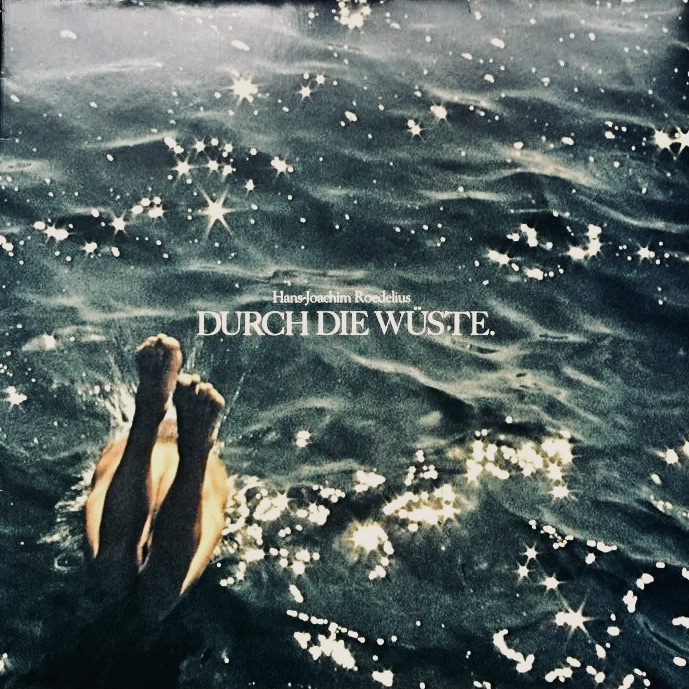
I’ve also listened to Cluster 71, their first album after Conrad Schnitzler left the group, Zuckerzeit, and Grosses Wasser, plus Roedelius’s Offene Türen, all pretty much consecutively. Each of these albums is unique. Cluster 71 is distorted, droney soundscapes; Zuckerzeit is proto-electro IDM, a real precursor to that style and very influential; Grosses Wasser is disciplined, calm like water but still quite catchy, possibly my favorite of their output; Offene Türen is dramatic and fiery, almost Kurt Weil-like, though still simple, and centered, as all of Cluster’s music is, on the idea of the minimal drone; and the above-pictured album is, once again, a unique experience, a blending of a mid-seventies rock aesthetic and Cluster’s distinctive drone. If you come to DDW after being familiar with much of the rest of this ouvre, it will surprise you, as it did me, by being very far from what one would expect from them, but completely within their unique wheelhouse.
You may have noticed that I am not distinguishing much between Roedelius’s solo work and Cluster as a group. I know that may be confusing, but the sensibility of all of this music is so insular and distinctive that it really is a thing unto itself. I would also include Moebius’s solo work and outside collaborations from both band members either collectively or apart from each other, such as the band Harmonia that is the two members of Cluster and Michael Rother, guitarist from peer German minimalist band Neu! and other efforts as well. It all feels of a piece to me: a sound that is sometimes imitated, but original and definitely belonging to Moebius and Roedelius. It embodies early electronic music, a kind of progressive rock aesthetic, classic minimalism that can extend backward in time to the work of Erik Satie, and also sits off to its own little sideline. Some have also called it “new age” but I would beg to differ, because the point of this music is less to calm and center than to open and challenge. It creates a space that can be meditative, but it contains discord and plays with expectations in a way that any music I would think of as “new age” studiously avoids.
Don’t be surprised if I write about this band and its various offshoots again (and again), they’re seminal to my tastes in music.
[ED]
 Broadcast From the Brain Radio
You must be logged in to post a comment.