
You can read part 2 here and part 3 here.
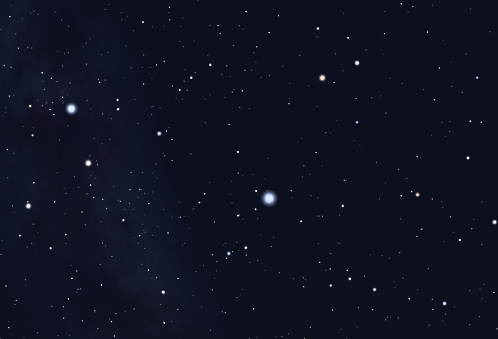
Say you’re out in the country. It’s a cold, clear, still night: the best kind of weather for stargazing. You look up and see such a multitude of stars that it shocks you, especially if you’re an urban dweller and don’t often get away from the ever-present glow of humanity. If it happens to be a moonless night, you can see the Milky Way like a glowing cloud across the sky. You might see planets, perhaps one or more of the next three out from the sun: Mars, Jupiter, and Saturn, the three of the visible five most often seen once the sun’s glow has completely faded from the sky.
Mercury almost never rises high enough to be seen past the last remnant of sunlight. Venus does, at times. When visible, it’s the second brightest object in the sky after the Moon. When ahead of the sun in processing across the sky, we call it the Morning Star. When it trails behind, it’s the Evening Star. When you wish upon a star, most often you will – either knowingly or unknowingly – pick Venus: beautifully white and pure, never twinkling even on the windiest night, brighter than any other star in the sky. I’ve wished upon the Evening Star many times.
If you’re lucky enough to live where the ambient light is low, and if you love the night sky enough to develop some intimacy with it, to know where the planets are to be seen at any given time, to know constellations like Orion, Cassiopeia, Pegasus, Ursa Major (the Big Dipper), and Ursa Minor (the Little Dipper, which includes Polaris, the North Star), you may see other objects in the sky. Some are always there if you know where to look, and some appear only briefly.
I’ve seen a supernova. When I was sixteen, a star in the late-night summer sky appeared in the constellation Lyra where there hadn’t been one visible before. Over the course of a night or two, it became the brightest light in the sky other than the Moon, surpassing the Evening Star. Then in a couple of weeks it faded to invisibility.
I’ve seen meteor showers: the Perseids in August, the Leonids in November. The Perseids are so named because they seem to generate from a point in the constellation Perseus, and the Leonids from the constellation Leo. Once, I saw a bright light streaking across the sky, a fireball that left a glittering ribbon trail long enough that I couldn’t quite cover it with the width of my hand held at arm’s length. I watched it travel all the way across the night sky. In the news the next day I learned that it was a Russian satellite that had re-entered the Earth’s atmosphere in a blazing fireworks display that I’d marveled at along with many others who happened to look up that night.
I’ve seen the northern lights: Aurora Borealis. I’ve seen the comet Kohoutek and Halley’s Comet. Comets are objects that are best seen using averted gaze, meaning to deliberately see out of the corner of your eye.
Other objects you can see with averted gaze are deep-sky objects, far beyond our solar system. Some are visible with the naked eye, and others you can see only with a telescope. The brightest and most well-known of these were catalogued in the late eighteenth century by the French astronomer and comet-spotter Charles Messier.
The brightest and most famous object in Messier’s catalogue is perfect for teaching yourself how to use averted gaze. In the late summer and autumn sky there is a large, bright rectangle of stars that represent the constellation Pegasus. Trailing away from one point of the rectangle is a double strand of stars that make up the constellation Andromeda. Old celestial maps often showed Andromeda riding Pegasus, and the trail of stars has sometimes been depicted as Andromeda’s hair. In Andromeda’s hair is an adornment, like a jeweled barrette, that Messier included in his catalogue as M31, and which most of us know as the Andromeda Galaxy.
If you can find this object in the night sky, visible at 9 pm near its highest point in November, try this: locate the little cloud of light in Andromeda. It won’t be particularly bright, but it won’t be too hard to find on a clear night. Look a little bit to the left or right of it, not too far, maybe the distance of a couple of finger-widths at arm’s length or less, but focus your attention on the faint, fuzzy cloud of light. It should reveal itself as a larger, more vivid, lens-shaped object.
Averted gaze works because it brings a different part of the retina into use than that part more accustomed to receiving all of the light you focus on in a day, in all of your days, and which your brain is used to translating into sense and meaning. A less-used part of your eye will be more sensitive, but your brain will be less able to filter out things it interprets as nonsense. The light your eye takes in through averted gaze will not be as focused and clear, but with practice you can sharpen your acuity for this way of seeing. Astronomers of Messier’s time made beautiful drawings of the planets, revealing startling details while peering through low-powered telescopes, using this technique.
–To Be Continued

 Broadcast From the Brain Radio
You must be logged in to post a comment.