I’ll Be Publishing a Book in September

What? You’re expecting me to do things properly? Of course not.

Since I finished my MFA a hundred or so years ago, I’ve had this idea for a collection of stories and poems that sit close to, and on either side of the line between fantasy and nonfiction. It’s about as postmodern a concept as I can generate and bring to fruition, and I’m very excited to announce that I am about to be able to make the thing available for you, my readers.

The subject matter revolves around family history, the borders between worlds, tall stories and true ones, death, and magic.

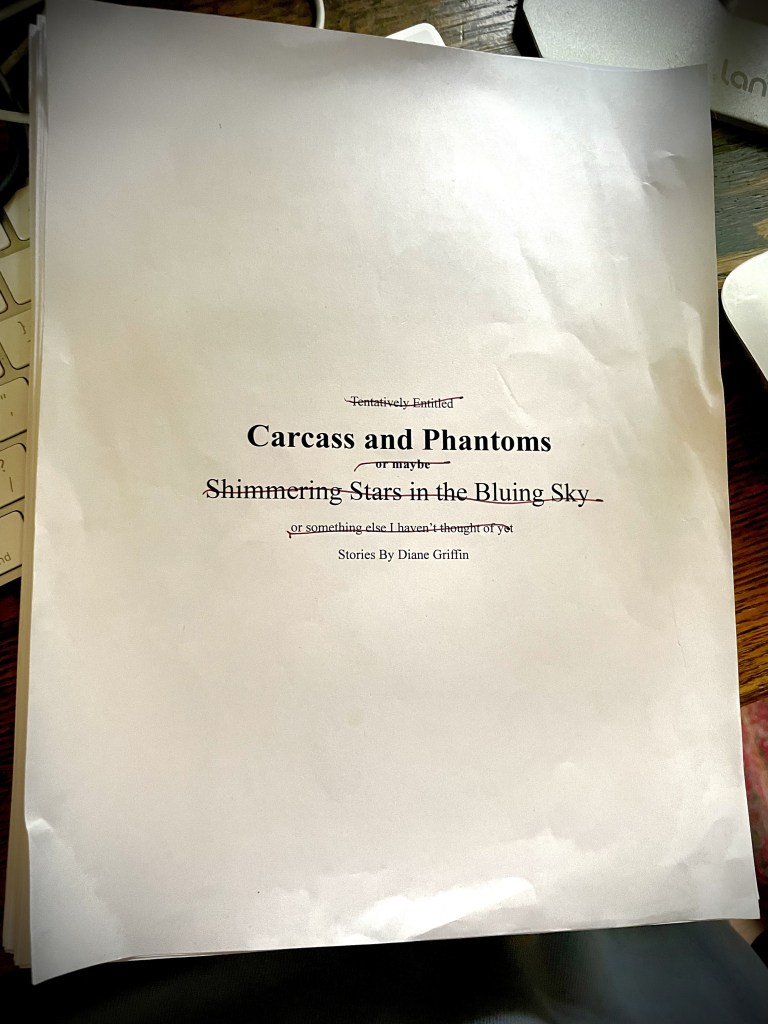
The title of the project is Carcass and Phantoms. I originally conceived it as a chapbook, but chapbooks are usually 32-40 pages, so Google tells me, and this will be closer to 80 pages. I thought I would call it a “double chapbook” for a minute, but then I decided that that sounded ‘way too chapped. I think I’m just going to call it a “thin volume” or maybe a short book.

I’m working with an artist and friend named Heather Balchunas whose work I adore and who is excited to be providing cover art. I’m proud to have her help with this little labor of love.

I’ll give you more news about this when I have it!

An earlier draft of the dealybob I’m working on. Photo by me.

Please consider liking and commenting on this post. Subscribe if you can – it costs you nothing (you no longer have to have a wordpress account to like or comment) and clicking on the buttons helps this site thrive! Also, do be a dear and share this post with those you know who might appreciate it!

Zeitgeist 3/28/26

No Kings 3.0 Edition

So… we went to the thing. And did the thing.

This one seemed calmer, but I think every bit of the determination is still there. It just didn’t feel as hair-on-fire as the ones last year, especially the first one, at least here in Greenfield. I’ve looked at a little bit of the news, and I do see that there are some huge protests in the big northern cities, and our little town managed about the same turn-out as the other two, which is to say large and strong. We’ve filled the common every time.

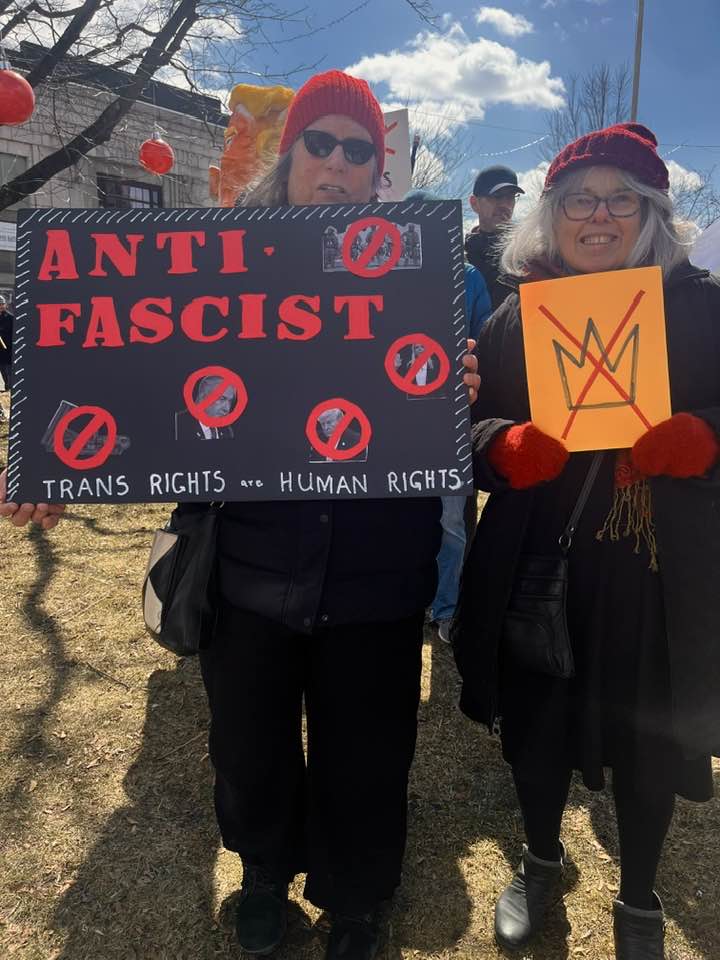
A picture of Karen and I at No Kings in Greenfield.
photo by Jovonna Van Pelt

That’s me and the BBE. I’m holding the sign I made and Karen is holding one that Jo made. Karen knitted our red hats.

I’ve seen in the news that other protests — Memphis and LA had clashes with the police happen. I don’t know enough details about any of that to say with any conviction what they mean, but even though us protesters are more focused and seemingly spending less of our energy yelling our frustration out at the world, it does seem like things are heating up between protesters and the establishment.

I want to point out the level of criminality of this regime – how they don’t seem to have any compunctions about killing and mass destruction – and suggest that they might bring that level of evil nonsense home to us. Further, I want us to be prepared for it, and to continue our commitment to nonviolence. The police and DHS would like things to get violent, because that will support their wish to start killing Americans on American streets with much greater regularity than they’re managing right now.

Just generally, I see that the world is heading for something cataclysmic. I think you’d have to be blind not to see how various forces are trying to force various issues around the world as well as here at home.

Buckle up.

It’s a few days later, and over the last couple of days, I’ve read that some on the left think these No Kings protests are not doing what we participants expect it to do. I will concede that just showing up in the streets in our millions and millions may not be enough to overthrow this fascist regime.

I never thought that was what peaceful protests would do. As far as I know, the purpose of protest is to signify solidarity and commitment. I think we’re doing that much, at least. Each one of these events gets larger and the energy gets more focused. The thing that brings down the fascists will come out of this movement, that’s what I think. These protests give the opportunity for people to unite, to know that they have power and that power is in sharing it with others. It says to those in power that there is some level of commitment to change.

What we need is leadership that arises to focus this energy and point it towards some achievable goal. What changes the system is concerted, targeted action. I’m hungry for that. I would love to support and participate in such action. In the meantime, though, I’ll go down to Greenfield Common and wave a sign from time to time. Gimme something better to do and I’ll do that.

Please consider liking and commenting on this post. Subscribe if you can – it costs you nothing and helps this site thrive – and share this post with those you know who might appreciate it.

You may not be aware of this, but people on the internet can be very mean and very stupid at times.

Look through the comments on any social media post, especially one that has controversial or political subject matter, as I’m sure you all have, many times. You will see that everyone seems to be collaborating on making everything just a leeetle bit more awful.

I’m guessing that if we were to be truthful, we would all have to admit that we’ve contributed to that mess. Sometimes flame wars can be fun, but tbh I think there are diminishing returns on this.

And let’s admit this, too – those idiots we’ve been whacking over the head with our most refined rhetorical flourishes? They deserved it! When I called someone a human carbuncle the other morning, I was simply telling the truth. As we say on the internet, “No lies detected.”

Of course, I deleted that comment almost immediately. I realized the fascist moderators would put me in internet jail if I didn’t. I just had to hope that the human carbuncle in question saw my comment before I exxed it out. It’s important to point out the errors of other people’s ways

Also, I kind of like saying “human carbuncle.” It fills me with a mixture of disgust and righteousness. That mixture of disgust and righteousness is one of the many pleasures one might hope to experience while doom scrolling and simultaneously sniping in the comments. A kind of satori, if you will.

Only, not really. I know better. I know I’m spreading poison. But it feels so good! It’s like… power.

The other night, Donald Trump posted 160 zingers in a single evening. As you might surmise from this, he is the most powerful man on the planet, except for Vladimir Putin, who hardly seems to post on social media at all, now that I think about it. At least not from his own account. The exception that proves the rule, I suppose.

Sometimes I wonder what would happen if I were to be nicer to people online. My fear is that I would disappear. I’m compelled to ask, “If I’m not poking the bear, will the bear remember to poop in the woods?” And how would I know if he did?

Hey, what do you think about liking this post and subscribing to my blog? Might be pretty cool, right? Give it a shot, what the hey. I also really love getting comments. Even on my political posts.

I Went to RPM Fest For a Day and Survived

By Diane Griffin

Music festivals – all sorts of festivals, really – are tiny, temporary utopias. One of the reasons I love them is the feeling that the rest of the world has faded into insignificance, and that the enclave you’re in can feel like the whole world. Food and camping and junk for sale in the vendors’ tents and artist’s booths and whatever else turns up make it seem like everything you need is right there.

We could talk about port-a-potties, which I think are the biggest drawback to the experience, and there! they have been mentioned, and we can move on quickly now, as one does when port-a-potties are involved.

If anyone were to notice this old trans lady at all at this event, my hope is that they saw me smiling, dancing, or walking back and forth between the two stages at opposite ends of the Miller’s Falls Rod and Gun Club. This isolated clearing in the woods is, in my opinion, put to its best use on Labor Day weekend. For that brief window in time, it’s filled with people of multiple generations and genders in black t-shirts with various outré images and bits of text printed on them, under multifarious unnatural hair colorations at a variety of uncivil lengths. The sweet smell of zaza wafts through the air everywhere.

It is a metal fest, after all.

This is the second year that I’ve attended RPM Fest Heavy Music Campout in Montague for as much of Saturday (the longest day of the festival) as I can endure. I love the atmosphere, generally love the music (not every band is to my taste, of course) and I feel a twinge of gratification for the fact that I’ve gone and done the thing.

Both years I’ve gone, I’ve skipped out before the headliner because I never want to contend with a crowd all trying to exit after that last act, and because these old ears and legs can only take so much. This year I missed Ghoul and last year I missed Prong. I feel some smidgeon of regret for missing the headliners, but it’s negligible pain compared to how my knees feel by 9 PM, after a long day spent mostly on my feet.

So what about the music? I think a festival is always going to be a mixed bag. I saw bits and pieces of sets from 12 different bands while I was there, and nothing offended me, but there was a stretch in the middle of the day when I found most of the music rather unmemorable.

There was this band Goblet that was doing the “Wacky Party band” thing. The bass player was wearing a shaggy hat with giant Viking horns, there was a cobbled-together sculpture of a pot pipe at the side of the stage made out of PVC tubing and an aluminum funnel, lit and smoking through the whole set. What I found most memorable about them (and this is emblematic of the spirit of the festival) was when the singer had two roadies bring out a big ice chest. While he was singing, all death growls and indecipherable lyrics over blasting chugga chugga guitars, he made a bologna sandwich, which he put on a plate and handed to an audience member. That was the finale of their set.

Death growls and niceness.

Among my favorite bands were Concrete Ties, a local hardcore punk band with a powerhouse female singer named Leyla Eileen, who was completely riveting onstage. I could not take my eyes off her as she prowled around, growling and exhorting the audience to rock.

I thought Mean Mistreater were great, high-powered 80s style metal with another fierce woman vocalist with clear and powerful tones, and a talented lead guitarist. A little research after the fact suggests that their name may have come from a Grand Funk Railroad song, and the strains of classic hard rock also flowed from The Atomic Bitchwax, a band that sounds like they’ve studied hard over every one of Grand Funk’s records.

The other two bands I enjoyed most are Coma Hole and Heavy Temple. Coma Hole is a two-member band: a fine drummer and a bass player who has an extraordinary setup. She plays a stereo bass and sends the two channels through different amp setups, one for the low tones and a separate channel which, on the other side of an octave pedal, goes through a massive guitar amp. All her gear is vintage and sounds amazing. Their music is psychedelic stoner rock with a deep vein of Nirvanna-esque grunge rock running through it.

Heavy Temple is a three piece stoner band who sound like they stepped out of a time machine from 1969. Their guitarist, Lord Paisley, is Hendrix-inspired, uses a fair amount of wah wah pedal and super-sludgy distortion. Their singer/bassist is High Priestess Nighthawk and she is another commanding presence. Drummer’s name is Baron Lycan. I know this because I happily purchased both of their albums and have referred to the liner notes as I’ve spun them.

I love the thread of fantasy that runs through so much of metal music. Of course it calls to me, as a writer of fantasy. It gives an air of freeness and imaginations allowed to run wild.

It’s not lost on me that almost all of the bands I liked best have women singers. There are many reasons for this, but I think I’ll list one here: I think the women are more likely to sing “clean” as they say, though there are certainly plenty who use death growls. I’m not opposed to death growls per sé, though I’m not as enamored of them as most of the younger metal fans are. I have learned how to produce that sound myself.

I did notice that every male singer I saw that day used death growls, with the exception of the two guys in The Atomic Bitchwax. Special mention here for the band Necropanther, who had two growly singers, one who pitched a little higher and one who pitched low. Death growl harmonies, anyone? I know where you can get some of that!

I spent a day in a far-away magical bubble world, and it was fine. It made me forget that there are people in the southern distance who are toiling to take this all away from us. I saw other people my age at the festival. I saw other trans folk there. Both sets of examples helped me feel like I was a welcome part of this ephemeral, idealized landscape.

I’ll go next year, too.

Anna Komnene

It’s been pointed out that I haven’t posted much about my research into the Eastern Roman Empire of late. There’s a reason for this: I’ve gotten hung up reading The Alexiad, written by the Roman princess Anna Komnene in the Twelfth Century CE: a history of her father, the Emperor Alexios I Komnenos, and his reign.

The problem is the relationship I’m having as reader to Anna Komnene as an author. She’s a huge personality, clearly brilliant, and every bit a member of an old-world, long-standing ruling class family. I’ve found the time I’ve spent with her words compelling, difficult, frustrating, and ultimately rewarding. I still haven’t finished it, so I won’t go far into the content of the book here. I’ll write about that once I’ve made it to the end. But I can talk to you about my experience of reading the book so far.

I’m intrigued with the contemporary perspective. She talks in the introduction about her uncle, who died of exhaustion: he was so tired he developed a tumor. As a result of such misunderstandings, I was willing to accept her as an at-least-somewhat unreliable narrator due to her medieval worldview. But there are other problems, including chronological errors throughout the book, which I wouldn’t have been aware of if I hadn’t been checking the end notes as I read.

I understand she was working within limitations: she was banished to a convent, and while primary source materials were available to her, it appears that she may not have been able to reconstruct timelines dependably. So much for the chronological inconsistencies.

It also seems to me that she considers the official narrative and contemporary affairs of state as she writes, which I can’t fault her for. It still made me trust her less as an authoritative voice. Causing your reader to be skeptical is a huge challenge to overcome in a work of nonfiction, and I was definitely skeptical about certain things I read.

But the main problem I’ve had is that I’m not sure what to make of Anna Komnene as a person. She was clearly, as I’ve said, brilliant, perceptive, and an engaging writer as well, but she was caught up in the politics of her time, about as high-born a person as there could have been. I admit that I am leery of such people. I have socialist leanings both politically and in how I view class generally. I was prepared to set those prejudices aside, but I was daunted by the way she speaks about her father: how gifted he was, how resourceful, how strong, what a great soldier, how handsome, how pious. It all began to seem like too much. After one such hagiographic passage, I set the book down for a couple of weeks.

To be fair, she doesn’t avoid talking about Alexios’ failures, and she avoids mitigating or excusing them. On reflection, I think she did her best to meet the challenges of writing about her father within the limitations of her circumstances. I still suspect she doesn’t tell the whole truth, and it’s taken me a fair amount of processing to make peace with that.

I also let myself in for a little bit of disappointment by imagining that this book would contain story elements I didn’t end up finding. That’s my shortcoming. I wanted more description, more relationships, a stronger story arc. I think I was looking for a style of writing that didn’t exist in her day. Modern narrative writing is richer in the sorts of details that for the most part Anna either only barely touches on or skips entirely.

The book is mainly accounts of wars and battles Alexios fought, with a paragraph here and there of surprising granular detail. There’s a brief conversation between Anna and her mother. Elsewhere there’s a description of the workings of a particular weapon. It’s for those moments that the book has held my attention most. They’re sparsely strewn throughout the narrative, and when I come upon them, the world of the story becomes much more vivid.

I have to remind myself that she wasn’t there for most of the events The Alexiad covers: not yet born at the beginning, a child in the Imperial creche for much of the time she writes about. She clearly held her father in the highest esteem, and probably heard stories of the events she writes about from him or those around him. It’s unfair of me to judge her for that.

Having understood these things, I am having a much easier time with her book. When I finish, I’ll say more.