Thoughts after reading Byzantium: The Surprising Life of a Medieval Empire by Judith Herrin

I appreciate Herrin’s activism on behalf of the Romans of Constantinople, and as often happens when I delve into history, I find that I appreciate Western Europe and the way it has acted in the history of the world less and less.

Think about what comes to mind when you hear the word “Byzantine” used as an adjective: a weak, decadent society that collapsed under the weight of its own corruption, with a huge and inefficient bureaucracy and too much of its energy spent on creating over-complicated and obscure art at the expense of running its own affairs. Before I became fascinated with it and began exploring, this is the impression my education had left me with.

Absolutely nothing I’ve read in the period of time it’s taken me to get through the three histories I’ve read — one of them contemporary (Anna Komnene’s The Alexiad), one written about 50 years ago (Vryonis Speros’ Byzantium and Europe), and this one, written in the last decade — confirms that set of stereotypes in any way. One of the things Herrin accomplishes with her fascinating popular history of that great, lost civilization is to delineate the history and meaning of that false negative view of the Eastern Roman Empire, and another is to overturn it completely. Even in its final throes, the empire was dynamic and progressive.

It seems certain that Europe as we know it would not exist had it not been for the efforts of the medieval Romans. When the first muslim jihad spread like wildfire across the world, overtaking the Persians, the cities of Damascus, Jerusalem, Alexandria, and flowing across northern Africa and into the Iberian peninsula, the Byzantines stood as a bulwark against their advances into Europe from the east. From the 7th century through to the mid-15th, they stood in the way of all incursions from that direction, allowing western Europe to find its footing in the wake of the collapse of the western Romans at the hands of the various Germanic tribes — Ostrogoths, Visigoths, Vandals, and others.

All through the history of the eastern Empire, there was world-changing brilliance. At the very end, one of its great thinkers, the philosopher George Gemistes Plethon, helped bring to Western Europe the ideas and thoughtfulness of the classical Greeks, including Aristotle and Plato. The west might not even know about these crucial thinkers were it not for his efforts. Plethon died in Mistras in the year before the Ottoman Turks captured the capitol, Constantinople.

He had been active in the efforts to save the Empire  in its final years by aligning the see in Constantinople with the Latin Church. Even then, in the midst of negotiations which appeared at first to have been successful, western Europe’s prejudices and intentional misunderstandings were evident, and the agreement brought back from those meetings with the Latin church were not embraced by the Empire. As a result, the last vestiges of the Empire were consumed in just a few years’ time.

The Byzantines were a cosmopolitan, diverse, literate society. They were patriarchal, but women held power there. There were a few women, such as Zoe and Theodora, sisters who held power in the 11th century, A different Theodora in the 9th, Irene who held power in the 8th, and others as well, who sat on the Byzantine throne.

Constantinople was, in its prime, the greatest city in the world, an unrivaled center for commerce and culture. At the heart of Byzantium was their church, While the Catholics in Rome sought to dominate the world, they forgot that it was Byzantium that sustained them, that it was Constantine himself, beginning with the Ecumenical council he called in 325 CE that created the structure in which they exist. And today, there is still a see that is centered there. Bartholomew I, 270th Archbishop of Constantinople, Patriarch of the Eastern Orthodox Church, still reigns in modern-day Istanbul, at the center of a very small Greek community still living there.

If we look, we can see many ways in which the Byzantines are still with us, and that is at the heart of my fascination with them.

 

Posting On My Blog About Posting On My Blog About Me

I perceive that my writing energy, what of it there is, is being spent on correspondence. I wish this was not so, or that I was devoting more time to writing than I am. This is most apparent on Facebook, and to a lesser degree, on Twitter.

I think my twitter is super boring. I hate that I’ve let it become about leftist politics and the Democratic Primary horse race, which is already such a sh*t show that I can’t believe it. I really don’t like centrist Democrats. They’re so full of it.

The thing that’s annoying me the most is the seemingly successful smear job they’re doing on Tulsi Gabbard. Let’s get this straight: The candidate who is basing her campaign on the need to stop doing foreign regime change wars is, somehow, an imperialist. Also, someone with a 100% score from the HRC is a secret homophobe.

Got it.

And so it gets harder and harder to look at social media, because most of my friends are het up about politics, because politics is such a sh*t show right now, and because I’m also het up about politics, and sometimes I just don’t have the heart for it. I don’t even have the will to finish an argument when I start one. This stuff is BORING.

I’m sick of idiots, and I’m sick of the led-around-by-the-nose centrists who are bound to go fight for Biden Man (as I call him) when Biden Man is the latest example of the sort of Democratic pol who is, at heart, more responsible for Trompe (as I call him) than any other faction in the country, including his own base.

But I digress, egregiously.

I’m depressed, and therefore more distractible than usual, and the human race is draining me of hope right now. There are a couple of factors here. One is that I am feeling a bit rudderless about my writing, and less than productive. It’s hard to remember that I’ve done a couple of things since graduating, and that I can, if I choose to, keep the momentum going. I’m making that choice.

The other is that I am lonely and feeling spiritually dark. I’ve been embracing my inner goth. Winter is really hard for me, and it takes until around this time of year to get over it. So I think I have a one or two month window in which to be as productive as possible, then I have to start splitting time with the film fest I program for.

I have to start being very strategic with my time. I am picking projects I really want to do, and putting as much love into them as I can. That’s the way I know of to keep myself going. I need to be excited about what I’m working on. That’s why the write-every-day experiment that I tried earlier this spring failed so badly — I had to force myself to the computer every day, and that sort of thing just will not work with me. It’s a problem, but it’s the truth.

Memorial Day Memory

My Grandpa and Grandma Matthews raised peonies for Memorial Day as a cash crop.

They had two one-acre plots that they would plant with peonies in March. They’d harvest at the end of May, cutting the blooms for bouquets, uprooting the plants and wrapping the roots to replant the next year.

Then he would plant his vegetable garden in the same soil — corn, tomatoes, beans, eggplant, beets, summer squash, peppers, etc, which would get et when fresh, but which Grandma would also put up for the winter, in the same cellar where they stored the peony plants.

Such bounty from the earth! Those two plots will always be the configuration of my fondest Memorial Day memories.

Personal Blog #203 Part 11: Sunny Southern Colorado

Why the Mountains Are Always to the West.

IMG_1261

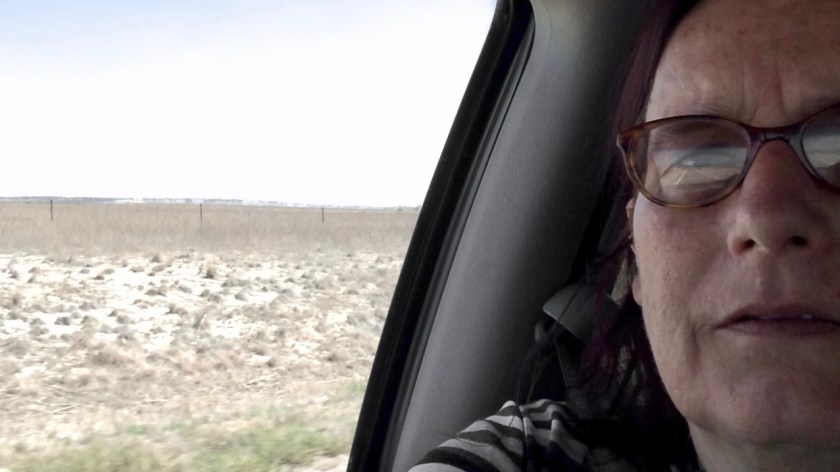
This is me riding shotgun through what was once called The Great American Desert, though it’s really a steppe, the eastern slope of southern Colorado. Much of my childhood was spent in this country, though I have not lived there since my freshman year of high school.

Sage, cactus, and grasses are a threadbare cover to the land I grew up on. The mountains are a grand presence in the west, impressed upon me to the point that any time I encounter mountains, no matter how they are actually oriented, the lizard part of my brain automatically labels the direction of those mountains “West.”

I still have family there, so I still go back. I’m glad that I do, because I love Colorado. I love its clear night skies and summer thunderstorms. I love being in the mountains south of Florence, where my Mother spent part of her childhood, in a dirt floor cabin, going to school in a one-room schoolhouse. My very favorite wildflower in the world grows in meadows around where my mother grew up. It’s called Indian blanket, and its ragged beauty is extravagant.

Indian Blanket

My roots in the Arkansas Valley run deep. My grandparents are buried there in the Fowler Cemetery.

IMG_3455

My brother and mother live there now. Though I haven’t lived there in decades, no place on Earth better deserves the appelation, “home.”

Byzantium, the Lost Empire (National Geographic Special)

Low-res version; Two episodes; 1 hr, 44 min.

This is the two-part National Geographic special about the Byzantine Empire. The first part is a laying of the groundwork, an answer to the challenge of condensing a millenium plus into a forty-five minute television show. Not bad.

The second part is for the Byzantium buff, and is full of little tidbits I’d never heard before. Worth your time, if you like history.