A 500-Word History of a Lost Civilization That Stood for Over a Thousand Years

No one can accurately depict this much history in so small a space, but hey! I tried.

In 293, The Emperor Diocletian created the Tetrarchy. He split the Roman Empire in two, west and east, in 286 CE. He found that he needed a second-in-command to help administer each half of the empire. In the west, he appointed Maximian as Augustus with Constantius as Caesar under him. In the east, he appointed himself Augustus and Galerius as Caesar. The Roman Empire had been in danger of falling apart and in this way, Diocletian saved it for a time. The Tetrarchy collapsed after he abdicated, due to rival claims to power from Maxentius, the son of Maximian and Constantine, the son of Constantius. There was a civil war and at the end of it in 324 Constantine was the Roman Emperor and Christianity had become the state religion.
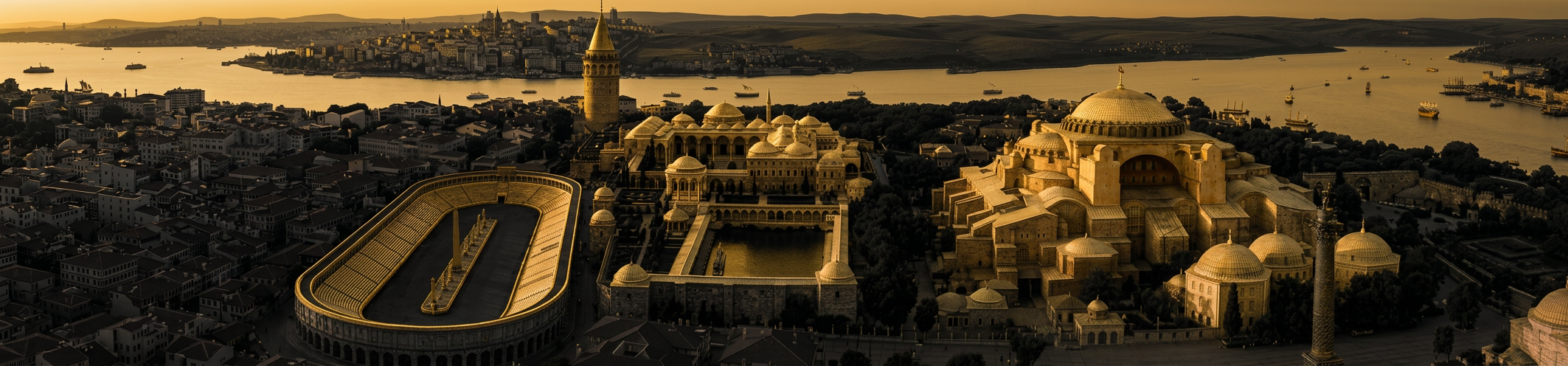
I don’t think this configuration is correct. I thought that the palace was across that square from the Hagia Sophia, and that the hippodrome was next to the palace. Tip of the hat to John Mendelssohn who devised this color scheme.

He founded the city of Constantinople in 330 and made it the capital of the empire, which it continued to be for 1123 years, barring the 57 years the Latins held the city in the 13th century. The division of the empire continued, however, and the last western emperor, Romulus Agustulus, was deposed in 476. The German who deposed him proclaimed himself the King of Italy, ending the western empire.

The Eastern Roman Empire survived for many complex reasons. To vastly oversimplify, many of the emperors were good statesmen. A higher percentage of Romans were literate than in any other kingdom in Europe. They benefitted from advanced technology, such as Greek Fire and compound bows. Constantinople itself was situated in such a way and defended so well that it survived many sieges.

In the 7th century a new and charismatic religion appeared in the world, known as Islam. The Romans lost much of their territory – all of their holdings in northern Africa and much of their territory in Asia – to the Caliphate, at that time rulers of the Muslim world. The empire struggled, lost some of their power and prestige, but survived and came to thrive again.

In 1025, one of the empire’s greatest Emperors, Basil II, died without an heir. Afterwards, the Empire entered a period of decline, with a revolving door of 14 Emperors succeeding each other over a period of 50 years. During this time the Imperial coffers were drained, the Army was destroyed beyond recovery at the Battle of Manzikert, and internal strife took a major toll on the empire’s wellbeing. In 1081, the young general Alexios came to power. His army was the first to sack Constantinople. Still, he ruled for 38 years and is considered the last truly great emperor among the Romans. Every ruler of the empire to come after him was his relative or direct descendant.

But the power of the empire had been broken beyond recovery. The empire continued to decline, though it took another 350 years to die. In 1453, Mehmet II laid siege to Constantinople and after two months of fighting, entered the city and sacked it for the 4th and final time. The last Roman Emperor, Constantine XI, disappeared in the fighting at the Theodosian Wall and was never heard from again. The Eastern Roman Empire became a memory, receding into history.

Thoughts after reading Byzantium: The Surprising Life of a Medieval Empire by Judith Herrin

I appreciate Herrin’s activism on behalf of the Romans of Constantinople, and as often happens when I delve into history, I find that I appreciate Western Europe and the way it has acted in the history of the world less and less.

Think about what comes to mind when you hear the word “Byzantine” used as an adjective: a weak, decadent society that collapsed under the weight of its own corruption, with a huge and inefficient bureaucracy and too much of its energy spent on creating over-complicated and obscure art at the expense of running its own affairs. Before I became fascinated with it and began exploring, this is the impression my education had left me with.

Absolutely nothing I’ve read in the period of time it’s taken me to get through the three histories I’ve read — one of them contemporary (Anna Komnene’s The Alexiad), one written about 50 years ago (Vryonis Speros’ Byzantium and Europe), and this one, written in the last decade — confirms that set of stereotypes in any way. One of the things Herrin accomplishes with her fascinating popular history of that great, lost civilization is to delineate the history and meaning of that false negative view of the Eastern Roman Empire, and another is to overturn it completely. Even in its final throes, the empire was dynamic and progressive.

It seems certain that Europe as we know it would not exist had it not been for the efforts of the medieval Romans. When the first muslim jihad spread like wildfire across the world, overtaking the Persians, the cities of Damascus, Jerusalem, Alexandria, and flowing across northern Africa and into the Iberian peninsula, the Byzantines stood as a bulwark against their advances into Europe from the east. From the 7th century through to the mid-15th, they stood in the way of all incursions from that direction, allowing western Europe to find its footing in the wake of the collapse of the western Romans at the hands of the various Germanic tribes — Ostrogoths, Visigoths, Vandals, and others.

All through the history of the eastern Empire, there was world-changing brilliance. At the very end, one of its great thinkers, the philosopher George Gemistes Plethon, helped bring to Western Europe the ideas and thoughtfulness of the classical Greeks, including Aristotle and Plato. The west might not even know about these crucial thinkers were it not for his efforts. Plethon died in Mistras in the year before the Ottoman Turks captured the capitol, Constantinople.

He had been active in the efforts to save the Empire  in its final years by aligning the see in Constantinople with the Latin Church. Even then, in the midst of negotiations which appeared at first to have been successful, western Europe’s prejudices and intentional misunderstandings were evident, and the agreement brought back from those meetings with the Latin church were not embraced by the Empire. As a result, the last vestiges of the Empire were consumed in just a few years’ time.

The Byzantines were a cosmopolitan, diverse, literate society. They were patriarchal, but women held power there. There were a few women, such as Zoe and Theodora, sisters who held power in the 11th century, A different Theodora in the 9th, Irene who held power in the 8th, and others as well, who sat on the Byzantine throne.

Constantinople was, in its prime, the greatest city in the world, an unrivaled center for commerce and culture. At the heart of Byzantium was their church, While the Catholics in Rome sought to dominate the world, they forgot that it was Byzantium that sustained them, that it was Constantine himself, beginning with the Ecumenical council he called in 325 CE that created the structure in which they exist. And today, there is still a see that is centered there. Bartholomew I, 270th Archbishop of Constantinople, Patriarch of the Eastern Orthodox Church, still reigns in modern-day Istanbul, at the center of a very small Greek community still living there.

If we look, we can see many ways in which the Byzantines are still with us, and that is at the heart of my fascination with them.