You may not be aware of this, but people on the internet can be very mean and very stupid at times.

Look through the comments on any social media post, especially one that has controversial or political subject matter, as I’m sure you all have, many times. You will see that everyone seems to be collaborating on making everything just a leeetle bit more awful.

I’m guessing that if we were to be truthful, we would all have to admit that we’ve contributed to that mess. Sometimes flame wars can be fun, but tbh I think there are diminishing returns on this.

And let’s admit this, too – those idiots we’ve been whacking over the head with our most refined rhetorical flourishes? They deserved it! When I called someone a human carbuncle the other morning, I was simply telling the truth. As we say on the internet, “No lies detected.”

Of course, I deleted that comment almost immediately. I realized the fascist moderators would put me in internet jail if I didn’t. I just had to hope that the human carbuncle in question saw my comment before I exxed it out. It’s important to point out the errors of other people’s ways

Also, I kind of like saying “human carbuncle.” It fills me with a mixture of disgust and righteousness. That mixture of disgust and righteousness is one of the many pleasures one might hope to experience while doom scrolling and simultaneously sniping in the comments. A kind of satori, if you will.

Only, not really. I know better. I know I’m spreading poison. But it feels so good! It’s like… power.

The other night, Donald Trump posted 160 zingers in a single evening. As you might surmise from this, he is the most powerful man on the planet, except for Vladimir Putin, who hardly seems to post on social media at all, now that I think about it. At least not from his own account. The exception that proves the rule, I suppose.

Sometimes I wonder what would happen if I were to be nicer to people online. My fear is that I would disappear. I’m compelled to ask, “If I’m not poking the bear, will the bear remember to poop in the woods?” And how would I know if he did?

Hey, what do you think about liking this post and subscribing to my blog? Might be pretty cool, right? Give it a shot, what the hey. I also really love getting comments. Even on my political posts.

I Went to RPM Fest For a Day and Survived

By Diane Griffin

Music festivals – all sorts of festivals, really – are tiny, temporary utopias. One of the reasons I love them is the feeling that the rest of the world has faded into insignificance, and that the enclave you’re in can feel like the whole world. Food and camping and junk for sale in the vendors’ tents and artist’s booths and whatever else turns up make it seem like everything you need is right there.

We could talk about port-a-potties, which I think are the biggest drawback to the experience, and there! they have been mentioned, and we can move on quickly now, as one does when port-a-potties are involved.

If anyone were to notice this old trans lady at all at this event, my hope is that they saw me smiling, dancing, or walking back and forth between the two stages at opposite ends of the Miller’s Falls Rod and Gun Club. This isolated clearing in the woods is, in my opinion, put to its best use on Labor Day weekend. For that brief window in time, it’s filled with people of multiple generations and genders in black t-shirts with various outré images and bits of text printed on them, under multifarious unnatural hair colorations at a variety of uncivil lengths. The sweet smell of zaza wafts through the air everywhere.

It is a metal fest, after all.

This is the second year that I’ve attended RPM Fest Heavy Music Campout in Montague for as much of Saturday (the longest day of the festival) as I can endure. I love the atmosphere, generally love the music (not every band is to my taste, of course) and I feel a twinge of gratification for the fact that I’ve gone and done the thing.

Both years I’ve gone, I’ve skipped out before the headliner because I never want to contend with a crowd all trying to exit after that last act, and because these old ears and legs can only take so much. This year I missed Ghoul and last year I missed Prong. I feel some smidgeon of regret for missing the headliners, but it’s negligible pain compared to how my knees feel by 9 PM, after a long day spent mostly on my feet.

So what about the music? I think a festival is always going to be a mixed bag. I saw bits and pieces of sets from 12 different bands while I was there, and nothing offended me, but there was a stretch in the middle of the day when I found most of the music rather unmemorable.

There was this band Goblet that was doing the “Wacky Party band” thing. The bass player was wearing a shaggy hat with giant Viking horns, there was a cobbled-together sculpture of a pot pipe at the side of the stage made out of PVC tubing and an aluminum funnel, lit and smoking through the whole set. What I found most memorable about them (and this is emblematic of the spirit of the festival) was when the singer had two roadies bring out a big ice chest. While he was singing, all death growls and indecipherable lyrics over blasting chugga chugga guitars, he made a bologna sandwich, which he put on a plate and handed to an audience member. That was the finale of their set.

Death growls and niceness.

Among my favorite bands were Concrete Ties, a local hardcore punk band with a powerhouse female singer named Leyla Eileen, who was completely riveting onstage. I could not take my eyes off her as she prowled around, growling and exhorting the audience to rock.

I thought Mean Mistreater were great, high-powered 80s style metal with another fierce woman vocalist with clear and powerful tones, and a talented lead guitarist. A little research after the fact suggests that their name may have come from a Grand Funk Railroad song, and the strains of classic hard rock also flowed from The Atomic Bitchwax, a band that sounds like they’ve studied hard over every one of Grand Funk’s records.

The other two bands I enjoyed most are Coma Hole and Heavy Temple. Coma Hole is a two-member band: a fine drummer and a bass player who has an extraordinary setup. She plays a stereo bass and sends the two channels through different amp setups, one for the low tones and a separate channel which, on the other side of an octave pedal, goes through a massive guitar amp. All her gear is vintage and sounds amazing. Their music is psychedelic stoner rock with a deep vein of Nirvanna-esque grunge rock running through it.

Heavy Temple is a three piece stoner band who sound like they stepped out of a time machine from 1969. Their guitarist, Lord Paisley, is Hendrix-inspired, uses a fair amount of wah wah pedal and super-sludgy distortion. Their singer/bassist is High Priestess Nighthawk and she is another commanding presence. Drummer’s name is Baron Lycan. I know this because I happily purchased both of their albums and have referred to the liner notes as I’ve spun them.

I love the thread of fantasy that runs through so much of metal music. Of course it calls to me, as a writer of fantasy. It gives an air of freeness and imaginations allowed to run wild.

It’s not lost on me that almost all of the bands I liked best have women singers. There are many reasons for this, but I think I’ll list one here: I think the women are more likely to sing “clean” as they say, though there are certainly plenty who use death growls. I’m not opposed to death growls per sé, though I’m not as enamored of them as most of the younger metal fans are. I have learned how to produce that sound myself.

I did notice that every male singer I saw that day used death growls, with the exception of the two guys in The Atomic Bitchwax. Special mention here for the band Necropanther, who had two growly singers, one who pitched a little higher and one who pitched low. Death growl harmonies, anyone? I know where you can get some of that!

I spent a day in a far-away magical bubble world, and it was fine. It made me forget that there are people in the southern distance who are toiling to take this all away from us. I saw other people my age at the festival. I saw other trans folk there. Both sets of examples helped me feel like I was a welcome part of this ephemeral, idealized landscape.

I’ll go next year, too.

From the Corner of My Eye, part 3

Note: This should have been posted days ago. Sorry about that, but here it is!

You can read part 1 here and part 2 here.

How does a reasonably intelligent, well-educated person, interested in and accepting of science, who views themselves as rational (whether it’s true or not) and mindful, come to an experience like this one, and what do I (being the person described above) take away from it? How do I process and interpret it?

Here’s another question: how can I write about this experience and not completely destroy my credibility? If I’m being honest, I have to start by admitting that for some people’s purposes, I can’t. A true skeptic is going to want far more than my say-so, and I don’t have more than that to offer. I have my eyewitness account, which is not objective proof of anything.

I’ve spoken to Matt about it since. He remembers that day but not clearly. He remembers that I told him I saw a pixie, and that I agree with his friend that there may be fairies in those woods, but not that a damselfly followed us. As time goes on, the incident lives only in my memory, though it remains vivid.

Now, I wouldn’t say I’m a skeptic, though I wouldn’t describe myself as credulous, either. I’m willing to examine or to re-examine any idea and I don’t believe most things in this world don’t have have clear-cut “yes” or “no” answers.

Are there fairies? Probably not.
Giovanni_map_mars

Is there other intelligent life in the universe? I’d say that there must be, almost certainly. In this century, we have discovered hundreds of exoplanets – planets beyond our solar system – in our nearby galactic neighborhood. We’ve even begun to find the little, Earth-like worlds that might bear life similar to our own, though we haven’t yet found that life.

Is Schrödinger’s cat alive or dead? Yes. My understanding of the uncertainty principle is not that the unseen cat in the box is both alive and dead, but that because we don’t know one way or the other, we have to include in predictions we make involving the cat in the box both possibilities, with the knowledge that the cat certainly is in a single state, alive or dead. Until we know one way or the other, both might be true.

Is Schrödinger’s cat undead? We have no prior example of this condition available, so the probability of a zombie cat inside Schrödinger’s box is pretty much nil.

But in my memory is a clear image of a five-inch-long, quite handsome, fierce little blue man with gossamer wings.

Maybe I’m a little bit like Percival Lowell the astronomer, in that I’m captivated by a romantic notion. Lowell took something he misunderstood and turned it into his life’s work, and swayed not only generations of young dreamers, but got the University of Arizona, among other bastions of respectability and learnedness, to support his search.

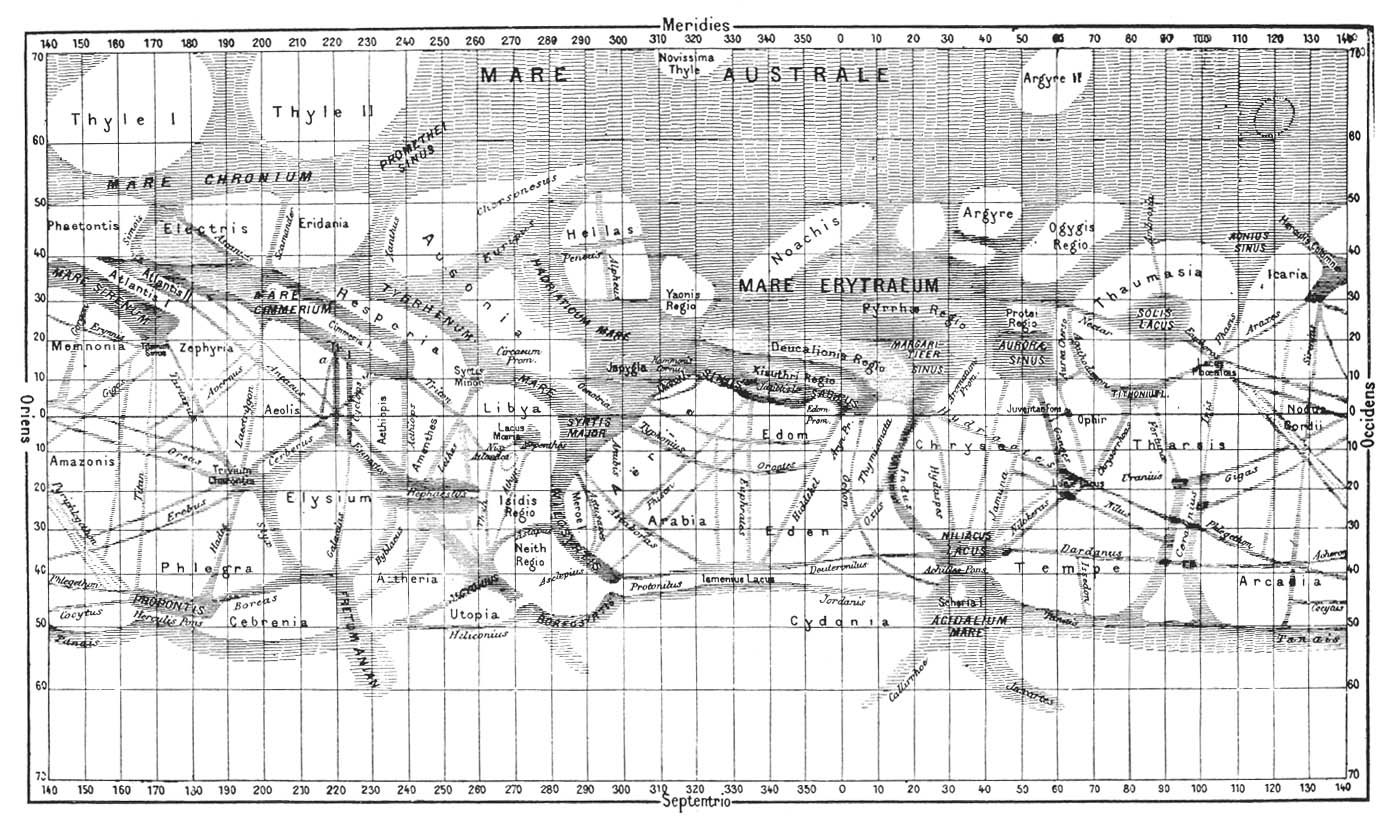
The Italian astronomer Giovanni Schiaparelli, using a new, higher-powered telescope developed in the late nineteenth century, spent a great deal of time studying Mars at a closer level of detail than had previously been possible. He made a number of discoveries about the surface of the planet, including a seasonal change in the coloration of some regions of the surface, a darkening that seemed associated with the warmer temperatures of Martian summer. He discovered the immense Martian sandstorms that can cover the entire surface of the planet for weeks at a time. He also noticed some deeper channels cut into the surface of Mars that ran in straight lines for long distances. He called them “canali,” marking them on the beautiful hand-rendered maps he made of the Martian surface.

Lowell, an American planetary astronomer of some renown, saw Schiaparelli’s maps and became obsessed with the notion of the Canals of Mars, envisioning them as immense artificially-created waterways, marvelous feats of engineering created in an effort to conserve water by an ancient and advanced civilization, purposed towards saving a desertified, dying world.

Schiaparelli, learning of Lowell’s enthusiasm, wrote to him, explaining that “canali” was the Italian word for “channel,” referring to striations observed on the Martian surface without any inference of intelligent purpose intended or necessary, and furthermore that he had seen nothing to suggest that the canali were, in fact, evidence of intelligence, much less the advanced engineering marvels Lowell was busy convincing himself and others that they were.

No matter. Lowell continued to pursue his obsession, to the point of getting the Lowell Observatory at Kitt Peak in Arizona built with the intention of exploring the surface of Mars as closely as possible.

Over time, the dream of Martian canals has faded and died, though it burned brightly for a time in the popular imagination. From Lowell’s misinterpretation of Schiaparelli, we have been gifted with enduring adventure classics like H. G. Wells’ War of the Worlds, Edgar Rice Burroughs’ A Princess of Mars and ten more books featuring the former Civil War Captain John Carter, and the contemplative Robert A. Heinlein’s Stranger in a Strange Land, the story of a human infant, sole survivor of a failed Martian expedition who is raised by ancient and mysterious Martians, who comes back to Earth to become a prophet for the modern age. The book was controversial and influential in its time, and would not have existed but for Percival Lowell’s misreading of Giovanni Schiaparelli’s work.

Lowell was wrong, we know that for certain. In fact, it was known at the time that Lowell’s ideas were probably fanciful. But it’s also true that his fancies have left a mark on reality. If I’m like him, it’s in my willingness to entertain an idea that holds little objective merit, for reasons of my own. I’m different from him in that I don’t have any particular ambition to convince people that my fanciful ideas are real.

I actually hope what I saw never proves to be real. How disappointing it would be to have the existence of pixies, unicorns, or other such creatures confirmed by science: perhaps more disappointing than if someone were able to prove the negative, that fairies are, indeed, mere products of fertile imaginations and romantic hearts like mine.

From the Corner of My Eye, part 1

First of three parts

You can read part 2 here and part 3 here.

Lyra

Say you’re out in the country. It’s a cold, clear, still night: the best kind of weather for stargazing. You look up and see such a multitude of stars that it shocks you, especially if you’re an urban dweller and don’t often get away from the ever-present glow of humanity. If it happens to be a moonless night, you can see the Milky Way like a glowing cloud across the sky. You might see planets, perhaps one or more of the next three out from the sun: Mars, Jupiter, and Saturn, the three of the visible five most often seen once the sun’s glow has completely faded from the sky.

Mercury almost never rises high enough to be seen past the last remnant of sunlight. Venus does, at times. When visible, it’s the second brightest object in the sky after the Moon. When ahead of the sun in processing across the sky, we call it the Morning Star. When it trails behind, it’s the Evening Star. When you wish upon a star, most often you will – either knowingly or unknowingly – pick Venus: beautifully white and pure, never twinkling even on the windiest night, brighter than any other star in the sky. I’ve wished upon the Evening Star many times.

If you’re lucky enough to live where the ambient light is low, and if you love the night sky enough to develop some intimacy with it, to know where the planets are to be seen at any given time, to know constellations like Orion, Cassiopeia, Pegasus, Ursa Major (the Big Dipper), and Ursa Minor (the Little Dipper, which includes Polaris, the North Star), you may see other objects in the sky. Some are always there if you know where to look, and some appear only briefly.

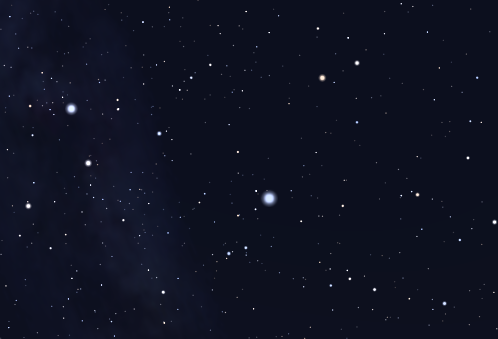
I’ve seen a supernova. When I was sixteen, a star in the late-night summer sky appeared in the constellation Lyra where there hadn’t been one visible before. Over the course of a night or two, it became the brightest light in the sky other than the Moon, surpassing the Evening Star. Then in a couple of weeks it faded to invisibility.

I’ve seen meteor showers: the Perseids in August, the Leonids in November. The Perseids are so named because they seem to generate from a point in the constellation Perseus, and the Leonids from the constellation Leo. Once, I saw a bright light streaking across the sky, a fireball that left a glittering ribbon trail long enough that I couldn’t quite cover it with the width of my hand held at arm’s length. I watched it travel all the way across the night sky. In the news the next day I learned that it was a Russian satellite that had re-entered the Earth’s atmosphere in a blazing fireworks display that I’d marveled at along with many others who happened to look up that night.

I’ve seen the northern lights: Aurora Borealis. I’ve seen the comet Kohoutek and Halley’s Comet. Comets are objects that are best seen using averted gaze, meaning to deliberately see out of the corner of your eye.

Other objects you can see with averted gaze are deep-sky objects, far beyond our solar system. Some are visible with the naked eye, and others you can see only with a telescope. The brightest and most well-known of these were catalogued in the late eighteenth century by the French astronomer and comet-spotter Charles Messier.

The brightest and most famous object in Messier’s catalogue is perfect for teaching yourself how to use averted gaze. In the late summer and autumn sky there is a large, bright rectangle of stars that represent the constellation Pegasus. Trailing away from one point of the rectangle is a double strand of stars that make up the constellation Andromeda. Old celestial maps often showed Andromeda riding Pegasus, and the trail of stars has sometimes been depicted as Andromeda’s hair. In Andromeda’s hair is an adornment, like a jeweled barrette, that Messier included in his catalogue as M31, and which most of us know as the Andromeda Galaxy.

If you can find this object in the night sky, visible at 9 pm near its highest point in November, try this: locate the little cloud of light in Andromeda. It won’t be particularly bright, but it won’t be too hard to find on a clear night. Look a little bit to the left or right of it, not too far, maybe the distance of a couple of finger-widths at arm’s length or less, but focus your attention on the faint, fuzzy cloud of light. It should reveal itself as a larger, more vivid, lens-shaped object.

Averted gaze works because it brings a different part of the retina into use than that part more accustomed to receiving all of the light you focus on in a day, in all of your days, and which your brain is used to translating into sense and meaning. A less-used part of your eye will be more sensitive, but your brain will be less able to filter out things it interprets as nonsense. The light your eye takes in through averted gaze will not be as focused and clear, but with practice you can sharpen your acuity for this way of seeing. Astronomers of Messier’s time made beautiful drawings of the planets, revealing startling details while peering through low-powered telescopes, using this technique.

–To Be Continued

Anna Komnene

It’s been pointed out that I haven’t posted much about my research into the Eastern Roman Empire of late. There’s a reason for this: I’ve gotten hung up reading The Alexiad, written by the Roman princess Anna Komnene in the Twelfth Century CE: a history of her father, the Emperor Alexios I Komnenos, and his reign.

The problem is the relationship I’m having as reader to Anna Komnene as an author. She’s a huge personality, clearly brilliant, and every bit a member of an old-world, long-standing ruling class family. I’ve found the time I’ve spent with her words compelling, difficult, frustrating, and ultimately rewarding. I still haven’t finished it, so I won’t go far into the content of the book here. I’ll write about that once I’ve made it to the end. But I can talk to you about my experience of reading the book so far.

I’m intrigued with the contemporary perspective. She talks in the introduction about her uncle, who died of exhaustion: he was so tired he developed a tumor. As a result of such misunderstandings, I was willing to accept her as an at-least-somewhat unreliable narrator due to her medieval worldview. But there are other problems, including chronological errors throughout the book, which I wouldn’t have been aware of if I hadn’t been checking the end notes as I read.

I understand she was working within limitations: she was banished to a convent, and while primary source materials were available to her, it appears that she may not have been able to reconstruct timelines dependably. So much for the chronological inconsistencies.

It also seems to me that she considers the official narrative and contemporary affairs of state as she writes, which I can’t fault her for. It still made me trust her less as an authoritative voice. Causing your reader to be skeptical is a huge challenge to overcome in a work of nonfiction, and I was definitely skeptical about certain things I read.

But the main problem I’ve had is that I’m not sure what to make of Anna Komnene as a person. She was clearly, as I’ve said, brilliant, perceptive, and an engaging writer as well, but she was caught up in the politics of her time, about as high-born a person as there could have been. I admit that I am leery of such people. I have socialist leanings both politically and in how I view class generally. I was prepared to set those prejudices aside, but I was daunted by the way she speaks about her father: how gifted he was, how resourceful, how strong, what a great soldier, how handsome, how pious. It all began to seem like too much. After one such hagiographic passage, I set the book down for a couple of weeks.

To be fair, she doesn’t avoid talking about Alexios’ failures, and she avoids mitigating or excusing them. On reflection, I think she did her best to meet the challenges of writing about her father within the limitations of her circumstances. I still suspect she doesn’t tell the whole truth, and it’s taken me a fair amount of processing to make peace with that.

I also let myself in for a little bit of disappointment by imagining that this book would contain story elements I didn’t end up finding. That’s my shortcoming. I wanted more description, more relationships, a stronger story arc. I think I was looking for a style of writing that didn’t exist in her day. Modern narrative writing is richer in the sorts of details that for the most part Anna either only barely touches on or skips entirely.

The book is mainly accounts of wars and battles Alexios fought, with a paragraph here and there of surprising granular detail. There’s a brief conversation between Anna and her mother. Elsewhere there’s a description of the workings of a particular weapon. It’s for those moments that the book has held my attention most. They’re sparsely strewn throughout the narrative, and when I come upon them, the world of the story becomes much more vivid.

I have to remind myself that she wasn’t there for most of the events The Alexiad covers: not yet born at the beginning, a child in the Imperial creche for much of the time she writes about. She clearly held her father in the highest esteem, and probably heard stories of the events she writes about from him or those around him. It’s unfair of me to judge her for that.

Having understood these things, I am having a much easier time with her book. When I finish, I’ll say more.