
So we arrive at the final volume of our little trilogy, the most The Nice-like album that ELP ever did, thus inviting a direct comparison. Let’s talk about what I get from the grooves of 3 (at least mostly) live albums recorded as Keith Emerson left The Nice and joined ELP. It’s an interesting journey. I’ll offer the spoiler right now that he really did find a better bassist and singer in Greg Lake. but in my opinion, whether Carl Palmer is a better drummer than Brian Davison is debatable.
I give the nod to Lake here with all due respect to Lee Jackson, who is a fabulous musician. He’s still with us at 83, and is still out there playing music.
And I prefer Brian Davison to Carl Palmer on the issue of pocket. If you haven’t heard that term before, it means finding the place in the rhythm of the music where there’s a gravitic center to the beat. If you can find the pocket, you unlock a feeling of being meshed in with your bandmates in such a way that the feeling of the music gets deeper. In that situation, the synchronicity of the players together feels transcendent. It’s hard to describe if you haven’t been inside it, but it will affect any music you hear. It can draw you in, settle you inside the beat in such a way that your whole body feels like it’s swaddled in groove.
There are microdivisions of the beat, and a range of time within the beat — either slightly forward of it, right on it, or slightly behind — where the feeling of “locking in” can be all-encompassing or it can make you anxious, or it can make the music feel almost robotic. That anxious feeling can be useful to convey a sense of aggression or danger, which some find attractive, but if you’re looking for an expansive, powerful groove, you’ll find that locked-in feeling so much more unifying. The anxious feeling is at the leading edge of that groove, the locked-in feeling comes more from being just the slightest bit past the middle of that range of being “in rhythm.” Brian Davison could find the pocket with ease. Carl Palmer was always at the anxious edge of the beat, anticipating slightly and pushing. So while Palmer would typically pack more strokes into a beat than Davison would, Palmer always felt like he was pushing things, and there’s plenty of evidence of that on Pictures at an Exhibition.
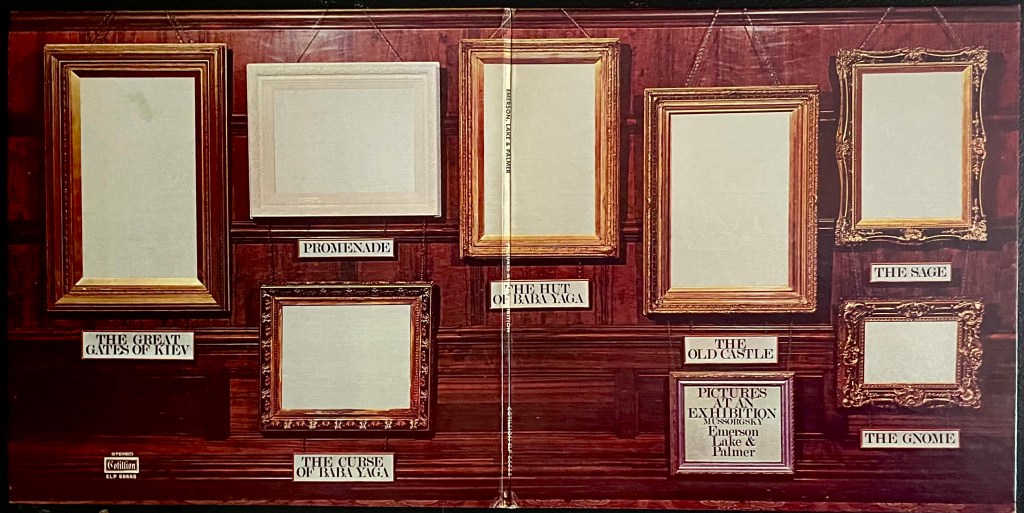
On paper, this could almost be an album by The Nice, with the caveat that strong compositional elements come from both Lake and Palmer, as well as Emerson. There’s a song on side one that is a solo acoustic piece from Greg Lake. There wasn’t a piece that was untouched by Keith Emerson as an arranger/composer since the days of Davy O’List, back on the very first album by The Nice. Honestly, Greg Lake is the best singer and songwriter Emerson ever worked with in a band. Still, it’s the same basic approach as the previous band, with the two new components plugged in.
Lake played a Fender Jazz bass, giving a much rounder, fuller tone than Lee Jackson’s plunky hollow body ox teardrop bass, which gives the whole band a smoother, more contemporary tone. He was also a more fluid player. There was less jazz in his sensebility (the model of his bass notwithstanding) and more rock. As discussed above, Palmer was much more kinetic behind the kit. Emerson seems liberated here, though he’s the same player. ELP was more of a well-oiled machine than The Nice, it’s plain…
I’ll have more to say about this album in my next post. Stay tuned.
Please consider liking and commenting on this post. Subscribe if you can – it costs you nothing and helps this site thrive – and share this post with those you know who might appreciate it.

