Two Albums By The Nice and Pictures At an Exhibition, part 4

Side 2 of Elegy

This album came out a couple of months before Emerson, Lake, and Palmer’s Tarkus, the new band’s second album. The breakup was already established, ELP was a going concern, and a final album by The Nice was, it seems, of interest, at least in the British market, where the album charted at number 5. There’s a previous post that talks about side one of this album. You might want to reference that for the “bigger picture.”

The second side of the record consists of Tchaikovsky’s “Third Movement, Pathetíque Sympnony,” which is credited both to the Russian composer and The Nice, and Bernstein and Sondheim’s “America” which is subtitled “2nd Amendment,” in The Nice’s version. Emerson claimed that this was the world’s first instrumental protest song, which I find to be a dubious claim, although I do support the claim that this is a protest song, and does make its point well.
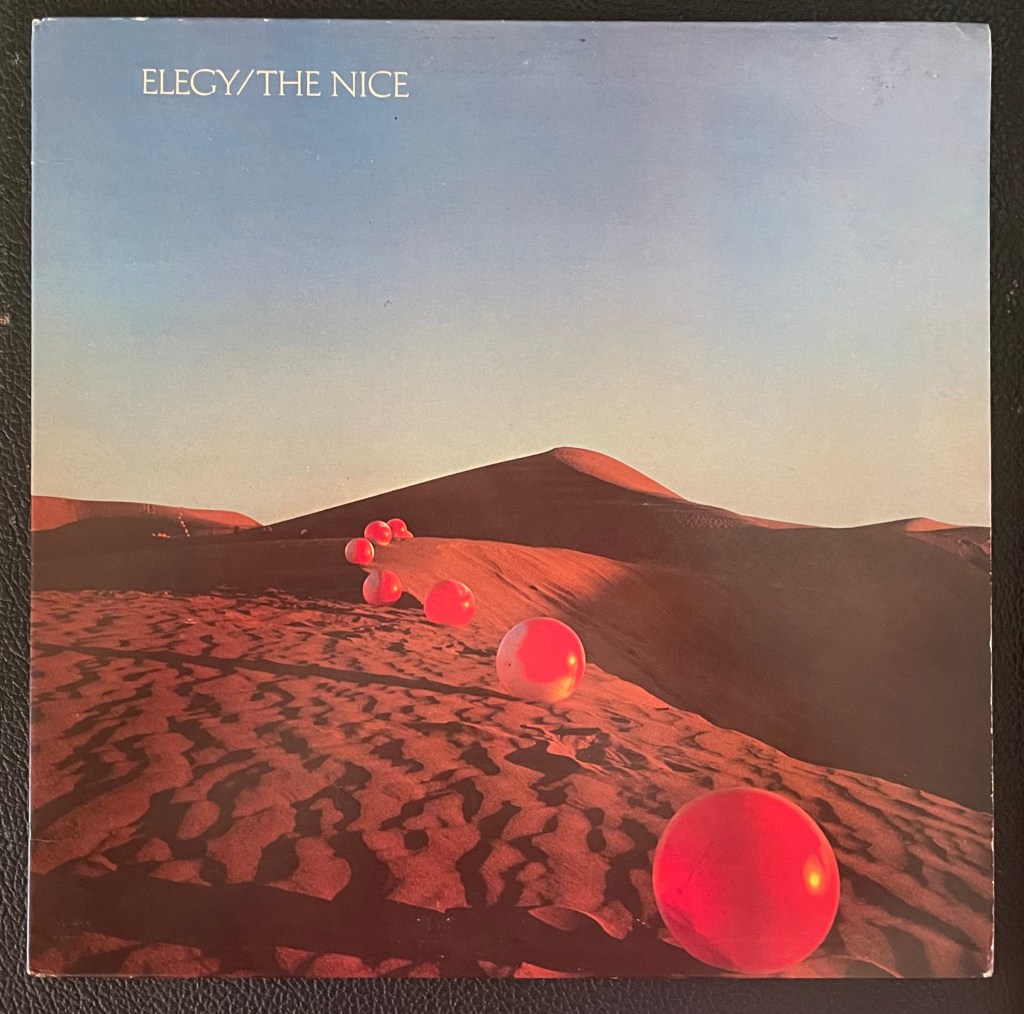
Yes, I found a copy fo the gatefold on eBay…

I said before that side 2 followed the same pattern as side 1, beginning on piano and moving to organ later, but here I am listening again and glory be! the first thing you hear is organ! How did I not remember that? In fact, there’s no piano on this side of the record at all. I apologize for the misinformation. I hadn’t listened to side 2 but the once in preperation for part 3 of this article. Repeat listenings have had me wondering if I should go back and edit that part, but in this case, it’s published and it would feel dishonest to change what you might already have read.

While there are jazz touches, and classical themes are explored in these arrangements, this is first and foremost a rock album. Though all of these songs have appeared on other albums, the band are working from new arrangements. One can look at this release as some sort of afterthought, but I love the warmth of these performances. I feel like this album may be the best justification for the band’s existence, released after the fact, when all of the members had moved on.

I love the instrumental freakout at the end of “America.” It’s very much in the wheelhouse of other early-70s drone at times, but ultimately represents the theme of entropy and destruction that appears to be the point here, and seems to be drafted into being the band’s big goodbye as well. Lee Jackson gets a final word in, playing the bass line a couple of times, as if to say that he’d be willing to continue the project, if only…

Honestly, I feel what Jackson is doing here. There are many points in my life where that whimper of an ending could have been magnificent if it was the beginning of rebirth. But here we are, at the end of something beautiful, falling apart for the lack of will to find the common ground to continue.

Side one of ELP’s Pictures at an Exhibition is next.

Please consider liking and commenting on this post. Subscribe if you can – it costs you nothing and helps this site thrive – and share this post with those you know who might appreciate it.
Two Albums by The Nice and Pictures at an Exhibition, part 3

Elegy, side 1

Here we have the very last official release by The Nice. It’s another live/studio mix of things: four tracks, two recorded at the FIllmore East, two recorded at Trident Studios in London.

This gives the lie to something I said about the previous album Five Bridges. I’d claimed that their last studio recording was the final and only studio track on the album, “One of Those People.” I can amend that to say that “One of Those People” was the last original track recorded by the band, since the two studio recordings here are renditions of “My Back Pages” by Dylan and Tchaikovsky’s “Pathetíque Symphony, 3rd Movement.” There’s a different, longer version of the Tchaikovsky piece on Five Bridges.

There are no originals here, everything is material sourced from outside the band. the two live tracks are Tim Hardin’s “Hang On to a Dream” and Bernstein/Sondheim’s “America” from West Side Story. Again, we’re straddling that line between rock and classical, a line pretty much marked off and danced back and forth over by The Nice.

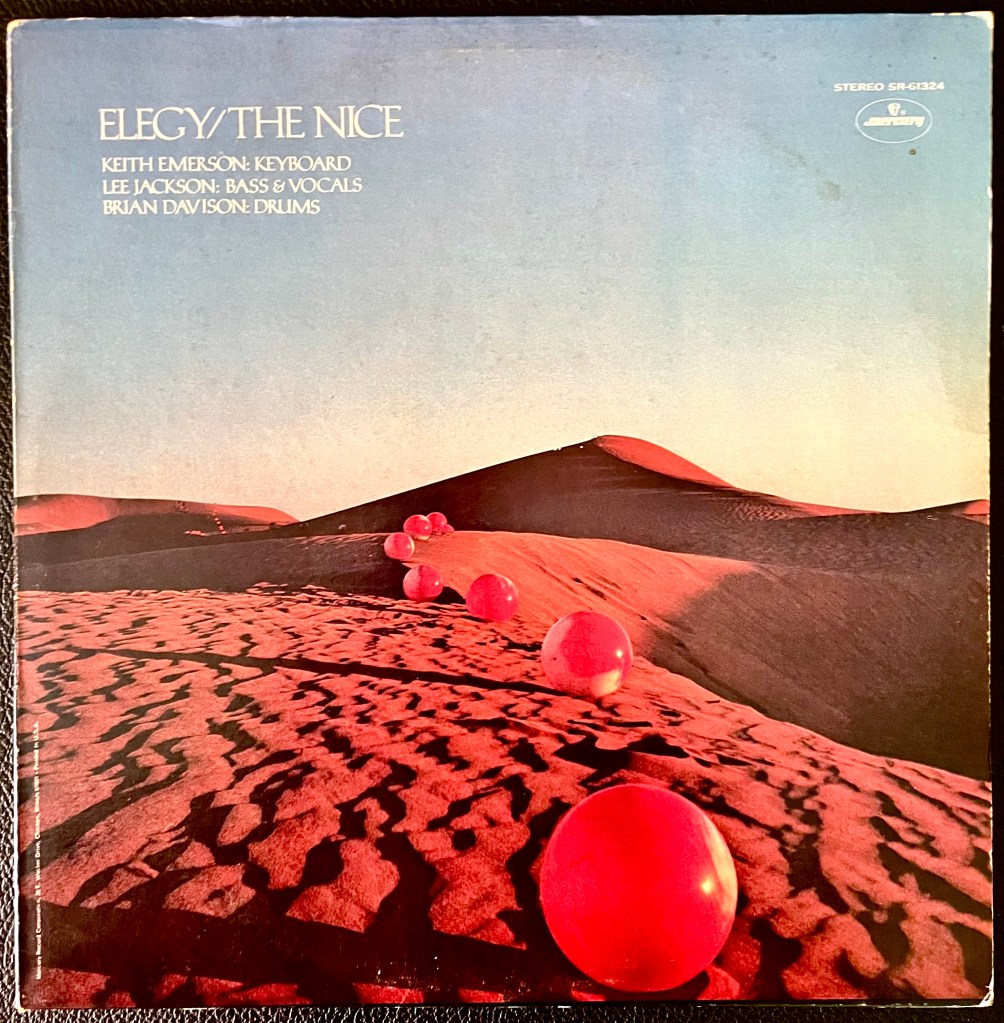
My copy of Elegy.

The cover is again by Hipgnosis. This photo session was more expensive, as the photography was done in the Sahara Desert. It definitely has that surreal Hipgnosis feel to it. There is, evidently, a gatefold version of this cover. My copy is in a standard jacket.

Side 1 is the two folk-derived tracks. “Hang On To a Dream” is a jazz/blues take, with a lot of piano soloing, and then a middle section that feels a bit more trancy and features something that sounds like Emerson reaching inside the piano and plucking the strings directly. I like the acoustic feel of the track. There’s no organ and the bass has a flat sound that feels like a hollow body played through a very clean amp — almost like stand-up, but it penetrates a bit better than a double bass would in this context. All of the flash comes from Emerson, although both members of the rhythm section add bits of flair here and there.

I’m doing this series of posts based on things I’ve read saying that Keith Emerson left the Nice because they didn’t measure up musically, but in general, my sense is that Jackson and Davison don’t seem like liabilities. I won’t say that about Jackson’s voice. His voice is flat and nondescript. I’m sure that’s not meeting the standard, but what do I know? Keith Emerson isn’t here to tell me. I have to say that I wish he had a little bit more edge, a little bit more fullness, but it also seems like he has that smooth jazz voice that was the style at the time.

Then on “My Back Pages,” I hear the limitations more. Jackson is almost croaking here, when he pushes. Emerson starts on piano, then switches to organ and sounds a bit more like the ELP guy, though the feeling is less the early-seventies “electric” thing than a more amped-up jazz feel. It’s got some rock edge to it, but we’re definitely keeping to a more human feel. Even though it’s a studio track, it still seems very live.

I’ll post about side 2 in a bit.

Please consider liking and commenting on this post. Subscribe if you can – it costs you nothing and helps this site thrive – and share this post with those you know who might appreciate it.
Two Albums by The Nice and Pictures at an Exhibition, part 2

Five Bridges Side 2

Side 2 is three cover versions from the same bunch of shows as Side 1, plus a studio recording of a final song. This would be the final time that The Nice would go into the studio before Emerson left the band. The first track was composed by Sibelius and the second is by Tchaikovsky. The third is a medley, the first half by Dylan and the second half by Bach.

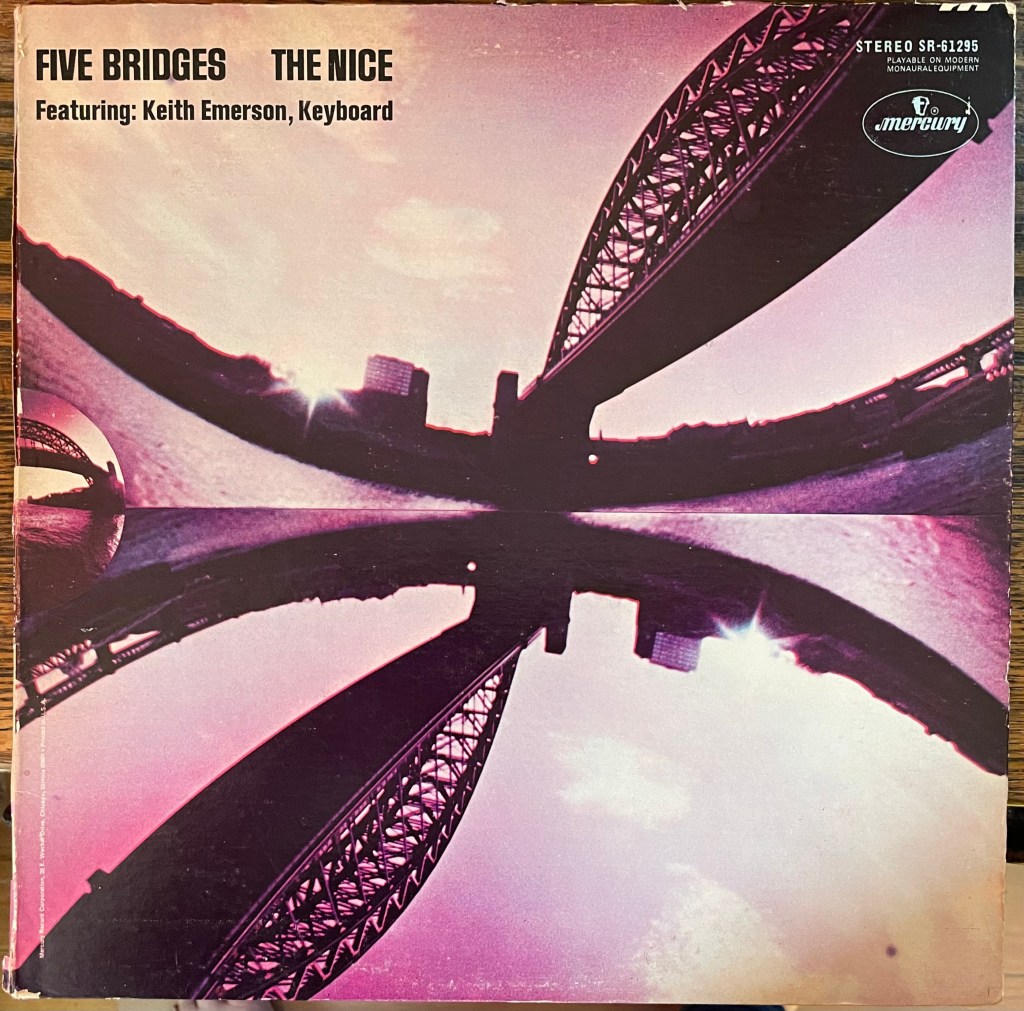
This is the back cover, which is much better on many levels than the front cover, even though it’s the same image.

They were really leaning in to the whole classical/rock fusion thingie, since many of us had music teachers who would proclaim that rock music would never be as great as the classics and wanted to know music that proved those supercilous teachers wrong.

Keith Emerson really was a hero to that kid, the one with the snooty music teacher. Emerson obviously knew that was a big part of his appeal. It was the point of prog in those days. PRO(ve you wron)G. I was that kid, but I never really “got” Keith Emerson.

But lately, I’ve been trying to figure it out – what the attraction is, can I manage to at least understand the mindset.

I found I had a similar problem with Genesis, which I addressed by repeatedly listening to some of their early records. I love Genesis now, up to about their 10th album. Still not a Phil Collins fan, and they were definitely better as a 5-piece, but I do like everything up to Duke.

So where’s that gonna land me with ELP? Especially if I treat them as a continuation of The Nice, which… to be honest, I think they are.

In the end, I have to say that I think Greg Lake does a better job doing the same things Lee Jackson did, and for me, the jury is still out on Brian Davison v. Carl Palmer. In general, I think The Nice had better pocket than ELP, and I guess I’ll lay that at Palmer’s feet. He may be more technically profidient than Davison (though that’s at least somewhat debatable) but that guy never met a groove he couldn’t push.

My sense is that Emerson was already deeply dissatisfied with The Nice by the time of this record, but that the band was still a very good representation of what I think of as the central idea — a keyboard-led power trio with a high rate of musical proficiency and a real penchant for mixing classical music with rock.

I’ll tackle Elegy next…

Please consider liking and commenting on this post. Subscribe if you can – it costs you nothing and helps this site thrive – and share this post with those you know who might appreciate it.

Two Albums by The Nice and Pictures at an Exhibition, part 1

Thoughts about Keith Emerson’s journey from The Nice to Emerson, Lake and Palmer

The Nice’s Five Bridges was recorded in October of 1969 except for one track, and released in June of 1970. The Nice’s Elegy was recorded in December of 1969 and released in April of 1971. Emerson Lake and Palmer’s Pictures at an Exhibition was recorded in March of 1971 and released in November of 1971.

I’m sure I’m not the first person who has noticed that these albums have some strong similarities in terms of material choices and general sound. They seem to me to document an evolution from one band to another, centered on Keith Emerson. I’ve never really understood how the change came about, except within the idea of “supergroup,” which was a persuasive idea at the time in British rock music. Maybe a review of these three records together will help me contextualize things.

(ed. note: I’ve bitten off more than I can chew at one time, so this is going to be a series of articles. I’m going to write about these as a series of sides, since I have them on vinyl. I will try to post these faster than my usual once-a-week schedule.)

Side 1 of Five Bridges

This is a sidelong epic suite, part orchestral, part solo Emerson piano, part rock band. The work is commissioned for the Newcastle Arts Festival and performances were recorded with the London Sinfonia at the Fairfield Halls in Croydon.

It’s not wrong to say that Keith Emerson overwhelms things. In a way, I can see what he was talking about when thinking of the rhythm section of Lee Jackson and Brian Davison not being “virtuosic” enough for what he wanted to do. But at the same time, I appreciate what Jackson and Davison contributed to The Nice. I think the word Emerson was looking for might have been “too understated,” because I love those rhythm section parts, but yeah. You have to admit that they were simpler and didn’t spur Emerson on to be even more excessive.

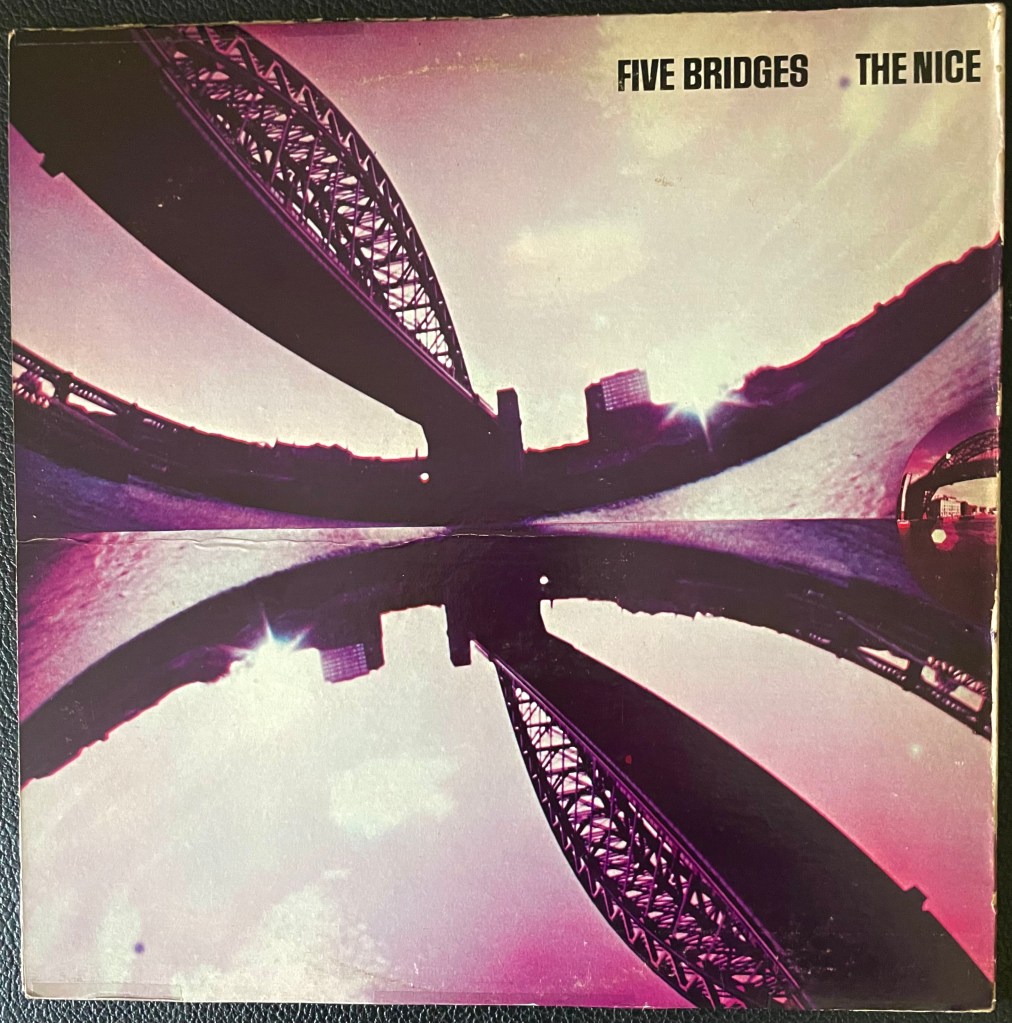
photograph of my copy of the lp "Five Bridges" by The Nice.
My copy of the album in question, featuring an early Hipgnosis cover.

KE was an early proponent of the mixing of classical symphonic music with rock, as evinced here. He uses blues and rock motifs in the orchestral arrangements, complexifies the rock band bits. Prog in general was more successful at advancing the rock aesthetic than the classical. The classical stuff here strikes me as being in the realm of the romantic composers, in much the same way as symphonic film soundtracks are. Emerson uses a bit more repetition than most classical composers do.

I will admit that I don’t think original guitarist Davy O’List would have had much to add here… I think Emerson wanted all of that space for himself, and he certainly makes use of it. The last of the five movements of the piece split the difference between the rock and the orchestra by using a horn section in a way that feels a bit along the line between jazz and motown, with a sort of fanfare towards at end. This feels like a blueprint for what would later happen with ELP, but that’s the point, isn’t it — that it feels a bit prototypical of something that would be more fully realized later.

I have no issue with The Nice. I can see the ambitiousness of Emerson and from the perspective of a non-fan of ELP, I can also see that Jackson and Davison are doing a fine job of keeping up with those ambitions.

I’ll talk about Side 2 of this one in a separate post, which should arrive here in the next day or two.

Please consider liking and commenting on this post. Subscribe if you can – it costs you nothing and helps this site thrive – and share this post with those you know who might appreciate it.

How to Not Be Bored With Your Blog

Unless you want to be bored with your blog, in which case, go ‘head.

  • Don’t be half-assed. That will guarantee that you’re not going to write stuff you’ll come back to later. The way to keep creating writing/content/ideas worth your time is to commit to doing your best.
  • Don’t repeat yourself. This seems obvious, but sometimes you’ll get on a tear and want to get something across and you’ll come back to it again and again because you’re obsessed. Even if your blog has a focus — lefty politics, trans rights, etc. etc. keep moving forward and find new angles.
    • This can be a challenge. You’ve got to meet it, though. The world keeps moving. There are new angles coming towards you. Look for them.
  • Care about what you write. If what you’re writing means something to you, that will come across to the reader. Your writing will be more interesting because you’re interested.
  • Know why you’re doing this. Have a sense of mission. Have a goal. That is not to say you have to be single-minded. Side quests are sometimes necessary and rejuvenating. But remember your central point. Remember why you started blogging in the first place, and return to that point whenever you start to feel that sense of mission creep.
    • You can refine that mission over time. Life is a process, and change is the truth. Keep up with those changes in your writing, your interests, and your knowledge.
    • When you change, bring your reader along with you. Disclose. Explain. Empathize. Remember that there are two of you in the equation.
  • Be Honest. NEVER go along to get along. Never give in to “audience capture.” This is part of being committed to a project. Have enough faith in what you’re about to be willing to risk shrinking your audience in the short run. Tell the truth, and keep that personal truth at the center of your project.
  • Keep Blogland Weird. Embrace idiosyncracy. Revel in quirkiness. Be you. Have fun.