Dear Editors: I Am Not My Transition!

I’ve heard back from more than one editor, and a couple of agents as well, that a story about my childhood that I’ve been sending around is “just a chapter” because it includes a scene of me directly trying to deal with my gender issues: they all seem to want to make the whole 6,000 word story I’ve submitted about that one page-long scene. I don’t have the opportunity to explain that the story I’ve sent them doesn’t really have anything to do with “transition” per sé, because cover letters need to be brief and professional. If I did take the space to try to explain this, it would feel like I’m apologizing for my work if I were to drill down into aspects of my story in a preface that only the editor will ever see. A story needs to stand on its own.

So I’m writing this post.

I’ve been told to just leave that part of the story out, but that seems just as unreasonable. Physically, it would be possible to do that, and while that would certainly bypass the issue of my “problematic” identity, to leave that important part of myself out of my story would feel like I’m retreating into the closet that I’ve fought so hard not to be trapped in. From my point of view, the choice I’m being presented with is either to leave out this important aspect of who I am or focus my story on the expected trope of transition.

Imagine requiring a story about a black kid to include some kind of resolution to the “problem” of their blackness, or else leave that out of the story entirely. Such an expectation from an editor would immediately brand them as racist. And yet, any time I have heard an actual critique of the piece I’m discussing, this is what I hear back.

I’m trans every day. Getting my hormone prescription was only one day, one story. There have been so many stories in my life: I was trans in all of them. My being trans is just a trait, not my whole identity. I am not my transition. That’s not the only story I have to tell. Surprisingly, the vast majority of what’s happened in the time I’ve been walking the Earth has nothing to do with a particular course of medical treatment.

I refuse to accept that any memoir I write needs to either deny who I am or be about the gatekeepers who OK’ed my medical transition. I am grateful to them, but at least one of these people has had me sign an NDA. They don’t want the publicity, and I’m OK with that.

This particular memoir piece is a story about a kid who is being bullied. The fact that the main character is trans is important, but not central, and the resolution to the story is not going to come from waiting the thirty seven years it took me to get my medical transition started: the situation is much more immediate than that, so the resolution must be, too. That resolution must be about being bullied and how the central character, who happens to be trans, deals with it.

By the logic of these literary gatekeepers, no story can be self-contained, because there is always some central issue in a person’s life that won’t resolve into a nice little package with a ribbon and a bow on it. Requiring a self-contained solution to such a global problem as gender incongruence is unreasonable. Conversely, you can live with such an unresolved issue for a very long time, while many other things happen. I can tell you that this is so from personal experience.

Unfortunately, it’s been a major obstacle to getting my work published. It’s quite frustrating.

Books I Like #8

A Madness of Angels by Kate Griffin

Orbit Books 2009

A Madness of Angels

By 10 a. m., Chapel Street Market already smelt of cheese, fish, Chinese fast food and McDonald’s. It was a market defined by contrast. At the Angel end of the street, punk rock music pounded out from the stall selling pirate DVDs; from the French food stall, more than half a van with a rumbling engine at its back, there sounded a recording of a man singing a nasal dirge about love, and Paris when it rained; at the cannabis stall (for no other name could do justice to the array of pipes, T-shirts, posters, burners, and facial expressions that defined it, everything on display but the weed itself), Bob Marley declared himself deeply in love to the passing hooded youngsters from the estate down at King’s Cross. Outside the chippy, where the man with inch-wide holes in his ears served up cod to the security guards from the local shopping mall, a gaggle of schoolgirls from the local secondary bopped badly in high-heeled shoes to a beat through their headphones of shuung- shuung-shuung-shuung and shouted nicknames at their passing school friends in high voices that didn’t slow down for the eardrum. Fishmongers chatted with the purveyors of suspicious rotting fruit, sellers of ripped-off designer gear gossiped with the man who sold nothing but size-seven shoes, while all around shoppers drifted from the tinned shelves of Iceland to the rich smell of the bakery, wedged in between the TV shop and the tattooists parlour.

Somewhere, I don’t know where, I found out about this British publisher’s daughter who got her first novel published when she was 14, named Catherine Webb. I may have looked up the author of this book, Kate Griffin, because I had been joking with a friend about how she was my cousin, and found Catherine Webb behind the pseudonym. She wrote that novel, Mirror Dreams over summer break from school. Her father read it, then advised her to find an agent, which she did.

The next year its sequel, Mirror Wakes was published, and she has continued to publish prolifically since. At the time I picked AMOF up, she had published 11 novels at the age of 25. She currently publishes under the name Claire North, and has published several wonderful books under that name.

The four books in the Matthew Swift series all inhabit the fringes of a magical London, dark and full of panoramic, almost hallucinatory imagery like the passage above. The story begins with Swift resurrecting out of thin air in the flat he had lived in before his demise two years earlier, sharing his newly-reconstituted body with what he calls “angels”: actual living beings brought to life in the telephone lines of London from the unfinished ends of telephone conversations, on a mission to find the person who murdered him.

The problem I see with the series is that over time, they begin to seem like copies of themselves, as Griffin (Webb) follows Swift on endless walkabouts through London, always with these long hallucinatory passages that never lose their immediacy. I suspect Webb just got tired of walking through London enough to create these descriptions: I certainly never got tired of reading about them.

The tone is noir and almost post-apocalyptic (in the way that we are all living in a nearly post-apocalyptic world these days) and the magic of these books is original and dark.


Books I Like #7

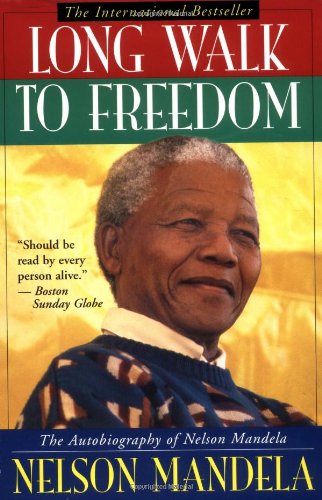
Long Walk to Freedom: The Autobiography of Nelson Mandela

Little, Brown and Company, New York, Boston, London 1994, 1995

Nelson

More of a history than a memoir, Long Walk to Freedom is the man’s detailed account of his extraordinary life. He seems to have lived every sort of life a man could live within the span of the twentieth century. Born an indigenous Xhosa, he was taken from his tribe at the age of ten and educated as a tribal prince. Then he moved to Johannesburg and lived in Soweto township. He was a laborer during the day and walked into Johannesburg in the evenings to go to law school. He was the leader of the ANC, a revolutionary, a prisoner for over two and a half decades and a beloved head of state.

Here is the story of a man who was a pedestrian for pretty much his whole life, hence the title, and a monumental human being.

If only David O. Lean were still alive.

Books I Like #6

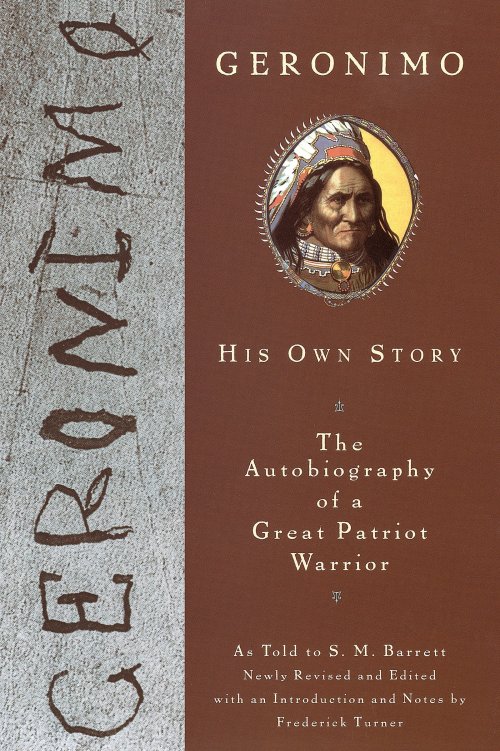
Geronimo: His Own Story: The Autobiography of a Great Patriot Warrior by Geronimo, with S. M. Barrett and Frederick W. Turner

Plume (revised edition) 1996)

A1Io8dGTEaL

Here’s some history that was not told by the victors, though they did transcribe and edit it. It’s an amazing and enraging account.

Geronimo was not a chief, though he did become a war chief of the Mescalero Apaches. In this book he recounts for us the story of how his tribe ran afoul of the Tucson city fathers, who got tired of Apache raids and decided to have the Apaches removed, and how Geronimo led the fight to stay put. He was a brilliant leader, and managed to keep his small band of warriors and family together and on their land for years. Geronimo’s retelling made me hate those old Tusconans just as much as Woody Guthrie’s talking about their grandsons did in Bound For Glory.

This book is also notable for the archival photos of Geronimo and other Mescaleros. I got a lot out of them. They were all taken post-capture, so there’s an air of sadness to them, but I also loved that how Geronimo’s personality was captured in some of them. He was a very charismatic man, stylish and uniquely handsome, as well as being one of the fiercest warriors the world has yet seen.

Books I Like #5

The Slow Regard of Silent Things by Patrick Rothfuss, Illustrated by Nate Taylor

DAW Books, New York, 2014

Slow Regard

Patrick Rothfuss has been working on the Kingkiller Chronicles for long enough that it’s almost reasonable to call it his life’s work. The first two books in the series, The Name of the Wind (2008) and The Wise Man’s Fear(2011) are as good as epic fantasy gets: character-driven (and what characters!), in a vividly realized world. It’s the story of a brilliant, romantic boy who has lost everything and then found purpose in life again, framed with an older version of the character, who is in hiding, having caused a slow-rolling, ongoing disaster from which he cannot entirely escape. We have no idea what that disaster is, because Rothfuss saved that reveal for the third and final book, which he’s still working on.

Rothfuss is a hugely talented writer, and apparently meticulous in his process. I feel quite confident that when we do finally get that ending, those of us who are eagerly awaiting it 8 years later are going to be blown away, because everything he’s written has done this already.

So, in the midst of our wait for that third book, to be called The Doors of Stone, Rothfuss has written a couple of interim pieces set in his world, which is called “The Four Corners”. There’s a short story about a supporting character in the later time frame, and TSROST, which focuses on Auri, a character known to Kvothe, his first-person narrator in the two previous books, from his time at The University.

Auri’s a former student at the University, who studied alchemy, and whom magic has broken in some way that we still don’t (and probably will never) know. She’s the only character in the book, though it’s the nature of Auri that she would disagree with that statement, and that’s at the heart of this story.

I’ll go no farther in describing it than to say that some hate TSROST because they think it has no plot. I disagree, though the throughline here is extremely subtle. It’s my favorite of his books. I think the writing is luminous.