Rama Lama Whippity Ding #1

I met with an agent

AI slop

Recently, I had a speed date-style Zoom meeting with a generalist/genre book agent. It was an interesting and informative experience. I’d even say that on the whole it was a good experience. But it was also awkward and distant, and a little bit depressing. I’m clearly not the author this agent wants to represent, that’s the first thing to say. And I’m OK with that. As with any speed dating sort of situation, you’re looking for something to click.

When it became clear that this wasn’t going to be a thing, I asked a couple of biz questons and they were open and honest with their answers. Helpful. Cheerfully so.
more AI slop

I asked about how it is out there for trans authors these days. I was told that trans adult fantasy authors can pretty much do what they want, it doesn’t seem to matter. But kidlit is getting hit pretty hard, lots of bannings, lots of pushback.

I guess we’ve found the actual canaries in the coalmine. If you’re a trans-inclusive YA or middle grade author, you’re having a rough go right now. I don’t think that points to a winner in the contest, but it does make it clear that it IS a contest. There’s a war being fought out there. And if the trans kid’s authors lose, I’m next.
further AI slop

What the agent kept repeating when asking me to talk about my project is “What are the stakes? What’s the thing I can’t walk away from?” This caused me some cognitive dissonance because the whole idea of my novel is the protagonist walking away, over and over. And it’s not that my main character is an anti-hero. Sometimes Rose walks away from things by choice, sometimes she walks away because she’s forced to. Sometimes she’s kidnapped. Sometimes a disaster happens, either on a large or a small scale. Sometimes it’s her fault. Sometimes she’s a victim. Sometimes it’s a sacrifice she makes. And that’s a story too. It’s a story I feel personally, because it’s how my life has been.

My perception of the general run of fantasy novels these days — and I’d have to say that most everything I’ve read in the genre for the last ten or so years fits into this formula — is that you start with an action sequence, it sets up a conflict and some tension, the bulk of the book is the main character on the run and under the gun based on the conflict/tension, but also there’s some guy or girl who is very very annoying until they’re not, then there’s an aha moment when the protagonist figures out what’s really going on and consequently how to win, and then there’s a huge high-stakes battle, like a multiple orgasm of crash! bang! pow! as big as whatever the author can imagine, then a few pages of happy every after.
Such AI, much slop

Whose life is like that? Having read a hundred iterations of that, who needs it again? I think this is a problem, and it’s not something I want to “create” the next iteration of, although I will say the story I’m working on actually does follow that formula to some extent, though it doesn’t have that ratchet-up, ratchet-up, and ratchet-up-again thing going on.

At some point during the interview, I began to imagine the novel I would write to meet the standards of this era of fantasy fiction. The title would be “Rama Lama Whippity Ding #1” and the first sentence would be “How do you like your steaks?” I bet I could get a few thousand words out of riffing on that.

Clearly, I wasn’t made for these times.
last bit of AI slop… for now.

Please consider liking and commenting on this post. Subscribe if you can – it costs you nothing and helps this site thrive – and share this post with those you know who might appreciate it.
I Have Thoughts About the Rowling Implosion

I won’t spend a lot of time recounting the public record about JK Rowling’s recent forays into gender identity politics, there’s a pretty good and reasonably unslanted account of the major and more recent events in the controversy here. This controversy is one of the most written-about dustups between an author and their fans ever; one of the most focused-on stories of any sort this year short of the Corona pandemic and the US Presidential election. I don’t know that there’s a lot left to say on the subject. Still, I’ve been asked for my opinion about this several times, and it’s taken me until now to feel like responding.

That’s because my feelings on the subject are complex and I balk at the idea of being any sort of spokesperson for trans folk, or anyone but myself. I am a contrarian by nature, so I’ve had to sit with this for a while, deal with my trepidation about what Harry Potter’s real mom might be saying about me, a trans woman who has always felt a strong affinity for Our Young Wizard and his gaggle of friends. I’ve finally taken the time carefully sort out the ways in which I might agree or not with consensus opinion.

Some of you may remember this piece by me, which I have referred to a few times, about distinguishing between an artist and their work. This should establish that I make a fairly clear distinction between whatever public statements Rowling’s made and the world she created, which I’ve spent so many pleasant hours in, and which I will yet almost certainly devote some hours to in the coming years. I won’t comment further on Harry Potter in this context. I feel it’s a separate issue from what Rowling has said about trans folk in the last few months (and the opinions which we trans folk were fairly certain she held for some time before she Came Right Out and Said Stuff.) I will not be pretending, as I see that many have, that her work was never good, or that I knew she was a transphobe all along. Neither of those statements would be true.

But to get to the point, Rowling’s basic premise in posts on Twitter and on her blog – that trans women make her feel unsafe, and that young trans people may be making a mistake – are both well-known canards. She’s a good writer, so she makes those arguments in fine, writerly form, but she doesn’t vary from standard, long-since-debunked tropes, no matter how well she writes them. She references sources but doesn’t cite them, nor does she offer any counter to her own assertions so that we can judge them for ourselves. Her best defense is that she “has transwomen friends” who agree with her. The more one looks into what she’s saying, the more you just see a lot of carefully-worded jingoism framed as concern.

There’s no evidence she can cite, or that any of those who have made these charges previeously can cite, that show that men pretend to be women to invade public restrooms and commit rape. It simply doesn’t happen.

And really, why would these supposed cross-dressing rapists bother? If a public restroom is going to be the venue for a sexual assault, there’s no need to jump through all of the hoops a transgender woman has to jump through just to commit it. Just break down the door and go be a monster. I would think that female dress would be the opposite of an enhancement of this experience for the sort who is willing to consider the crime to begin with. Rape is a crime of power, and to that end an assertion of the most toxic masculinity. The two notions of dressing as a woman and committing rape are extremely dissonant. My assertion here is supported by the evidence: again, there are virtually no incidents of sexual assault committed in this manner.

In fact, it is far more common for trans folk to be subjected to violent assault simply for being who they are. I could, if I were so inclined, post links to videos of trans women being subjected to assault for attempting to use the public restroom that aligns with their gender. I am not so inclined, sorry to disappoint.

As for youth being “seduced” into transitioning “before they’re certain,” examples of this are extremely rare, and once again far outstripped by tragic counterexample. The suicide statistics among trans folk are often quoted and don’t need to be restated here. (Here’s a link to The Trevor Project’s factsheet about trans suicide prevention so that you will at least go to The Trevor Project’s site. Consider supporting them, please.

Childhood development experts place the age at which children generally develop an understanding of themselves as gendered beings at between 2 and 5 years of age. A teenager knows who they are gender-wise. Incidents of post-transition regret and detransitioning are extremely low. The idea that people only know what gender they are at some arbitrarily created age of consent is ridiculous in the face of the best evidence we have.

So don’t be fooled by Rowling’s seemingly reasonable tone and claims of concern for the safety of cis women and vulnerable teens. They are, upon examination, unconvincing covers for shockingly standard anti-trans tropes, none of which are worthy of the person who created one of the most embracingly humanist pop culture worlds of the last half-century.

Transphobia is deadly to trans folk. The evidence shows that trans folk are NOT a danger to anyone else.

And that’s what I think about that.

[ND] [ED]

Books I Like #9

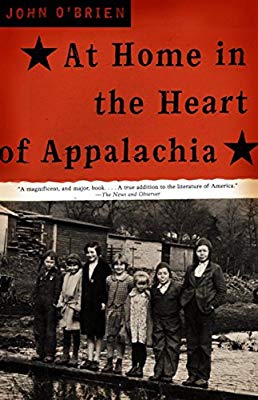
At Home in the Heart of Appalachia by John O’Brien

Anchor Books New York 2001

Appalachia

Here’s a wonderful book-length personal essay that resonates with me on a number of levels. Although O’Brien never names it, it’s clear to me that he suffers with ADHD: all the hallmarks are there, and he frankly discusses some of those markers.

He writes about his home in West Virginia, about many different aspects of life there, with an astute eye and a gift for clear, beautiful prose. Ultimately, It’s a perfect marriage of person and environment, exploring how much of West Virginia is a part of who he is, and drawing the parallels back between his own life and how that is reflected in different aspects of what this place is.

It’s a beautiful book that I just happened to pick up at a Barnes and Noble once, but it has stuck with me. I point to it as an influence in my journey from an exclusively genre reader to someone who likes various sorts of nonfiction: history, biography, memoir, essay, and journalism.

Books I Like #8

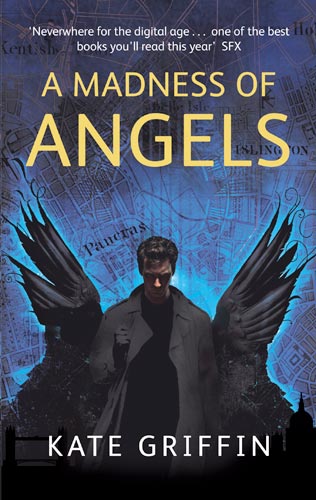
A Madness of Angels by Kate Griffin

Orbit Books 2009

A Madness of Angels

By 10 a. m., Chapel Street Market already smelt of cheese, fish, Chinese fast food and McDonald’s. It was a market defined by contrast. At the Angel end of the street, punk rock music pounded out from the stall selling pirate DVDs; from the French food stall, more than half a van with a rumbling engine at its back, there sounded a recording of a man singing a nasal dirge about love, and Paris when it rained; at the cannabis stall (for no other name could do justice to the array of pipes, T-shirts, posters, burners, and facial expressions that defined it, everything on display but the weed itself), Bob Marley declared himself deeply in love to the passing hooded youngsters from the estate down at King’s Cross. Outside the chippy, where the man with inch-wide holes in his ears served up cod to the security guards from the local shopping mall, a gaggle of schoolgirls from the local secondary bopped badly in high-heeled shoes to a beat through their headphones of shuung- shuung-shuung-shuung and shouted nicknames at their passing school friends in high voices that didn’t slow down for the eardrum. Fishmongers chatted with the purveyors of suspicious rotting fruit, sellers of ripped-off designer gear gossiped with the man who sold nothing but size-seven shoes, while all around shoppers drifted from the tinned shelves of Iceland to the rich smell of the bakery, wedged in between the TV shop and the tattooists parlour.

Somewhere, I don’t know where, I found out about this British publisher’s daughter who got her first novel published when she was 14, named Catherine Webb. I may have looked up the author of this book, Kate Griffin, because I had been joking with a friend about how she was my cousin, and found Catherine Webb behind the pseudonym. She wrote that novel, Mirror Dreams over summer break from school. Her father read it, then advised her to find an agent, which she did.

The next year its sequel, Mirror Wakes was published, and she has continued to publish prolifically since. At the time I picked AMOF up, she had published 11 novels at the age of 25. She currently publishes under the name Claire North, and has published several wonderful books under that name.

The four books in the Matthew Swift series all inhabit the fringes of a magical London, dark and full of panoramic, almost hallucinatory imagery like the passage above. The story begins with Swift resurrecting out of thin air in the flat he had lived in before his demise two years earlier, sharing his newly-reconstituted body with what he calls “angels”: actual living beings brought to life in the telephone lines of London from the unfinished ends of telephone conversations, on a mission to find the person who murdered him.

The problem I see with the series is that over time, they begin to seem like copies of themselves, as Griffin (Webb) follows Swift on endless walkabouts through London, always with these long hallucinatory passages that never lose their immediacy. I suspect Webb just got tired of walking through London enough to create these descriptions: I certainly never got tired of reading about them.

The tone is noir and almost post-apocalyptic (in the way that we are all living in a nearly post-apocalyptic world these days) and the magic of these books is original and dark.


Books I Like #7

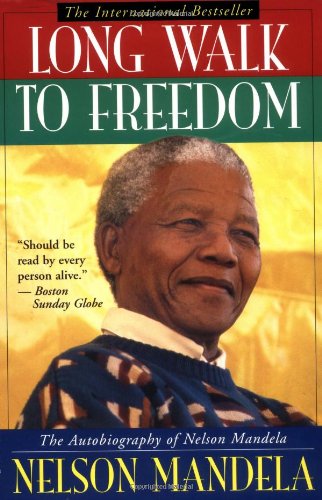
Long Walk to Freedom: The Autobiography of Nelson Mandela

Little, Brown and Company, New York, Boston, London 1994, 1995

Nelson

More of a history than a memoir, Long Walk to Freedom is the man’s detailed account of his extraordinary life. He seems to have lived every sort of life a man could live within the span of the twentieth century. Born an indigenous Xhosa, he was taken from his tribe at the age of ten and educated as a tribal prince. Then he moved to Johannesburg and lived in Soweto township. He was a laborer during the day and walked into Johannesburg in the evenings to go to law school. He was the leader of the ANC, a revolutionary, a prisoner for over two and a half decades and a beloved head of state.

Here is the story of a man who was a pedestrian for pretty much his whole life, hence the title, and a monumental human being.

If only David O. Lean were still alive.