Interior layout’s done, I’ve seen a mockup of the beautiful cover Heather Balchunas is doing for me. I’m very excited to share this object with you! I am planning to have copies with me when I read at the North Quabban Garlic and Arts Festival later this month, and following that, you’ll be able to order it online from this site (the price will be ten bucks) or if you see me around and about, I will likely have copies to sell with me.
I’m resisting making an ebook, for probably silly reasons, but that’s how I’m going to roll here. I much prefer physical media anyway. I think there’s something powerful about being able to hold an object in your hands, and to feel a connection to the maker of said object through the thing itself.
The book itself will contain 10 short pieces — three poems and seven stories — all on some point in a spectrum between nonfiction and fantasy. It comes out to 60 pages total, not counting the cover. My last bit of work to do before committing it to print is to make a copyright page, and that should happen in the next couple of days, I think.
And then it’s off to the printer. And then, if all goes well, you can get yours from me!
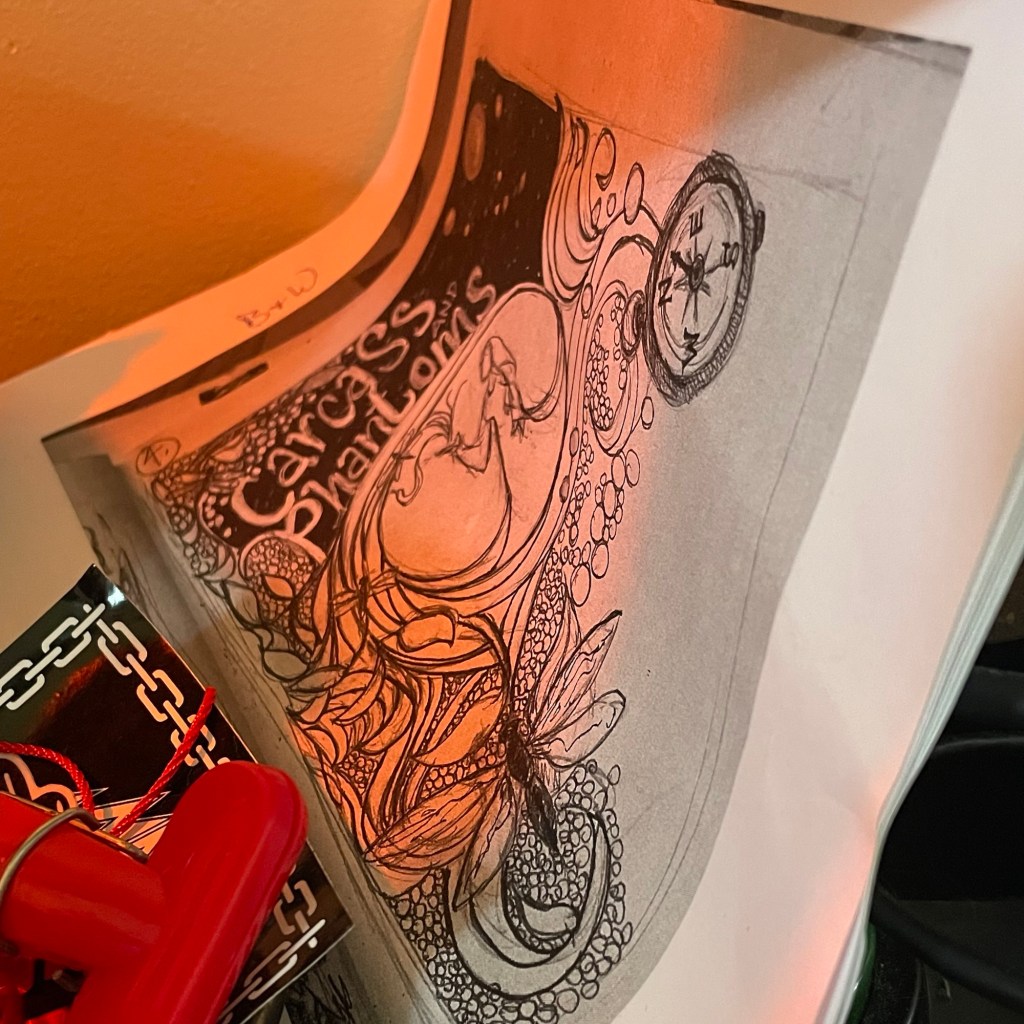
this is an early draft of the cover, printed out and “filed.” Photo by me, artwork by Heather.
Because even though I don’t really play music much any more, I still think of myself as a musician
I stopped playing music over a decade ago. Honestly, I stopped playing gigs another decade earier than that. The reasons for it were multitudinous, but came down to a few overarching concerns, some having to do with transitioning my gender (voice dysphoria) but others going to the simple fact that playing out was getting to be nothing but a grind, something I had little passion for… essentially, it was burnout. I went through a number of years when I didn’t even listen to music, preferring to just enjoy the ambient noise of life.
I’ve definitely returned to music appreciation now. I used to do all of my retail therapy at the record store. I’ve redeveloped that habit. A couple of years ago, I decided I wanted to have a working turntable again. I now have that, and I’ve just about tripled my vinyl collection since doing so. I’m considering a moratorium on buying new stuff, just so I can spend some time with the things I’ve picked up and decide on some favorites. I mean. I do have favorite things, and I’ve written about a few of them on this blog, but there are things I’ve filed away, having listened through them once or twice, that I want to make time to pull out again and listen on repeat, because that’s how you get things into your bloodstream and make them part of your internal soundtrack.
So I’ve been thinking about whether I should get back to playing music. I have no real interest in reconstructing my solo act. I was so tired of the lack of interaction with other players, of endlessly repeating the same songs in rehearsal and at gigs. One of the things I prefer about writing is that you compose, you perfect, then you move on. That’s not what playing music is like.
But it would be fun to have a group of humans to get together with on a regular basis and treat music as the social interaction it’s meant to be. I’m sure I would enjoy it, as long as it was somewhat low-key, done for fun, and kept away from the crazymaking that is also so much a part of being in a band. One thing I’d need to do to get back to playing is to update my equipment. Some of that is only worth doing once you know what sort of music you’ll be playing (some kind of rock music for me, but even that carries lots of variables) but I do find myself looking at various basses and guitars – mostly basses – that it would be nice to have and play.
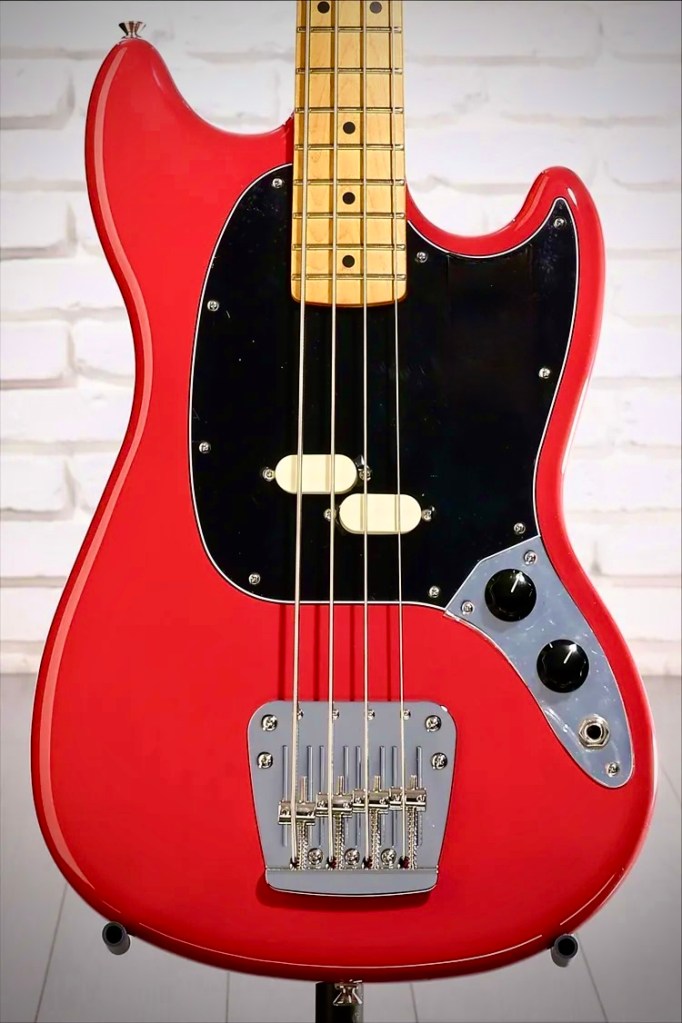
My top three basses to get would be a Stingray, a Thunderbird, or (and?) a Mustang.
My top guitars to get would be a Les Paul, a Martin 00, and a Mustang.
All except the Martin would be red with a black pickguard, ideally.
But the fact is, I don’t have any reason to buy any guitar. I have guitars. I have worked hard to retrain my creative impulses towards writing, for reasons listed above as well as a few others I’m not going to bother listing here.
There’s nobody around who is interested in making music with me. I’m not really pursuing it. It’s OK. I’ll enjoy music as a consumer/spectator, and keep putting my energy into writing, which suits my life and my interests better.
Please consider liking and commenting on this post. Subscribe if you can – it costs you nothing (you no longer have to have a wordpress account to like or comment) and clicking on the buttons helps this site thrive!Also, do be a dear and share this post with those you know who might appreciate it!
What? You’re expecting me to do things properly? Of course not.
Since I finished my MFA a hundred or so years ago, I’ve had this idea for a collection of stories and poems that sit close to, and on either side of the line between fantasy and nonfiction. It’s about as postmodern a concept as I can generate and bring to fruition, and I’m very excited to announce that I am about to be able to make the thing available for you, my readers.
The subject matter revolves around family history, the borders between worlds, tall stories and true ones, death, and magic.
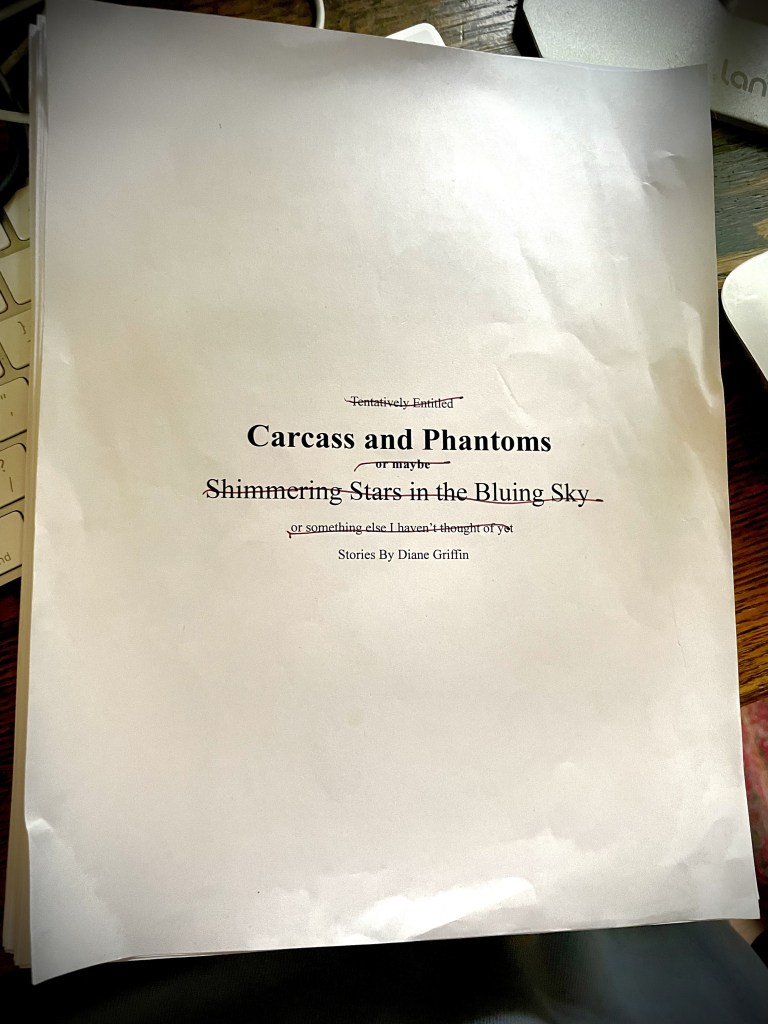
The title of the project is Carcass and Phantoms. I originally conceived it as a chapbook, but chapbooks are usually 32-40 pages, so Google tells me, and this will be closer to 80 pages. I thought I would call it a “double chapbook” for a minute, but then I decided that that sounded ‘way too chapped. I think I’m just going to call it a “thin volume” or maybe a short book.
I’m working with an artist and friend named Heather Balchunas whose work I adore and who is excited to be providing cover art. I’m proud to have her help with this little labor of love.
I’ll give you more news about this when I have it!
An earlier draft of the dealybob I’m working on. Photo by me.
Please consider liking and commenting on this post. Subscribe if you can – it costs you nothing (you no longer have to have a wordpress account to like or comment) and clicking on the buttons helps this site thrive!Also, do be a dear and share this post with those you know who might appreciate it!
I’m working my way through the Jethro Tull catalogue, one record at a time in chronological order. This Was was a shock to me, because it sounded like a different band entirely. All they changed, on the most physical level, was to switch out their guitar player. On a policy level, Tull became Ian Anderson’s baby. That narrowing and defining of leadership led to a huge expansion of the band’s artistic territory.
I can’t know this for sure, but I suspect that Mick Abrahams left Jethro Tull under a cloud. In the context of the band, he needed to be saged out of the space. Not to keep anyone in suspense or anything, but they 100% accomplished their goal. MA is pretty much a footnote in the Tull story, an early fork in the road. They become Tull as we know them on Stand Up.
In fact, by the third song on side one, the Brubeck-inspired “Bouree,” we’re already so far beyond the blues rock of what’s-‘is-name that the clock can never be turned back, and it becomes completely unfair of me to link everything that happens here to that guy.
But even though a listener who only had This Was as a reference point would feel his absence throughout, one would also hear the future. A great future. This album led to Benefit, and Benefit led to Aqualung, and everything that followed.
And Mick Abrahams could never have been the guitarist for Stand Up or any record that was made by Jethro Tull afterward. Martin Barre blows him out of the water, all while acknowledging that Ian Anderson is the boss. Where Abrahams wrote about half of the previous record, all of the songs here are Anderson’s, and collectively an upgrade from what had come before.
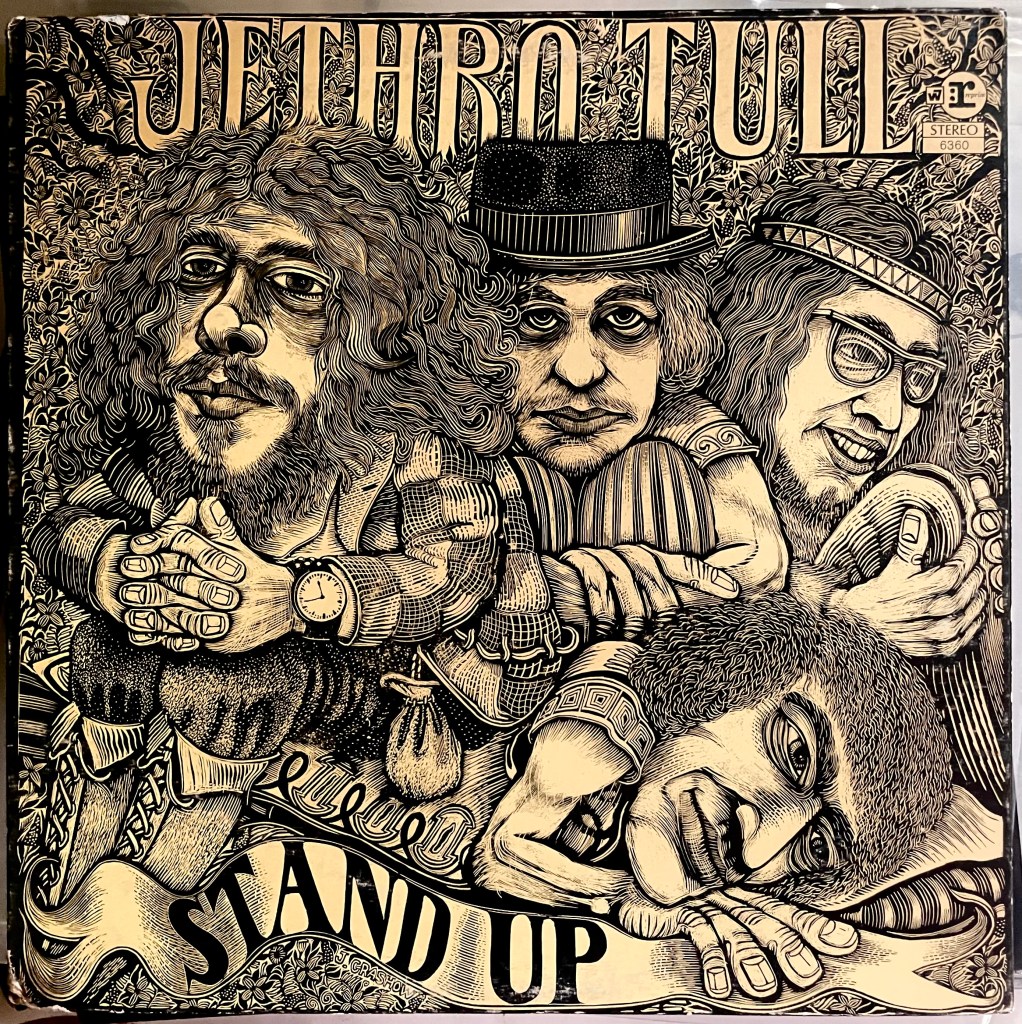
That’s Martin Barre in the middle, making eye contact with you. Hi, Martin! Photo of my copy of Stand Up by me.
While the Ghost of Mick hangs over this record, by the end of it, the listener is only looking forward, not backward. The band virtually never went back to the blues rock well from which This Was sprang.
And that’s what I like most about that time in rock music, bands grew and developed. Each new album was a chapter in the larger story arc. Taking a big chance such as completely redefining a band’s approach could be either a horrible disappointment or a thrilling expansion of what a band could be. It may be true that in most cases it would be the former, but in this case, it’s absolutely the latter.
So many bands went through these changes around that time. Yes booted Peter Banks in favor of Steve Howe. Genesis lost Anthony Phillips but added Steve Hackett and got Phil Collins in the bargain. In the larger context, the music was changing, but this round of changes seems to have codified things in such a way that they began to become stagnant. Less than a decade later, all of these revisions up in quality became an unassailable status quo which necessitated a revolution.
From this decades-later standpoint, one can see that things were both gained and lost amidst all the changes… as they always are.
Here’s to change. We all need it, from time to time.
Please consider liking and commenting on this post. Subscribe if you can – it costs you nothing and helps this site thrive!Also, do be a dear and share this post with those you know who might appreciate it!
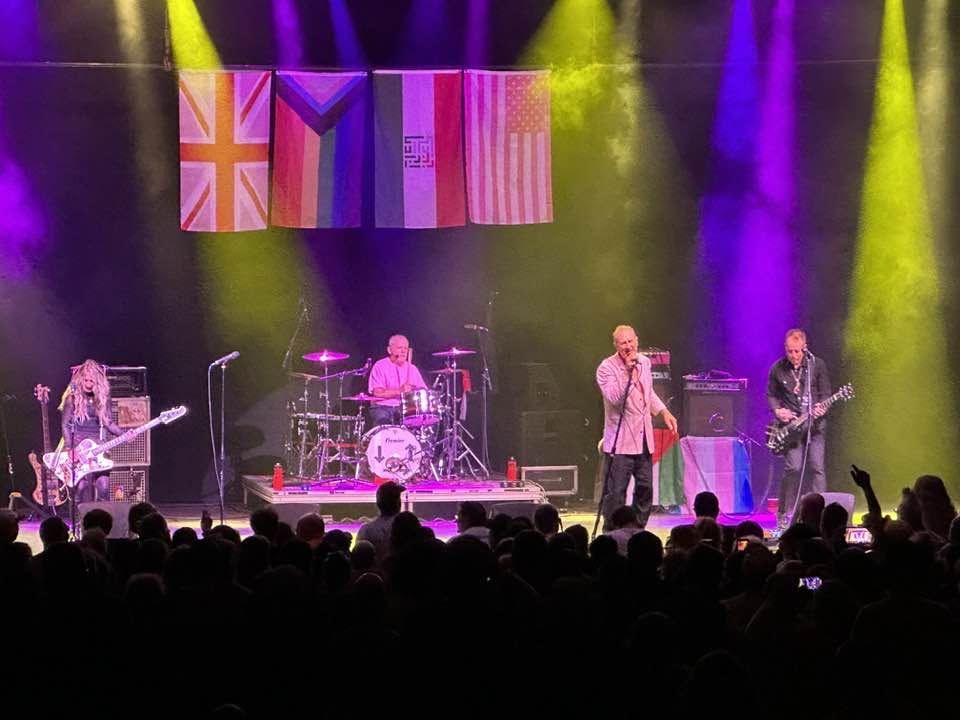
A rock show for this time, playing music that sends a message across the decades.
I have to start by saying that the State Theater is one of the worst-sounding music venues I’ve ever been in. Opening band The Downtown Boys, who I really wanted to like (and probably would on any other night) were absolutely unlistenable in that room. Pure sonic mud. They were passionate and political and clearly having fun up there on that stage (their saxaphonist/keyboard player is a hoot!) but if you played me one of their songs today and didn’t tell me who I was listening to, I’m about 90% sure I wouldn’t be able to tell you who they were. It was that bad. I apologize for not having the ability to form more of an opinion about their performance. I suppose I should make an attempt to learn more about them, and I will certainly try to do so at some point.
Regular readers (hah!) of this blog will know that most of the music I write about here fits under the “prog” umbrella, but it should be noted that I have had lots of years of music listening, and my tastes are quite broad. I have both obsessed about and reacted against more different music than most people hear in a lifetime, and in the fullness of time, I have probably both loved and hated almost every sort of music.
Gang of Four at the State Theater in Portland, Maine. Photo by Landi Michaels.
So when I tell you that this first-gen obsessively hard-left post-punk band, Gang of Four, hit the stage the other night, I about lost my mind. I LOVE Gang of Four. I am not rational about it (except, of course, that I have lots of thoughts about them, and have sorted through them at length) and I couldn’t help abandoning everything and just hopping up on to my spindly old pegs and DANCING as soon as they began their set. Their energy did not let up, nor did mine. Start to finish, they were amazing.
I found myself thinking about how, with four albums and a couple of EPs to their name, this band could play a full set that sounded like a high-level greatest hits comp, and they absolutely did! They didn’t play anything from their final album Hard. Frankly, that was no great loss. Give me those first three albums and the interstitial EPs and I’m all set.
And speaking of greatest hits: I know it’s a standard set piece, but Jon’s very rhythmic whacking of a microwave oven with a baseball bat was extremely satisfying. In fact, that was one of the many moments of cultural resonance that came with the set in general. There was a feeling in the air that what Gang of Four was offering from the stage was medicine, that every note and nuance was there to counteract the effects of fascist evil. It was a utopian moment in time for that very reason.
And it was also the band saying goodbye. Original band members Jon King and Hugo Burnham have said that they won’t be bringing the band out on tour again, that they’re closing the book on headlining tours. I’m grateful that I got to see them. I haven’t been able to get to any of their shows before, no matter how much I love them, but this moment seems like the most impactful time to have come to their positive, warm, anti-fascist performance. It is fuel, which I suspect is what they want their music to be.
Finally, I want to shout out Ted Leo and especially Gale Greenwood who did a great job of filling giant shoes. Gale especially was having a great time on that stage, bouncing around and clowning and holding down that very heavy beat along with Hugo. She was a great addition to the show. (I just learned that my friend Linda Bean Pardee played bass with Gang of Four before Gale! Hey, Mikey!)
Also, Hugo took a few moments at the end of the night to shill for Graham Platner, which I greatly appreciated.
Please consider liking and commenting on this post. Subscribe if you can – it costs you nothing and helps this site thrive – and share this post with those you know who might appreciate it.

 Broadcast From the Brain Radio