Ameleks

Sometimes the world won’t leave me alone.

The other night, I woke up from a dream about Netanyahu callling the Palestinians Ameleks, and how that was a justifucation for destroying them. I did something I almost never do, and came into my office, got on my computer and searched the term “Amelek.” Here’s what I learned:

The Torah and the Old Testament say that when the people of Israel were walking through the desert to return to their own land after being delivered from slavery in Egypt, they were attacked by the Ameleks. This act made the Ameleks the enemies of God, in the eyes of the Hebrews. But then, they thought that God himself had created the Ameleks to cause the Hebrews misery. It’s all very confusing and contradictory, but that’s how they thought.
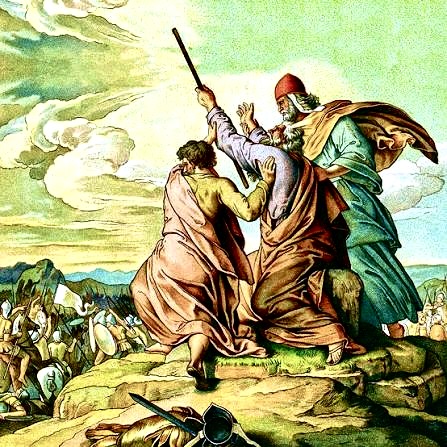
In the Bible/Torah, it says if Moses kept his staff held high while the battle continued, the Israelites would win. If he let it drop, the Ameleks would win. Aaron and Tur helped Moses keep his staff high. This is not in any way superstition or homoerotic symbolism. Get your minds out of the gutter, heathens.

The Ameleks were a nomadic people who mostly lived in and around Canaan, which is in the southern part of modern-day Israel. They had moved into the area because of the void left by the Hebrew tribes being enslaved in Egypt.

“Amelek” is what Netanyahu and other Israeli leaders have called the Palestinians. The Israelis think the Palestinians are the enemies of God. It doesn’t matter, though, because the Palestinians can’t be the Ameleks, because, over the course of generations, thousands of years ago, the Hebrews wiped out all the Ameleks.

Somehow we need to turn away from the path we’re trundling down as a species. We’re fixin to kill the world and ourselves with it if we don’t straighten up. The ideals and morals of the ruling class of this time are bereft of value and actively destructive. We have to change course.

And patterning behavior after tribal disputes from thousands of years ago doesn’t seem like a very good way to conduct ourselves. Especially when those tribal disputes ended with the death of an entire people.

Please consider liking and commenting on this post. Subscribe if you can – it costs you nothing and helps this site thrive! Also, do be a dear and share this post with those you know who might appreciate it!
Books I Like #5

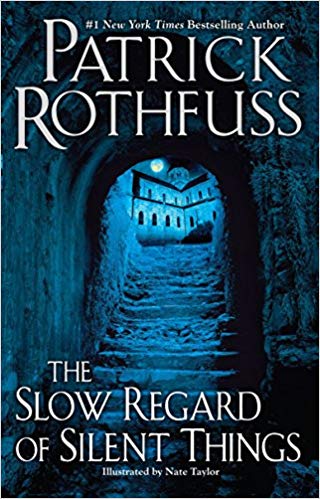
The Slow Regard of Silent Things by Patrick Rothfuss, Illustrated by Nate Taylor

DAW Books, New York, 2014

Slow Regard

Patrick Rothfuss has been working on the Kingkiller Chronicles for long enough that it’s almost reasonable to call it his life’s work. The first two books in the series, The Name of the Wind (2008) and The Wise Man’s Fear(2011) are as good as epic fantasy gets: character-driven (and what characters!), in a vividly realized world. It’s the story of a brilliant, romantic boy who has lost everything and then found purpose in life again, framed with an older version of the character, who is in hiding, having caused a slow-rolling, ongoing disaster from which he cannot entirely escape. We have no idea what that disaster is, because Rothfuss saved that reveal for the third and final book, which he’s still working on.

Rothfuss is a hugely talented writer, and apparently meticulous in his process. I feel quite confident that when we do finally get that ending, those of us who are eagerly awaiting it 8 years later are going to be blown away, because everything he’s written has done this already.

So, in the midst of our wait for that third book, to be called The Doors of Stone, Rothfuss has written a couple of interim pieces set in his world, which is called “The Four Corners”. There’s a short story about a supporting character in the later time frame, and TSROST, which focuses on Auri, a character known to Kvothe, his first-person narrator in the two previous books, from his time at The University.

Auri’s a former student at the University, who studied alchemy, and whom magic has broken in some way that we still don’t (and probably will never) know. She’s the only character in the book, though it’s the nature of Auri that she would disagree with that statement, and that’s at the heart of this story.

I’ll go no farther in describing it than to say that some hate TSROST because they think it has no plot. I disagree, though the throughline here is extremely subtle. It’s my favorite of his books. I think the writing is luminous.