What are the Final Four?

Deciding the contestants.

Here we go. I’m just going to go through the pile first and decide “no” or “maybe.” No yesses yet.

John Wesley Harding is a huge influence on me. Gorgeous record — one of the things I found inspiring was just the atmosphere of the thing. This one’s a “maybe.”

Absolutely Free is the one of the original trilogy that I’m least familiar with. I have copies of Freak Out and We’re Only In It For the Money. Both of which I like very much. Still, I’d have to seek out Absolutely Free on Youtube to hear it, which somehow seems less of an authentic way of doing this battle. I think they all have to be CDs so that format doesn’t affect my thinking. This one’s a “no.”

Piper at the Gates of Dawn is also a super-monolithic album for me. There are several Floyd albums that I rank as approximately equal to this one in value, And this is a first-tier Pink Floyd album. I’m going to call it a strong “maybe. “

Françoise Hardy’s Ma Jeunesse Fout le Camp might be of insterest. I think it’s a no but I definitely need to look it up. Her first album, Tous les garçons et les filles is one of my very favorite records. But for now, she’s a “no.”

Days of Future Passed is an album I’m less familiar with, but I’ve been listening to it quite a bit, lately, and I might just include it. Officially a “maybe.”

Disraeili Gears is the state-of-the-art heavy album of its time. It’s also a great psych album and a great blues/rock album. Very boy. “Maybe.”

Interstellar Space shocked me when I first heard it. This is avant-garde jazz at its most out-there. It is astrology-inspired free jazz made by a duo – Coltrane and drummer Rashied Ali. This is a strong “maybe.”

I think this The Nice CD is unlikely, unfortunately. Not a contender, I think, considering what else there is on this list. Still, I’m going to list it as a “maybe.” I think there are probably things I have more to say about, for instance —

Revolver. Quite honestly, I think this is the greatest rock album ever made. I’m listing it as a “maybe” but I am so tempted to just call it a yes. Spoiler alert, I guess.

Smiley Smile is as important to my sensibilites as a music fan as John Welsey Harding. This is also a maybe.

Of the two Byrds albums, I think I’m more likely to have something to say about Younger that Yesterday. Sweetheart of the Rodeo has been written about way more, and I resonate more with the psychedelic touches of YtY, so I will pick that over SotR.

So the “maybes” are

  • John Wesley Harding
  • Piper at the Gates of Dawn
  • Days of Future Passed
  • Disraeli Gears
  • Interstellar Space
  • Revolver
  • Smiley Smile
  • Younger than Yesterday

So let’s do brackets…

Bracket One: JWH v YtY. I’ll go with John Wesley Harding.

Bracket Two: Piper at the Gates of Dawn versus Disraeli Gears. I’ll go with the Floyd.

Bracket Three: Interstellar Space versus Smiley Smile. I’ll go with Smiley Smile. EDIT: Having trouble finding my copy on CD. Might have to go with Interstellar Space instead.

And finally…

Bracket Four: Revolver versus Days of Future Passed. I think I have more to say about that Beatles record. Maybe I’ll do a consolation battle…

But the official choices for this battle are:

Bob Dylan – John Wesley Harding
Pink Floyd – Piper at the Gates of Dawn
The Beach Boys – Smiley Smile
The Beatles – Revolver

Coming next: The Big Battle.
Annotated Short List for Album Battle 1967.

I’m gunna do an album battle. 700 words max.

  • The Beatles – Revolver. This one pretty much has to be in.
  • The Nice – The Thoughts of Emerlast Davjack. I need to hear this one a couple more times before I decide whether or not to include it.
  • John Coltrane – Interstellar Space. fabulous free jazz. Do I like this better than A Love Supreme?
  • Cream – Disraeli Gears. Perhaps the epitomy of heavy psych.
  • The Moody Blues – Days of Future Passed. Gorgeous record.
  • Pink Floyd – Piper at the Gates of Dawn. See Revolver.
  • Frank Zappa – Absolutely Free. Don’t have this one, though I’m sure I could rustle up a copy if I really wanted to.
  • Bob Dylan – John Wesley Harding. This one is a near-certainty. Very influential to my songwriting.
  • The Beach Boys – Smiley Smile. This album is one of the weirdest, yet most beautiful recordings ever made.
  • The Byrds – Younger than Yesterday. Chris Hillman’s last album with the band.
  • The Byrds – Sweetheart of the Rodeo. Gram Parsons. The one that usually gets written about.

I will narrow this list down to 4. That’s my next post.

10/28/24

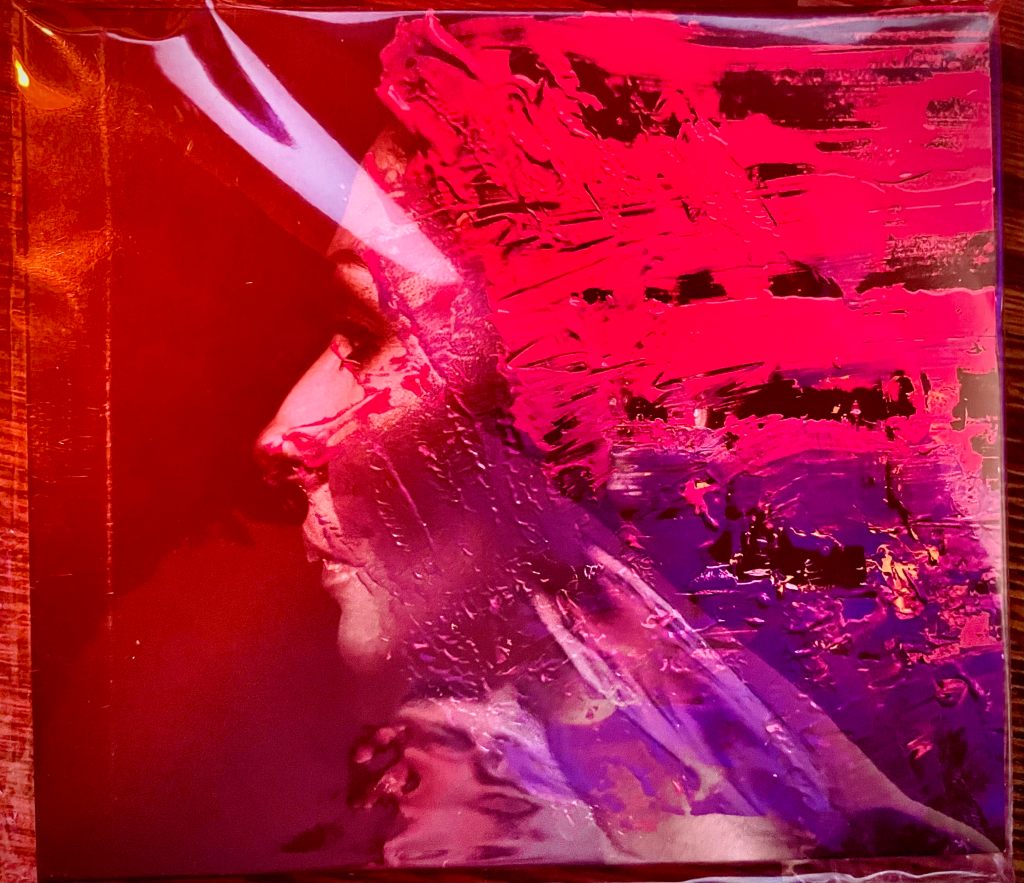
I’m listening to Hand. Cannot. Erase. by Steven Wilson and it’s a remarkable experience.

My copy of Hand. Cannot. Erase. by Steven Wilson

It came out in 2015. Wikipedia tells me it’s his fourth solo album, since deactivating Porcupine Tree after the less-than-successful The Incident (an album I liked, though they’ve made better.)

This album is proggy af. Synths, time signature shenanigans, lots of notes, two 10+ minutes-long tracks… and yet it feels contemporary. If Classic Rock™ were still a thing as of 10 years ago, this album would definitely qualify. I hear the influences, and the originality. This is a Contender, an album that should be in the pantheon.

I’m listening now and it soothes me. The election THE GODDAMN ELECTION is 8 days away and I have little hope that things are going to be OK. There is a charismatic cult leader openly running for president, describing the fascist policies he intends to implement publicly, and the supposed “normie” (but also authoritarian and a genocide) alternative is barely hanging on to a lead in the current polling. The only person in the race whom I think might have a chance of setting this country on the right path has absolutely no chance of winning. It’s a scary time.

But this album is good, thoughtful, and human. The playing here reminds me that there is virtue in people, and that that virtue… great musicianship, great music production, a clear eye expressed in the lyrics of these songs, originality… can still happen.

Steven Wilson gives me hope.

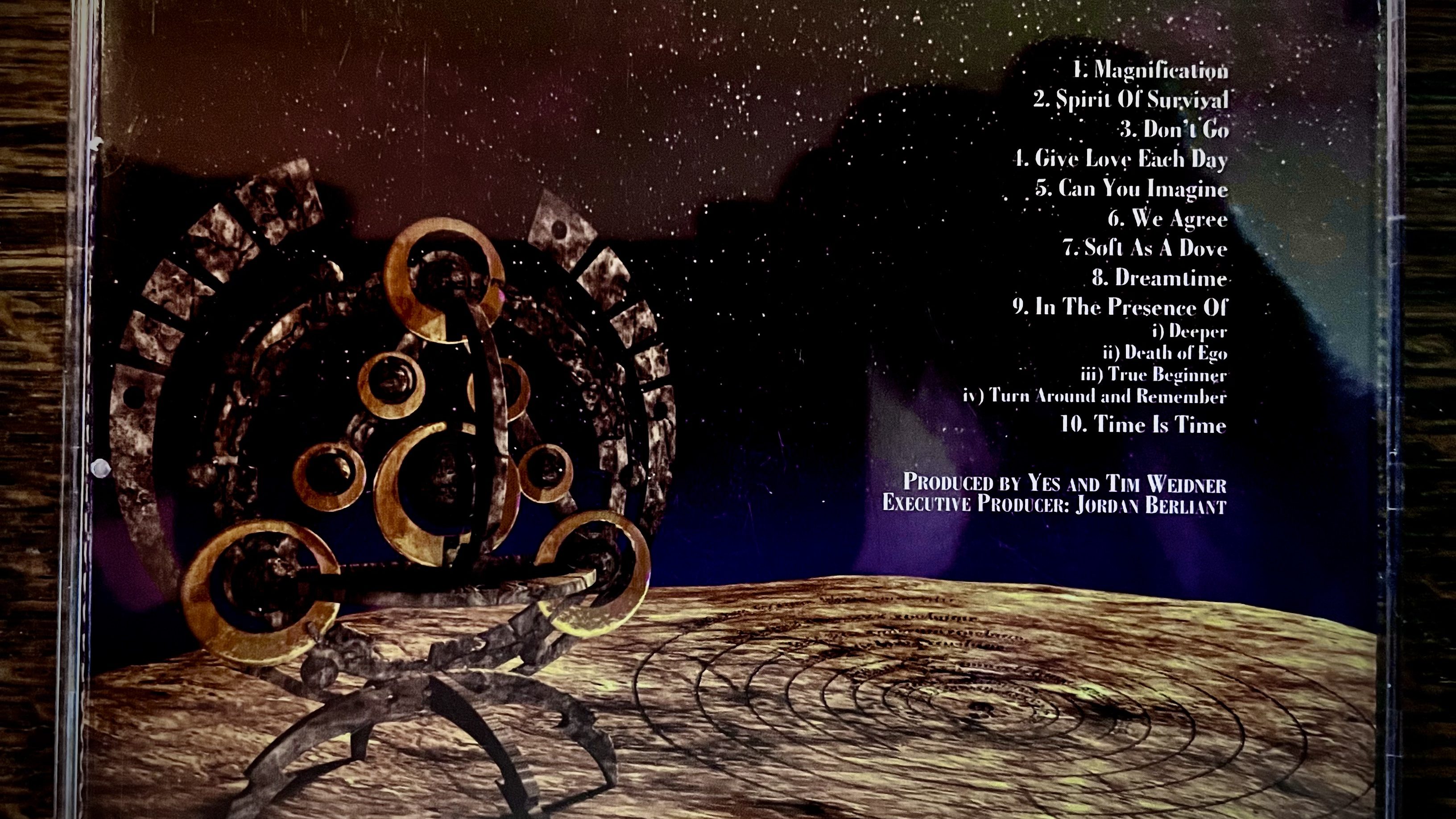
Object 9: Yes — Magnification CD

Jon Anderson’s last album with the band

As noted in my previous post, these days when I go to record stores, I’m combing the racks for prog cds. This is often frustrating, as most of the music I’m interested in is a bit too esoteric for the typical used record store buyer to take a chance on, or there were few enough of a particular album pressed that they just don’t show up much.

Therefore, I bought my copy of Yes’s Magnification online, which is fine, as I think it unlikely that I would find a used copy.

Writing about music is challenging for me, as there are only so many hours in the day for music in my life, maybe only one or possibly two hours in a typical weekday. I have minor audio processing issues, so it’s hard for me to sort out two different audio sources at the same time, especially when it comes to music. It never fades into the background for me, which makes it difficult to focus on anything else, especially if the music has a lot of movement, or strong emotions, or lyrics that need to be focused on. If I’m listening to music, I can’t also be writing. I have to pick one or the other.  It’s just the way my quirky brain works.

As a result, I don’t have the encyclopedic knowledge your average music writer is expected to have, and it’s hard to speak with authority about a band’s work if you don’t know all of it, if you don’t know biographies of the various musicians involved, or their connections to other bands, etc. This is especially true of a band like Yes, who have been active for well over 50 years, who seem to rotate members in and out every album or two, and when they have, at this point, 23 studio albums, multitudinous solo albums by various members past and present, and other bands that various members have played in either before, during, or after their time in Yes…

I’ll pause here to note that lineup changes are such a constant that there are no original members still recording and touring with Yes at this point. The closest is Steve Howe, who has been with the band on and off since their third album, and having been out of the band for pretty much all of the 1980s. Sendond longest-standing member of Yes currently is Geoff Downes, whose first album with the band was Drama (1980). It’s probably worth discussing whether or not the current band calling itself “Yes” is really Yes, Since nobody there now was there when the band was named. Maybe I will sometime.

Magnification is their nineteenth album, the last one to feature the majority of Yes’s creative main lights. Singer Jon Anderson, guitarist Steve Howe, and bassist Chris Squire are all on this CD, as is Alan White, their longest-standing drummer, who came into the band when Bill Bruford moved on after their fifth album Close to the Edge. Magnification is the only Yes album to not have a keyboard player, and their second to utilize an orchestra, the other album to do so being Time and a Word, their second album. The orchestrations on Magnification are by Larry Groupe, and they both serve as a replacement for a keyboardist, and also stand on their own as orchestrations with their own identity.

The space that the orchestrations take in the recordings present a problem, making the sound a bit muddy – too many of the strings and winds occupy the same tonal space as instruments already in the band, the way that they recorded the orchestra gives each of the acoustic instruments too much presence. Guitar lines get lost in the mix, Squire’s normally bright, spritely bass lines are dulled because the instrumentation is so extra that they have to minimize the punch that is so much a trademark of the Yes sound. I believe that this is also a criticism laid on their previous orchestral record, though it was original guitarist Peter Banks and organist Tony Kaye that were pushed to the side then.

To my mind, Magnification harks back to Time and a Word, back to the fundamentals of the band, yet marks the years of the band’s growth. I like both Magnification and Time and a Word, the performances themselves are up to the Yes standard, and the songs on each are emotive, complex, yet more concise than the band’s most expansive work. Another treat here is that Chris Squire sings lead on “Can You Imagine,” which will remind the true Yes fan of Squire’s one solo album Fish Out of Water (my favorite of all of the myriad solo albums by Yes members) which, incidentally, is another rare example of orchestral Yes-related music.

There are still a few of the latter-day Yes albums that I haven’t gotten around to, and others that just aren’t that great in my opinion. Magnification’s songs are engaging, and for once, sixty minutes of new material created with the extra expanse of a CD in mind doesn’t cause me to pine for the more concise albums of the vinyl era.

I think Magnification, while not without its problems, ranks in the upper echelons of the band’s recorded output and therefore gets spun regularly during my valuable listening time.