Genesis – Trespass

1970: the year Genesis figured out who they were, and then were forced to evolve again.

The lineup for this album is Peter Gabriel, Tony Banks, Mike Rutherford, Anthony Phillips, and John Mayhew. This is Mayhew’s only album with the band, and Anthony Phillips’ last. It’s the band’s second. I have to say, it casts a spell.

My reissue copy of the gatefold sleeve. The cover’s janky but the vinyl is unblemished.

Trespass is the album that would establish Genesis as one of the world’s very best prog bands — it’s the template for much that came later. By the same token, it follows the template set by In The Court of the Crimson King, Time and a Word, and The Least We Can Do is Wave to Each Other while remaining distinctly a Genisis album.

Anthony Phillips is a more Steve Howe-like guitarist that Steve Hackett is. He’s a classical guitarist, which, granted, Hackett also is, on occasion, but of the two, I think Phillips has a slightly more delicate touch. I admire Phillips’s early solo work very much. this album is packed with some very out-front melodic ideas from Phillips, and Tony Banks has a lighter touch. The general aspect of the band is spritelier.

Peter Gabriel is front and center, as stong and evocative a singer and master of ceremonies as anyone could ask for, a great rock performance centerpiece fully realized, with that trademark sweet, honey-and-cigarettes baritone and finely tuned theatrical sense… And he was so young! He was quite fey on those early records, was he not?

The band also feels more balanced than it did later. At least it’s a *different* balance. Later albums would shift the sonics of the band more towards Banks being dominant, and new guitarist Steve Hackett was often treated like a “junior” member of the band. I wonder what a second or a third album by this lineup would have sounded like if Phillips hadn’t become ill and if Mayhew had found his way into the social circle of the band?

I own this one on CD and vinyl. I seem to be moving towards owning multiple copies of certain records. I also seem to be lacking storage space. I will need to address this issue at some near-future point. Something’s gonna have to give.

I like likes, love subscriptions, and crave comments.

Neon Heat Disease is my jam

What would an all-yankee King Crimson sound like, you ask? Here’s the answer.

Belew/Levin/Vai/Carey

Not to limit myself to a single answer to this question, but Beat is my favorite currently-active band. I hope (they’ve hinted) that they’re working on an album of original music. The primary work here, covering the music of King Crimson’s 80s ouvre, lends itself to a lot of things that I resonate with in terms of a creative approach to rock music.

They have the deepest pocket of any rock band I can think of, and I love their mathy-ness. They’re algo-rhythmic®! I hear the Beatles in this music. King Crimson’s next phase would be more overt about the connection, but the basic sonics of this band harken back in the melodicism, the collaborative writing process between Fripp and Belew, and the exacting approach to arrangements.

On the other hand, I can note the similarity of “Neon Heat Disease” to “Neon Meate Dream of a Octafish” by Captain Beefheart and his Magic Band off of Trout Mask Replica. So.. is 80s Crimson a perfect amalgam of Revolver and Trout Mask with a forward-looking technical bent? I think the case could be made by plunking the needle down on this album.

Tony Levin is the second vocalist on this, and he’s also taken over keyboards from Fripp. He also provided many of the photographs of the band that grace the inside of this triple gatefold and booklet. His presence in this re-imagining of the original music is vital to its success.

Steve Vai’s replacement of Fripp works because there’s a line he treads between copying and originating. He has to honor that huge presence that would otherwise be missing without disappearing as a separate entity. One early indication of how he approached this is his solo in Heartbeat. It sounds like electric erhu. That’s a really cool way to interpret Fripp’s playing and take it somewhere else entirely at the same time, by adding an unexpected third element. There’s nascent world-music ambitions in the 80s Crimson music sourced here, and adding sonics that suggest new contexts is absolutely in keeping.

What Danny Carey adds most significantly here is that he plays all of these songs on a set of acoustic drums. I think the music from the later source albums is greatly improved by this one change. I don’t recall seeing any electronic drums in Carey’s setup from the show (you can correct me if you know different) and the essential liveness of the sounds he provides raises all of the music from the second and third albums up to the sonic level of the first album. I get that Bruford wanted to push the envelope on the sound palate he was using, but this live recording makes an excellent case for the irreplaceability of percussion sounds coming from skin and bone, not curated electrons.

This is one of my most important objects from my move back to analog music. I love vinyl in all its machine-age glory. Carey’s drumming here is evidence for my case. Music must be made by flesh and bone and all of the worldly materials. I fully believe that, and here’s some strong evidence.

Thanks for reading! If you enjoyed this, please leave a comment and a like, and as always, subscriptions are welcome and encouraged!

The Texts of Yesterday

A show-and-tell by Diane Griffin

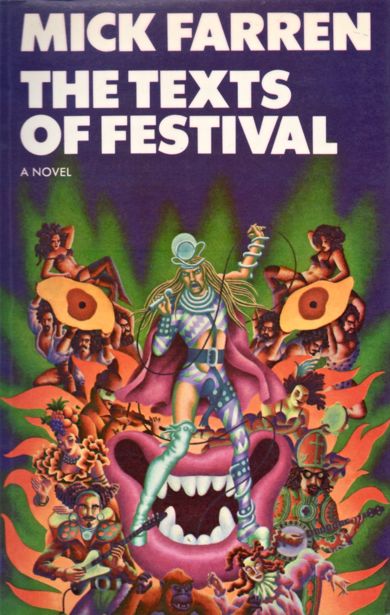
Mick Farren published a dystopian science fiction novel called The Texts of Festival back in 1973. From that vantage, he saw a doomed, far-future world where people worshipped Gods with names like Dhillon, Djeggar, and Morrizen the Lizard King.

When I was a kid back in Yuma, Arizona, there were some of my brother’s friends who had both a cover band and a Kiss tribute band called “Kiss Theatre.” The cover band was the thing they cared about, but on occasion, for parties, they would wear all black and put on Kiss makeup and play a set of Kiss’s songs. When they did that show for the first time, people talked about it for weeks afterwards. The Yuma Daily Sun wrote about them.

 It seemed to me that these guys in Kiss Theatre considered it a schtick. It was too unserious for a band with larger ambitions. Even playing a set of hits-of-the-day was more dignified and relevant than pretending to be a famous band and doing a knock-off of their whole concept, regardless of the extra attention it garnered them.

I agree with them. If I were to start a band now, I think I would want to do mostly or even all cover songs, but I would not want to pretend to be someone else. I understand that people want familiarity, but I think – maybe I only hope – that they also want authenticity, some kind of connection to the artist they’re in the room with.

I’m not a purist about this, however.

Standing just on this side of the line is the band Beat, which is half members of the 80s version of King Crimson, half the two highest-level “ringers” there could possibly be. I saw Beat last year and found the show transcendent. They don’t call themselves King Crimson, as lead guitarist and founder Robert Fripp is not involved.

They ‘re often called a “tribute band” in the press, even with the involvement of two original members. Guitarist Steve Vai – one of the ringers — has taken great pains to learn Fripp’s original parts but adds as much of his own style as he can without breaking the vibe. Is this a tribute to or a continuation of King Crimson? I’m hoping for a CD of new original music, which would tip the scales away from “tribute band.”

Let’s move a little closer to that line between “tribute” and “continuation.” You may have heard, in a previous rant of mine, that the current touring and recording version of Yes has no original members. Another whole band playing this music exists. Jon Anderson, founding member of Yes, has done a couple of tours, a live album, and an album of original music in the 70s Yes style with a youtuber band called The Band Geeks. I think Jon and the Band Geeks are much truer to the spirit of Yes than Steve Howe’s band. So which is the tribute, really?

There are ways to put a twist into the notion of a “tribute band” without crossing the line. For example there’s Lez Zeppelin, the all-female Led Zeppelin tribute band, who play faithful renditions of the Zeppelin catalogue, without switching the gender of the original lyrics or toning down the cock-rock attitude.

I have friends who do a B-52’s tribute under the name Bikini Whale. They’re a straight-up note-for-note copy of the original, entirely competent and, to be fair, as high energy as the records. I roll my eyes at them, though. I’ve also talked to guitarist Kevin Coombs about some of the more technical aspects of what he does, and it’s clear he’s done quite a bit of research into the peculiar alternate tunings and gear the original guitarists – Ricky and then Keith – used to get the distinctive, and not-as-simple-as-you-might-think sound of the B-52’s. I admire the effort involved, but it makes me wish they would devote that energy to putting something new into the world.

Surprisingly, there are still a lot of rock music fans. However, what used to thrive on adventure and innovation seems to be made for comfort or identity confirmation now. The biggest touring bands have been around for forty, fifty, or sixty years. The guitars still scream, the singers still smile or snarl, with dentures to fill in for all the missing teeth.

Soon, there won’t even be that. All that will be left is the texts, the worshippers, and the tribute bands.

I Went to RPM Fest For a Day and Survived

By Diane Griffin

Music festivals – all sorts of festivals, really – are tiny, temporary utopias. One of the reasons I love them is the feeling that the rest of the world has faded into insignificance, and that the enclave you’re in can feel like the whole world. Food and camping and junk for sale in the vendors’ tents and artist’s booths and whatever else turns up make it seem like everything you need is right there.

We could talk about port-a-potties, which I think are the biggest drawback to the experience, and there! they have been mentioned, and we can move on quickly now, as one does when port-a-potties are involved.

If anyone were to notice this old trans lady at all at this event, my hope is that they saw me smiling, dancing, or walking back and forth between the two stages at opposite ends of the Miller’s Falls Rod and Gun Club. This isolated clearing in the woods is, in my opinion, put to its best use on Labor Day weekend. For that brief window in time, it’s filled with people of multiple generations and genders in black t-shirts with various outré images and bits of text printed on them, under multifarious unnatural hair colorations at a variety of uncivil lengths. The sweet smell of zaza wafts through the air everywhere.

It is a metal fest, after all.

This is the second year that I’ve attended RPM Fest Heavy Music Campout in Montague for as much of Saturday (the longest day of the festival) as I can endure. I love the atmosphere, generally love the music (not every band is to my taste, of course) and I feel a twinge of gratification for the fact that I’ve gone and done the thing.

Both years I’ve gone, I’ve skipped out before the headliner because I never want to contend with a crowd all trying to exit after that last act, and because these old ears and legs can only take so much. This year I missed Ghoul and last year I missed Prong. I feel some smidgeon of regret for missing the headliners, but it’s negligible pain compared to how my knees feel by 9 PM, after a long day spent mostly on my feet.

So what about the music? I think a festival is always going to be a mixed bag. I saw bits and pieces of sets from 12 different bands while I was there, and nothing offended me, but there was a stretch in the middle of the day when I found most of the music rather unmemorable.

There was this band Goblet that was doing the “Wacky Party band” thing. The bass player was wearing a shaggy hat with giant Viking horns, there was a cobbled-together sculpture of a pot pipe at the side of the stage made out of PVC tubing and an aluminum funnel, lit and smoking through the whole set. What I found most memorable about them (and this is emblematic of the spirit of the festival) was when the singer had two roadies bring out a big ice chest. While he was singing, all death growls and indecipherable lyrics over blasting chugga chugga guitars, he made a bologna sandwich, which he put on a plate and handed to an audience member. That was the finale of their set.

Death growls and niceness.

Among my favorite bands were Concrete Ties, a local hardcore punk band with a powerhouse female singer named Leyla Eileen, who was completely riveting onstage. I could not take my eyes off her as she prowled around, growling and exhorting the audience to rock.

I thought Mean Mistreater were great, high-powered 80s style metal with another fierce woman vocalist with clear and powerful tones, and a talented lead guitarist. A little research after the fact suggests that their name may have come from a Grand Funk Railroad song, and the strains of classic hard rock also flowed from The Atomic Bitchwax, a band that sounds like they’ve studied hard over every one of Grand Funk’s records.

The other two bands I enjoyed most are Coma Hole and Heavy Temple. Coma Hole is a two-member band: a fine drummer and a bass player who has an extraordinary setup. She plays a stereo bass and sends the two channels through different amp setups, one for the low tones and a separate channel which, on the other side of an octave pedal, goes through a massive guitar amp. All her gear is vintage and sounds amazing. Their music is psychedelic stoner rock with a deep vein of Nirvanna-esque grunge rock running through it.

Heavy Temple is a three piece stoner band who sound like they stepped out of a time machine from 1969. Their guitarist, Lord Paisley, is Hendrix-inspired, uses a fair amount of wah wah pedal and super-sludgy distortion. Their singer/bassist is High Priestess Nighthawk and she is another commanding presence. Drummer’s name is Baron Lycan. I know this because I happily purchased both of their albums and have referred to the liner notes as I’ve spun them.

I love the thread of fantasy that runs through so much of metal music. Of course it calls to me, as a writer of fantasy. It gives an air of freeness and imaginations allowed to run wild.

It’s not lost on me that almost all of the bands I liked best have women singers. There are many reasons for this, but I think I’ll list one here: I think the women are more likely to sing “clean” as they say, though there are certainly plenty who use death growls. I’m not opposed to death growls per sé, though I’m not as enamored of them as most of the younger metal fans are. I have learned how to produce that sound myself.

I did notice that every male singer I saw that day used death growls, with the exception of the two guys in The Atomic Bitchwax. Special mention here for the band Necropanther, who had two growly singers, one who pitched a little higher and one who pitched low. Death growl harmonies, anyone? I know where you can get some of that!

I spent a day in a far-away magical bubble world, and it was fine. It made me forget that there are people in the southern distance who are toiling to take this all away from us. I saw other people my age at the festival. I saw other trans folk there. Both sets of examples helped me feel like I was a welcome part of this ephemeral, idealized landscape.

I’ll go next year, too.

Best of 1967 battle

In which we learn more of my opinions about sixties rock.

John Wesley Harding

Recorded while Dylan took a break from The Basement Tapes sessions. Many consider it to be part of the larger project. This is Dylan at his most mythic. “I Dreamed I Saw St. Augustine” is begging me to cover it.

I love how the last two songs sound almost like a different project, but serve as perfectly seasoned representation of what I think is the central conceit of the collection. One way to look at the album is that there are ten philosophical predicate songs and that the last two are the full expression of the philosophical explorations in action.

The work here is a sort of bridge from that early-sixties era of great experimentation and rapid development represented by his previous 6 albums towards something a little bit more sustainable and relaxed. It still has that romantic, poetic drive but is at the same time more low-key and, I think, more musical.

Charlie McCoy’s bass playing throughout this record is some of the most breathtaking I’ve heard. A top-notch Nashville cat™ on mouth harp, his bass playing perfectly captures the spirit of discovery and freedom that lies at the heart of this clutch of songs.

  • Listenability: 9
  • Cultural Value: 6
  • Personal meaning: 12
  • Technical value: 7
  • Fuck the Establishment value: 3

37 out of 40

Revolver

I have in the past, it must be said, proclaimed this the best rock album ever made, and today I stand by that proclamation. So why am I doing an “album battle?” I think because of the significance of Revolver, the real battle is for second place. What do I think is the second best rock album that happened in 1967? Also, I love and have much to say ’bout this ‘un.

I love the 14-song version that has all of the John songs restored (and is much better for it!) I also have a two-disc version that includes the concurrently-recorded non-album single, “Paperback Writer” c/w “Rain,” but for my purposes here, I will listen to the “British version” single CD that I have had for years.

This is the tightest they ever were as a band and the Ringo/Paul duo has a HUGE amount to do with this era of the band’s musical success. Paul had (still has) a fantastic ear to go along with his expressive, melodically inventive playing, and Ringo unfailingly found the right strokes and was perhaps the best drummer around at editing his compositions. There’s not an extra move anywhere in his performances on Beatles records. The combination of the two and their ability to lock in together hits its absolute peak at around this time.

I also love all of the vocal work on this album. John’s ‘harmonies’ on “Yellow Submarine” are hilarious, and really, what makes all of the vocal performances here so compelling is the personality of the four singers. These are four guys with massive star power, and that presence comes through with great immediacy through these grooves some 58(!) years after they were recorded.

I also advocate for the consideration of Revolver as the very first progressive rock album, with its odd time signatures, horn sections, string quartets, tape loops and sound collages, while maintaining the feeling of an extraordinary rock band playing together, which is why I class this album abover Sergeant Pepper’s Loney Hearts Club Band, along with my sense that this is simply a better collection of songs than either the previous or subsequent Beatles album.

As an example, it contains a perfectly-constructed morning raga in George Harrison’s “Love You To,” which is compressed a bit to fit into the 3-minute pop song format this album adheres to, but which could just as easily be stretched out to the half-hour plus rendition inclusion in a performance of such music would cause it to be formatted as.

This whole album is just… pop perfection.

  • Listenability: 10
  • Cultural Value: 6
  • Personal meaning: 12
  • Technical value: 9
  • Fuck the Establishment value: 1. Dude. They were the establishment.

38 out of 40

Piper at the Gates of Dawn

“Look at the sky, look at the river. Isn’t it good?” from “The Gnome” slays me. I live in a place where I have that feeling pretty much every day, so the resonance with that love-of-nature conjuring Syd does is the warmest of embraces. A moment of surprising simplicity and purity, and a good representative moment of what this album does best — put you in a place and let you absorb it completely, without throwing any extraneous emotional baggage at you.

It’s worth remembering that whatever emotional baggage one can associate with Syd Barrett’s art comes later — not very much later, but within these grooves, it’s all in abeyance, all hidden behind the brilliance.

“Pow R Toc H” may be my favorite track on this album, because it comes from all 4 members of the band. I enjoy that it’s more compact than the more famous “Interstellar Overdrive,” which is the other track the band jammed out together.

“Take Up Thy Stethoscope and Walk” is Roger’s great Colin Moulding moment, marks him as a proficient songwriter and made him the leading candidate for main songwriter, once Syd was no longer an option. Another candidate for best song on the album.

In keeping with that, I’m sad that there’s no Richard Wright song on this album. It’s my greatest quibble with the project. There is a great Richard Wright song on the b side of “Apples and Oranges” called “Paintbox,” which is possibly my favorite Floyd song of all. I think it wouldn’t have been a good fit with the rest of what’s on this album, though it meshes quite well with what Pink Floyd would later become, and set the stage for much of what the band did.

  • Listenability: 9
  • Cultural Value: 6
  • Personal meaning: 12
  • Technical value: 7
  • Fuck the Establishment value: 2

36 out of 40

Smiley Smile

Mike Love is an infamous asshole. Let’s start there. As the follow-up to Pet Sounds, Smile would have been the great step forward that Brian Wilson was looking to create, but it was a step too far for Mike Love, who has made no secret over the years of his loathing for this music, particularly for Van Dyke Parks’s impressionistic lyrics, and the quantum leap away from accessible mainstream pop that Smile represented.

But the project was shelved, and instead we got Smiley Smile, which sounds to me like slightly tarted-up demo tracks for the larger project, but which also stands as a bold, if even less accessible experiment. I find I like it better than the long-after-the-fact reconstruction of Smile released under Brian Wilson’s name in the mid 1990s. I have not heard the double-album release of the Smile Sessions.

I’ve read interviews with former Fleetwood Mac guitarist and pop music mastermind Lindsay Buckingham where he points to the track “Wind Chimes” specifically as an example of pop genius. I have to agree, and there are several other songs here that stand along side that for me, including the lead-off track “Heroes and Villains,” “Vegetables,” the gorgeous Carl Stalling-like “Fall Breaks and Back to Winter,” and the ultimate Beach Boys song “Good Vibrations,” which was recorded during the Pet Sounds sessions but not completed in time to include. It seems likely that it was included here to make this album more attractive to the record-buying public.

Smiley Smile‘s lush, layered vocals and rudimentary instrumentation gives an aura of almost David Lynchian strangeness, and that is a huge attraction for me, as I love unconventional, even difficult-to-listen-to music. Frankly, if you open your ears even just a little bit, there is so much to love about this album as a listening experience. My “listenability” rating went up quite a bit with the review I did for the sake of this post.

  • Listenability: 7
  • Cultural Value: 6
  • Personal meaning: 12
  • Technical value: 9
  • Fuck the Establishment value: 3

37 out of 40

Conclusion

Final Standings:

  • 1. The Beatles – Revolver
  • 2. The Beach Boys – Smiley Smile (tie)
  • 2. Bob Dylan – John Wesley Harding (tie)
  • 4. Pink Floyd – Piper at the Gates of Dawn.

This was fun. I’ll do another one of these “album battle” thingies soon. There’s more background info on this battle in my previous two posts.