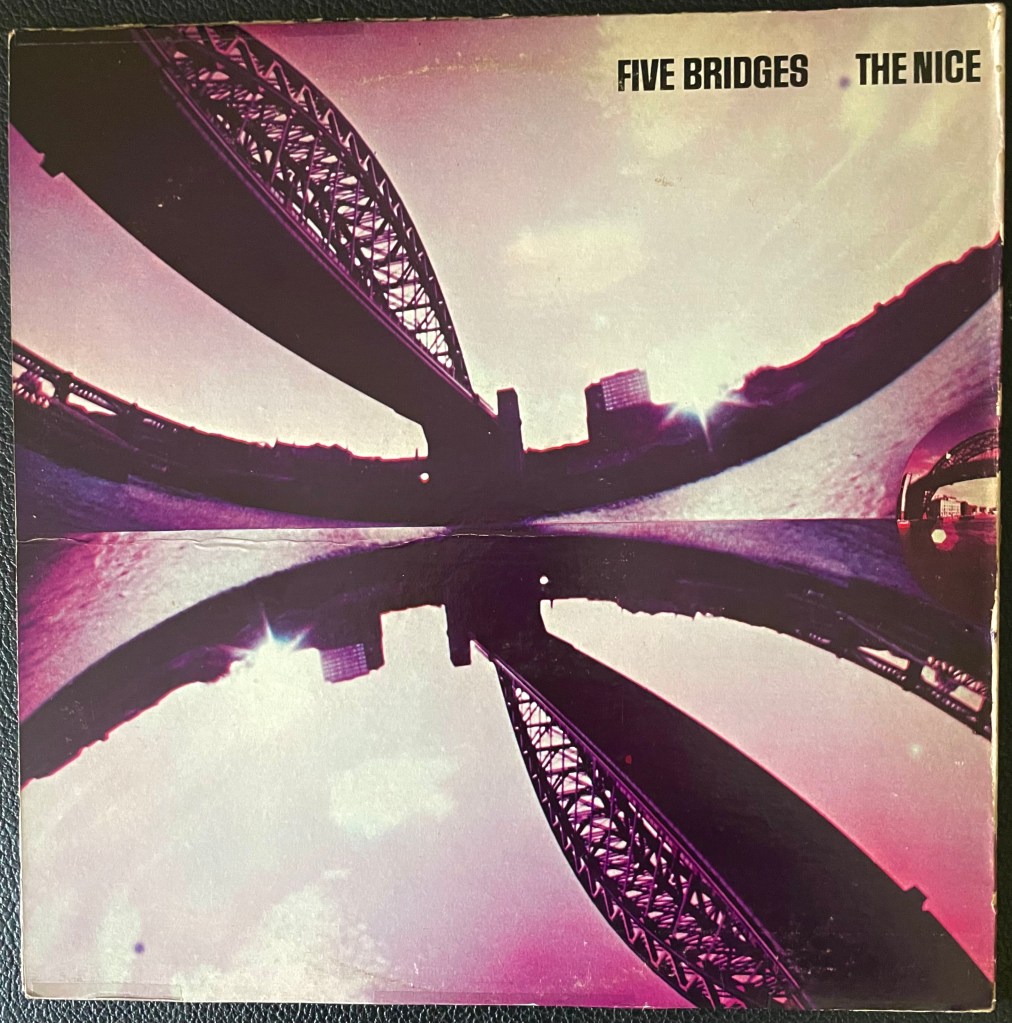
Side 2 is three cover versions from the same bunch of shows as Side 1, plus a studio recording of a final song. This would be the final time that The Nice would go into the studio before Emerson left the band. The first track was composed by Sibelius and the second is by Tchaikovsky. The third is a medley, the first half by Dylan and the second half by Bach.
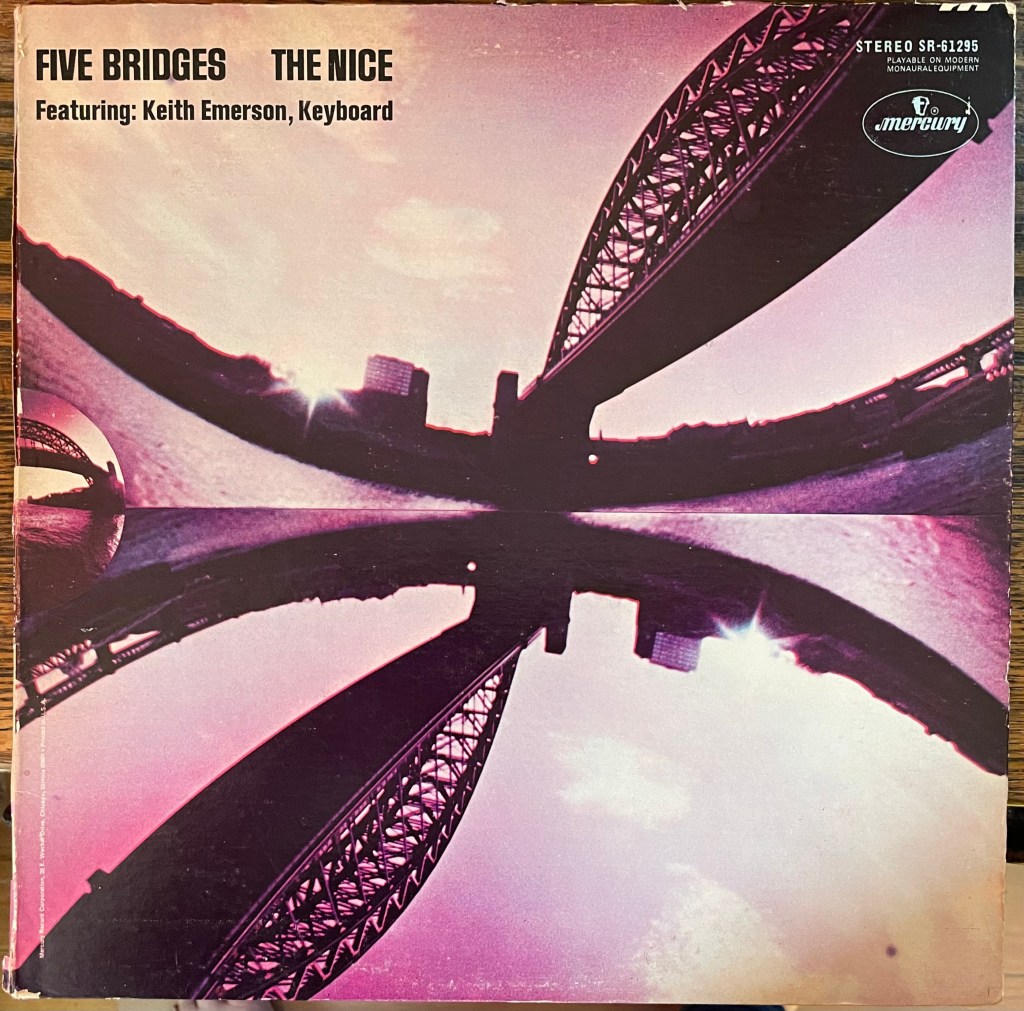
This is the back cover, which is much better on many levels than the front cover, even though it’s the same image.
They were really leaning in to the whole classical/rock fusion thingie, since many of us had music teachers who would proclaim that rock music would never be as great as the classics and wanted to know music that proved those supercilous teachers wrong.
Keith Emerson really was a hero to that kid, the one with the snooty music teacher. Emerson obviously knew that was a big part of his appeal. It was the point of prog in those days. PRO(ve you wron)G. I was that kid, but I never really “got” Keith Emerson.
But lately, I’ve been trying to figure it out – what the attraction is, can I manage to at least understand the mindset.
I found I had a similar problem with Genesis, which I addressed by repeatedly listening to some of their early records. I love Genesis now, up to about their 10th album. Still not a Phil Collins fan, and they were definitely better as a 5-piece, but I do like everything up to Duke.
So where’s that gonna land me with ELP? Especially if I treat them as a continuation of The Nice, which… to be honest, I think they are.
In the end, I have to say that I think Greg Lake does a better job doing the same things Lee Jackson did, and for me, the jury is still out on Brian Davison v. Carl Palmer. In general, I think The Nice had better pocket than ELP, and I guess I’ll lay that at Palmer’s feet. He may be more technically profidient than Davison (though that’s at least somewhat debatable) but that guy never met a groove he couldn’t push.
My sense is that Emerson was already deeply dissatisfied with The Nice by the time of this record, but that the band was still a very good representation of what I think of as the central idea — a keyboard-led power trio with a high rate of musical proficiency and a real penchant for mixing classical music with rock.
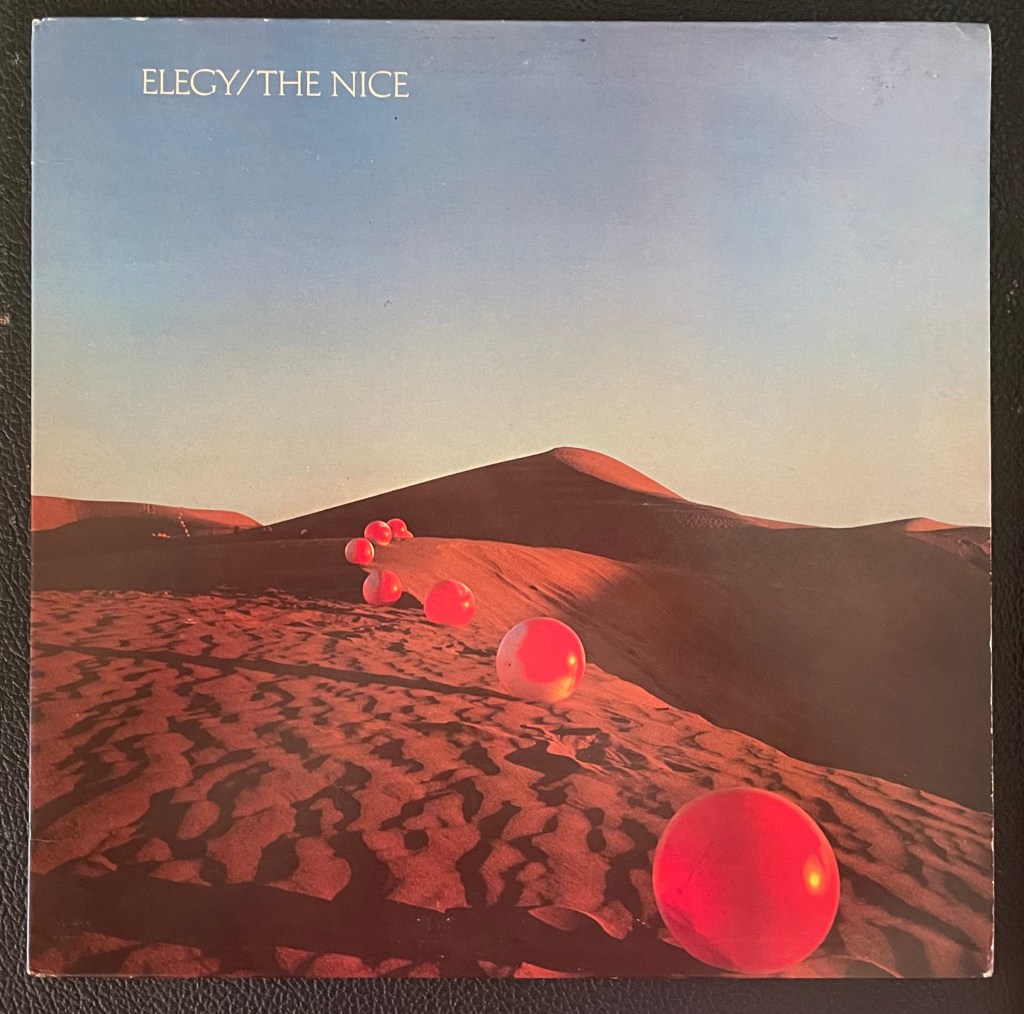
I’ll tackle Elegy next…
Please consider liking and commenting on this post. Subscribe if you can – it costs you nothing and helps this site thrive – and share this post with those you know who might appreciate it.
Thoughts about Keith Emerson’s journey from The Nice to Emerson, Lake and Palmer
The Nice’s Five Bridges was recorded in October of 1969 except for one track, and released in June of 1970. The Nice’s Elegy was recorded in December of 1969 and released in April of 1971. Emerson Lake and Palmer’s Pictures at an Exhibition was recorded in March of 1971 and released in November of 1971.
I’m sure I’m not the first person who has noticed that these albums have some strong similarities in terms of material choices and general sound. They seem to me to document an evolution from one band to another, centered on Keith Emerson. I’ve never really understood how the change came about, except within the idea of “supergroup,” which was a persuasive idea at the time in British rock music. Maybe a review of these three records together will help me contextualize things.
(ed. note: I’ve bitten off more than I can chew at one time, so this is going to be a series of articles. I’m going to write about these as a series of sides, since I have them on vinyl. I will try to post these faster than my usual once-a-week schedule.)
Side 1 of Five Bridges
This is a sidelong epic suite, part orchestral, part solo Emerson piano, part rock band. The work is commissioned for the Newcastle Arts Festival and performances were recorded with the London Sinfonia at the Fairfield Halls in Croydon.
It’s not wrong to say that Keith Emerson overwhelms things. In a way, I can see what he was talking about when thinking of the rhythm section of Lee Jackson and Brian Davison not being “virtuosic” enough for what he wanted to do. But at the same time, I appreciate what Jackson and Davison contributed to The Nice. I think the word Emerson was looking for might have been “too understated,” because I love those rhythm section parts, but yeah. You have to admit that they were simpler and didn’t spur Emerson on to be even more excessive.
My copy of the album in question, featuring an early Hipgnosis cover.
KE was an early proponent of the mixing of classical symphonic music with rock, as evinced here. He uses blues and rock motifs in the orchestral arrangements, complexifies the rock band bits. Prog in general was more successful at advancing the rock aesthetic than the classical. The classical stuff here strikes me as being in the realm of the romantic composers, in much the same way as symphonic film soundtracks are. Emerson uses a bit more repetition than most classical composers do.
I will admit that I don’t think original guitarist Davy O’List would have had much to add here… I think Emerson wanted all of that space for himself, and he certainly makes use of it. The last of the five movements of the piece split the difference between the rock and the orchestra by using a horn section in a way that feels a bit along the line between jazz and motown, with a sort of fanfare towards at end. This feels like a blueprint for what would later happen with ELP, but that’s the point, isn’t it — that it feels a bit prototypical of something that would be more fully realized later.
I have no issue with The Nice. I can see the ambitiousness of Emerson and from the perspective of a non-fan of ELP, I can also see that Jackson and Davison are doing a fine job of keeping up with those ambitions.
I’ll talk about Side 2 of this one in a separate post, which should arrive here in the next day or two.
Please consider liking and commenting on this post. Subscribe if you can – it costs you nothing and helps this site thrive – and share this post with those you know who might appreciate it.
1970: the year Genesis figured out who they were, and then were forced to evolve again.
The lineup for this album is Peter Gabriel, Tony Banks, Mike Rutherford, Anthony Phillips, and John Mayhew. This is Mayhew’s only album with the band, and Anthony Phillips’ last. It’s the band’s second. I have to say, it casts a spell.
My reissue copy of the gatefold sleeve. The cover’s janky but the vinyl is unblemished.
Trespass is the album that would establish Genesis as one of the world’s very best prog bands — it’s the template for much that came later. By the same token, it follows the template set by In The Court of the Crimson King, Time and a Word, and The Least We Can Do is Wave to Each Other while remaining distinctly a Genisis album.
Anthony Phillips is a more Steve Howe-like guitarist that Steve Hackett is. He’s a classical guitarist, which, granted, Hackett also is, on occasion, but of the two, I think Phillips has a slightly more delicate touch. I admire Phillips’s early solo work very much. this album is packed with some very out-front melodic ideas from Phillips, and Tony Banks has a lighter touch. The general aspect of the band is spritelier.
Peter Gabriel is front and center, as stong and evocative a singer and master of ceremonies as anyone could ask for, a great rock performance centerpiece fully realized, with that trademark sweet, honey-and-cigarettes baritone and finely tuned theatrical sense… And he was so young! He was quite fey on those early records, was he not?
The band also feels more balanced than it did later. At least it’s a *different* balance. Later albums would shift the sonics of the band more towards Banks being dominant, and new guitarist Steve Hackett was often treated like a “junior” member of the band. I wonder what a second or a third album by this lineup would have sounded like if Phillips hadn’t become ill and if Mayhew had found his way into the social circle of the band?
I own this one on CD and vinyl. I seem to be moving towards owning multiple copies of certain records. I also seem to be lacking storage space. I will need to address this issue at some near-future point. Something’s gonna have to give.
I like likes, love subscriptions, and crave comments.
What would an all-yankee King Crimson sound like, you ask? Here’s the answer.
Belew/Levin/Vai/Carey
Not to limit myself to a single answer to this question, but Beat is my favorite currently-active band. I hope (they’ve hinted) that they’re working on an album of original music. The primary work here, covering the music of King Crimson’s 80s ouvre, lends itself to a lot of things that I resonate with in terms of a creative approach to rock music.
They have the deepest pocket of any rock band I can think of, and I love their mathy-ness. They’re algo-rhythmic®! I hear the Beatles in this music. King Crimson’s next phase would be more overt about the connection, but the basic sonics of this band harken back in the melodicism, the collaborative writing process between Fripp and Belew, and the exacting approach to arrangements.
On the other hand, I can note the similarity of “Neon Heat Disease” to “Neon Meate Dream of a Octafish” by Captain Beefheart and his Magic Band off of Trout Mask Replica. So.. is 80s Crimson a perfect amalgam of Revolver and Trout Mask with a forward-looking technical bent? I think the case could be made by plunking the needle down on this album.
Tony Levin is the second vocalist on this, and he’s also taken over keyboards from Fripp. He also provided many of the photographs of the band that grace the inside of this triple gatefold and booklet. His presence in this re-imagining of the original music is vital to its success.
Steve Vai’s replacement of Fripp works because there’s a line he treads between copying and originating. He has to honor that huge presence that would otherwise be missing without disappearing as a separate entity. One early indication of how he approached this is his solo in Heartbeat. It sounds like electric erhu. That’s a really cool way to interpret Fripp’s playing and take it somewhere else entirely at the same time, by adding an unexpected third element. There’s nascent world-music ambitions in the 80s Crimson music sourced here, and adding sonics that suggest new contexts is absolutely in keeping.
What Danny Carey adds most significantly here is that he plays all of these songs on a set of acoustic drums. I think the music from the later source albums is greatly improved by this one change. I don’t recall seeing any electronic drums in Carey’s setup from the show (you can correct me if you know different) and the essential liveness of the sounds he provides raises all of the music from the second and third albums up to the sonic level of the first album. I get that Bruford wanted to push the envelope on the sound palate he was using, but this live recording makes an excellent case for the irreplaceability of percussion sounds coming from skin and bone, not curated electrons.
This is one of my most important objects from my move back to analog music. I love vinyl in all its machine-age glory. Carey’s drumming here is evidence for my case. Music must be made by flesh and bone and all of the worldly materials. I fully believe that, and here’s some strong evidence.
–
Thanks for reading! If you enjoyed this, please leave a comment and a like, and as always, subscriptions are welcome and encouraged!
I’ll talk about these in alpha order since I can’t think of a better rubric. These are the five things I brought with me for a trip east from Colorado with my brother. He brought a number of things too, my favorites from his stash were The Dambuilders’ Tough Guy Problem ep and Beach House 7. TGP is just about ideal 90s quirky hard indie rock, the Beach House is note-perfect shoegaze, with great songs and a beautiful droney sound. I’d stack their album up against Loveless anytime. btw, we had Loveless along, too.
It’s important to note that my brother’s truck has very loud road noise. Some music had more trouble cutting through that noise than other. “Road Noise Resistance” is another of the judging criteria I’m using to quantify my experience of these records on the trip.
Welcome, Michael!
Gentle Giant — Acquiring the Taste(1971) I brought this one along to either dispell or confirm that this might be my favorite Gentle Giant album. I certainly didn’t dispell that notion. eight tracks, less than forty minutes. We probably listened to it beginning to end maybe 10 times, maybe more, so that will give you some idea.
Favorite tracks were “The House, The Street, The Room,” “Wreck,” and “Plain Truth.” “Pantagruel’s Nativity” also merits a mention. Quite honestly, I like the whole album. The big stylistic difference I see between how they’re playing here as opposed to how they play on later albums is that they used a bit more legato phrasing on this earlier opus. Gary Green’s guitar work shines on “The House…” I love the sea shanty flavor of “Wreck,” and “Plain Truth” just rocks.
I’ve been trying to sit with Octopus (their 4th album) and the staccato element of their later style is taking a little bit of getting used to. I understand that they styled themselves a funk band, and I do like their mid-period sound a whole lot, but right now, Aquiring the Taske just feels more like a rock album, and “rock album” is the flavor that hit the spot on our trip! Strong contender for favorite disc of the trip, and DEFINITELY my favorite GG.
Estimated Number of Listens: 20 Road Noise Resistance: 9/10 Perfect Album Scale: 10/10 Overall Score: 10/10
King Crimson — Discipline (1981) This is the other strong contender for best CD of the trip. I love how every note on this album feels like it exists in a spacific aesthetic framework, and yet at the same time feels so free and spontaneous. Nice trick! Maybe the one makes the other possible?
Every song is great — it’s a perfect album. I absolutely include the two instrumentals at the end. “Sheltering Sky” is simple and primal yet hits you like a beautiful psychedelic painting. Bill Bruford is the star of the track! “Frame by Frame” has been an earworm for me for the last 43 years, and the recording we played again and again this past week justifies that level of imprint on my delicate tissues. There was a lot of singing along with various Adrian Belew vocal lines (And a couple of Tony Levin ones, too.)
ENL: 18 RNR: 9/10 PAS: 10/10 OS: 10/10
Yes – Relayer (1874) Back in the day, I thought this album was built around too much “try.” I sensed that they had been shocked by the reception of Tales From Topographic Oceans (I think Tales is genius, btw, possibly their best work, so of COURSE it wasn’t appreciated at the time…) After sitting with this album through 5+ listens, I would have to say that I do still hear some “try” but goddamn, this album a triumph.
Alan White is no Bill Bruford. He is not a “touch” drummer the way Bruford is… but he is pretty fricken good. He played on Revolver, he played on both Plastic Ono Bands, I rest my case.
The point being, that I think of Yes in the same breath in which I think of the Beatles, Zep, Bowie, and Chairs Missing-era Wire, in other words, at the tippy tippy top of its genre, and also rock and roll in general. They were not afraid of dischord, and their sixth album does not shy away. There are also some transcendently lyrical moments here. Alternating between beautiful and aggressive, this is one of absolute favorite albums by this band.
The road noise really bordered on making it hard to listen to an album.
ENL: 8 RNR: 7/10 PAS: 9.5/10 OS: 9/10
Pink Floyd — Soundtrack From the Film “More” (1969) I was using the cat brush on the Persian rug next to the kid’s bed we acquired from one of our previous “living situations” and listening to this, and I really came to feel like it’s one of my favorite of their albums. Early Floyd is the best Floyd by far, in my opinion.
My actual favorite Pink Floyd is Saucerful of Secrets. Soundtrack from More is the album they recorded next, and feels like an important, intersticial album for the band. It’s not my second favorite, that would be Obscured By Clouds.
I love early Pink Floyd, but have long harbored the sentiment that they were a remarkable band up through Dark Side of The Moon, and that everything that came after it was total shite, and the worst of the lot has to be The Wall (which everyone else seems to love for some not-understood reason) but which is the absolute nadir of the ouvre in my jaundiced eye.
Cinema was a part of their feel as a band, and I think some of their best music was informed by it.
ENL: 7 RNR: 3/10 PAS: 8/10 OS:8/10
Genesis — Selling England by the Pound(1973) This was probably the least listened-to of the 5, but we listened to it 3 times in a row while driving through Lincoln, Nebraska, and I love it. Kinda wish we’d listened to it more. I think the problem is the amount of road noise we were having. Oneof the considerations when picking a CD to pop in was that it had to stand up to the background noise. One of the ratings I’m giving each of these for the trip is about how well it battled the steady, dissonant drone of road noise in that truck. I’m giving this one a 4 out of 10 for that. The sound of the truck blended too oddly with Tony Banks’s playing.
I love every track on this album. I think Genesis has 3 perfect albums, and this is one of them, absolutely.
Can anybody ‘splain to my why I LOVE Peter Gabriel’s voice in every context I’ve ever heard it in, and why Phil Collins’s singing is like fingernails on a chalkboard to me?
ENL: 4 RNR: 4/10 PAS: 10/10 OS: 7/10
I think, in the final analysis, what needs to be said is that I love all 5 of these albums. The order of preference in this blog post relates directly to how much enjoyment I got out of each one in the particular context of that trip from Pueblo, Colorado to Gill, Massachusetts. Each album was a color on our journey cross-country. I loved them all, and wish we’d listened to them each 100 times more.
You must be logged in to post a comment.