Sometimes I Wonder if I Will Live to See the End of This Era.

A Show-and-Tell

If, if Reagan played disco
He’d shoot it to shit.
You can’t disco in jack boots.

High upon a white horse
He’d sing lame lyrics
To try to reach the working man.

–The Minutemen, 1982

That’s the entire lyrics to If Reagan Played Disco by southern California punk band the Minutemen, released as one of five songs on a seven inch vinyl record entitled “bean-spill e. p.”

Here’s my copy: Sorry, I will only be posting the non-obscene label here…


This cultural artifact from 43 years ago shows that the issues that seem so immediate and emergent right now have been with us for decades. The Republican conservative project has been the same for all this time. The Democratic response has been just that – a weak, ineffectual response. The Democrats initiate nothing. All they seem to do is talk in the least effective/offensive way about vaguely lefty ideas they never enact, while governing like diet Republicans.

The real response to what’s happening in the world now comes from outside the corporate infrastructure, in places like the LAVA Center, citizen political groups, spaces that hold independent artists, writers, musicians and other creatives, who exist outside that structure. We are purified in our intentions because we exist outside the mainstream.

The mission of mainstream cultural money and power is to blind us to what’s real, to create an artificially rarified sense of what qualifies as legitimate cultural contribution so that anything real – anything you’d recognize as coming from someone’s real life and intention is seen as substandard — grubby and grimy, faulty, unwashed and obscene.

Because the truth is obscene. We see the IDF shooting Palestinian children in the head, carpet bombing and starving an entire people out of existence. And in the Palestinian people we should see ourselves. The big money, the power of industry, and world leadership supplies the bullets to, as our president says, “finish the job.”

“The job” is to diminish working people, out of existence if necessary. Their mission is to fill us with artificial hopes and synthetic mass-manufactured bullshit dreams, all the while eroding all of the real value – the compassion and care, the pride, the willingness to work to better each other and ourselves together, the simple beauty of the world around us – and turn it all into a zero-sum game, a race to gobble up that which has more value if left alone, those things that will grow if nurtured but can only wither if exploited.

Our job is that nurturing, and we’re doing it now: sharing our hearts, hearing each other. It’s the same job the Minutemen were doing decades ago. “If Reagan Played Disco.” In those words, there is a dream. It’s the same dream that had that lone student standing in front of a line of tanks in Beijing not so long after this record was made.

Some say that student’s name was Wang Weilin. The Chinese government says there was no such person. It’s said he was 19 years old when he stood in front of those tanks. It’s said he was arrested for “political hooliganism,” whatever that means. Now, nobody can prove he existed or if he exists still, in some gulag somewhere. But we know who he is, because of what he did – what we all saw him do, even though his country’s government denies it ever happened.

D. Boon, the guitarist and singer of the Minutemen died in the band van when it rolled while they were on tour, three years after this record was released. These grooves are part of his corpse. After he died, his fellow band members George Hurley and Mike Watt continued on.

Years later, they recorded a drop-dead gorgeous instrumental called “Tien An Men Dream Again” as fIREHOSE, with guitarist Ed fROMOHIO.

Zeitgeist 3/5/25

Annie Haslam puts me in mind of Jacqui McShee

I’m listening to Renaissance’s Ashes are Burning from 1973. I read it as harkening back to Vanguard Records kinda stuff. Honestly, if you like Pentangle, you’re going to love this. Jon Camp is one of those Rick with a pick™ guys and is melodic in that Chris Squire/Paul McCartney way. Annie Haslam definitely puts me in mind of Jacqui McShee, but making mathy, orchestral music.

Really nice. I’m midway through side two of this thing, so I feel like I can say that this is a truly great pop/prog album.

I’m thinking about this theory Krystal Ball put forward that suggests that Trump may actually be trying to cause a recession. I think maybe so. Maybe that’s what’s happening.

Our options are these: he’s doing it intentionally OR he’s just that stupid. I don’t know which to believe. Much will be decided over the coming weeks. I’m praying that the upshot is that Trump is just a stupid muhfuggah, and that Elon Musk makes Pumpkin Spice Palpatine look like a friggin genius. (A big friggin OMG DUDE to whoever came up with the name “PayPalpatine” for Elon, btw.)

That’s my favorite conspiracy theory.

My LEAST favorite theory is that Trump is a Russian asset. I don’t believe it for a minute. Second worst possibility is that Trump and Putin see each other as equals, and Putin’s rule is the closest analogue to what Trump wants.

He might get it. <shrug>

Barrett by Syd Barrett

A reminder of what might have been

Syd Barrett was the original leading light of Pink Floyd, but succumbed to debilitating psychological issues that began around the time of the release of the band’s first album. He left the band under a cloud after a short struggle to continue contributing, and after two erratic solo albums, left the music business entirely. Barrett, his second solo album, was the end of the road for Syd as a recording artist.

It’s sssssooooo wwwwweeeeiiiirrrrrddddddddd, but it’s also surprisingly good considering the problems involved in making it, and different from anything else you might care to name in rock music.

The first thing I think of with Syd’s solo stuff is wild tempo shifts and a casual attitude towards pitch, but there’s less out-of-control-ness than you might think on Barrett. I mean, it’s loose, at times almost chaotic, but I think Syd was a lot more on top of things for this record than his rep might suggest.

“Gigolo Aunt,” for instance is prime late-sixties pop rock, as is “Baby Lemonade.” The shuffling beats, the psychedelic brightness, the unique phrasing and viewpoint — all are trademark, and testament to Barrett’s distinctive creativity.

The band is Syd on vocals and guitar, Richard Wright on keys, Jeff Shirley from Humble Pie on drums, and David Gilmour on bass and backing vocals. Gilmour and Wright are the producers. At Gilmour’s insistance, Syd plays all the guitars.

Ultimately, it’s both its own thing – loose and immediate, quirky and streamlined – and a reminder of what might have been.

Object 9: Yes — Magnification CD

Jon Anderson’s last album with the band

As noted in my previous post, these days when I go to record stores, I’m combing the racks for prog cds. This is often frustrating, as most of the music I’m interested in is a bit too esoteric for the typical used record store buyer to take a chance on, or there were few enough of a particular album pressed that they just don’t show up much.

Therefore, I bought my copy of Yes’s Magnification online, which is fine, as I think it unlikely that I would find a used copy.

Writing about music is challenging for me, as there are only so many hours in the day for music in my life, maybe only one or possibly two hours in a typical weekday. I have minor audio processing issues, so it’s hard for me to sort out two different audio sources at the same time, especially when it comes to music. It never fades into the background for me, which makes it difficult to focus on anything else, especially if the music has a lot of movement, or strong emotions, or lyrics that need to be focused on. If I’m listening to music, I can’t also be writing. I have to pick one or the other.  It’s just the way my quirky brain works.

As a result, I don’t have the encyclopedic knowledge your average music writer is expected to have, and it’s hard to speak with authority about a band’s work if you don’t know all of it, if you don’t know biographies of the various musicians involved, or their connections to other bands, etc. This is especially true of a band like Yes, who have been active for well over 50 years, who seem to rotate members in and out every album or two, and when they have, at this point, 23 studio albums, multitudinous solo albums by various members past and present, and other bands that various members have played in either before, during, or after their time in Yes…

I’ll pause here to note that lineup changes are such a constant that there are no original members still recording and touring with Yes at this point. The closest is Steve Howe, who has been with the band on and off since their third album, and having been out of the band for pretty much all of the 1980s. Sendond longest-standing member of Yes currently is Geoff Downes, whose first album with the band was Drama (1980). It’s probably worth discussing whether or not the current band calling itself “Yes” is really Yes, Since nobody there now was there when the band was named. Maybe I will sometime.

Magnification is their nineteenth album, the last one to feature the majority of Yes’s creative main lights. Singer Jon Anderson, guitarist Steve Howe, and bassist Chris Squire are all on this CD, as is Alan White, their longest-standing drummer, who came into the band when Bill Bruford moved on after their fifth album Close to the Edge. Magnification is the only Yes album to not have a keyboard player, and their second to utilize an orchestra, the other album to do so being Time and a Word, their second album. The orchestrations on Magnification are by Larry Groupe, and they both serve as a replacement for a keyboardist, and also stand on their own as orchestrations with their own identity.

The space that the orchestrations take in the recordings present a problem, making the sound a bit muddy – too many of the strings and winds occupy the same tonal space as instruments already in the band, the way that they recorded the orchestra gives each of the acoustic instruments too much presence. Guitar lines get lost in the mix, Squire’s normally bright, spritely bass lines are dulled because the instrumentation is so extra that they have to minimize the punch that is so much a trademark of the Yes sound. I believe that this is also a criticism laid on their previous orchestral record, though it was original guitarist Peter Banks and organist Tony Kaye that were pushed to the side then.

To my mind, Magnification harks back to Time and a Word, back to the fundamentals of the band, yet marks the years of the band’s growth. I like both Magnification and Time and a Word, the performances themselves are up to the Yes standard, and the songs on each are emotive, complex, yet more concise than the band’s most expansive work. Another treat here is that Chris Squire sings lead on “Can You Imagine,” which will remind the true Yes fan of Squire’s one solo album Fish Out of Water (my favorite of all of the myriad solo albums by Yes members) which, incidentally, is another rare example of orchestral Yes-related music.

There are still a few of the latter-day Yes albums that I haven’t gotten around to, and others that just aren’t that great in my opinion. Magnification’s songs are engaging, and for once, sixty minutes of new material created with the extra expanse of a CD in mind doesn’t cause me to pine for the more concise albums of the vinyl era.

I think Magnification, while not without its problems, ranks in the upper echelons of the band’s recorded output and therefore gets spun regularly during my valuable listening time.

Proggin’

I’ve been moderately obsessed with prog music lately. Genesis, Yes, Rush, Gentle Giant, Transatlantic, Wobbler, and Porcupine Tree have been my most constant musical companions of late.

my copy

One of the things that’s drawing me to this particular style of music is that I have no interest in playing it. It’s just music I can listen to and appreciate without feeling the urge to pull out my guitar and start learning it, because I am otherwise focused creatively and learning prog songs would take up far more free time than I have. So I’m free to just appreciate it.

I admire the amount of effort that goes into making good prog rock. The rap on prog is that it is full of tuneless, mindless noodling. I strongly disagree. I find prog music — the best stuff, at least — to be inventively melodic, passionate, intelligent music.

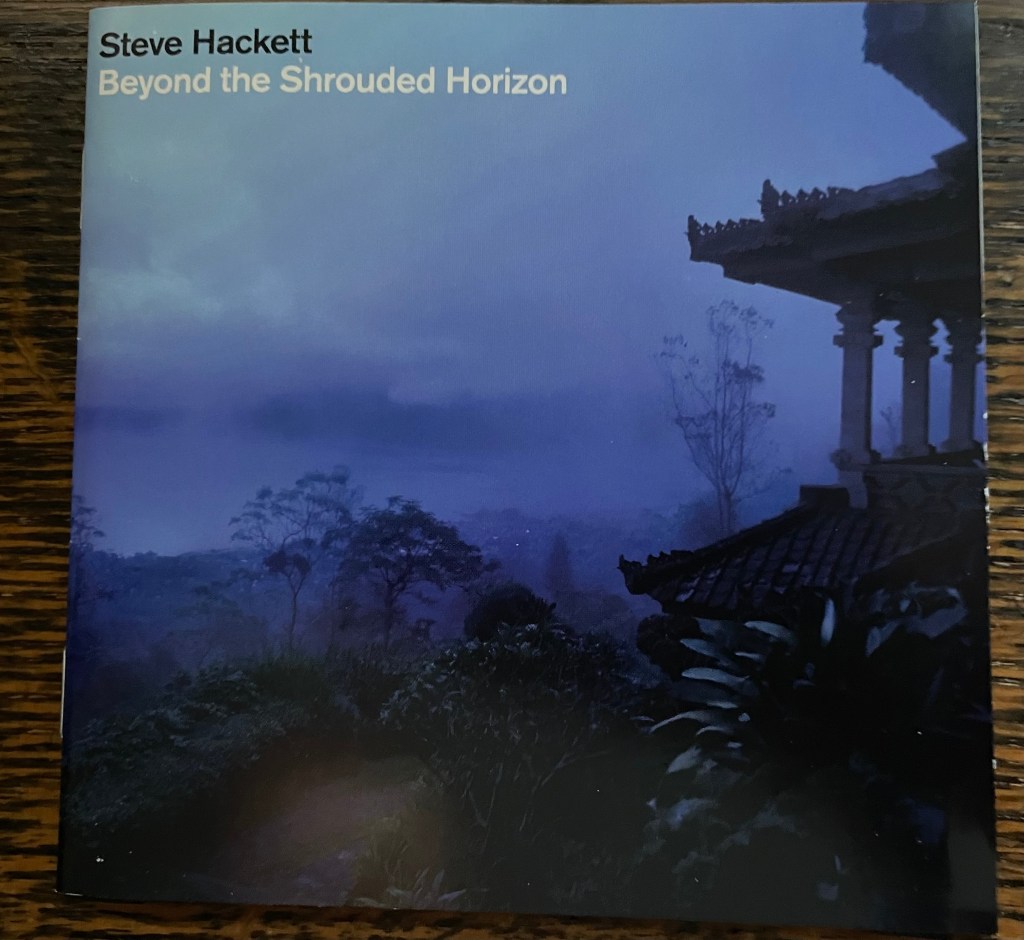
Genesis has been the greatest surprise of this phase of my music listening. I have never really “gotten” Genesis. The closest I have until recently has been a sincere appreciation for Peter Gabriel’s first for solo albums and a passing interest in The Lamb Lies Down on Broadway. At this point, I’d say my favorite Genesis album is Selling England by the Pound, although I really have a great fondness for Trespass, Nyrsery Cryme, and Foxtrot as well. I love Peter’s voice, but I have to say that though he has a timbre very similar to Peter’s I seem to have some resistance to Phil Collins’s voice. He was too prevalent in the pop culture at a certain point, and I can’t get past the annoyance I felt at his ubiquitousness. Even Trick of the Tail, which I can hear is musically on a par with Selling England, leaves me somewhat cold. I think of Trick of the Tail is the trio doing the quintet’s sound. I know Steve Hacket was there, but he was a player much more than he was a composer on that record. The vast majority of the material came from Collins, Banks, and Rutherford.

Other older bands have made their way back into my current rotation. In the past I’d stopped with Moving Pictures by Rush, Drama by Yes, and The Wall by Pink Floyd. I haven’t gotten any farther with Floyd, but I have spent a fair amound ot time with a few later albums by each of the other two. I have a new copy of Signals by Rush in my CD player right now, but I have also recently picked up Roll the Bones and Presto. None of the three quite compares with the first eight albums, although none of them are bad, by any means. I hope to spend more time with them. Yes, on the other hand, has given me a late-period album to compare with their earlier catalobue in Magnification, which I’ve been quite impressed with. In the matter of later-period Floyd or Roger Waters solo, let’s just say I haven’t been motivated to seek them out, really. If I want something newer that hits those Pink Floyd buttons, I am much more likely to go to Porcupine Tree.

A few years ago, I started a series of posts where I would listen to Porcupine Tree’s albums chronologically and write about each next album on Facebook. I never made it past Signify, but not because of the quality of the music. It was more a matter of my wandering mind. I actually quite like Signify, as a representative that early part of their catalogue. It’s transitional: they started to have their own sound on it. I might have been excited if I’d continued through to some truly great albums like Fear of a Blank Planet and In Absentia. I also have The Incident, which is a fascinating record. I love that it’s a long CD and an ep. The 4-song ep is particularly good. The hour-long “main” CD is some sort of concept album or other, very distinctively structured.

Two other more “modern” prog bands I’ve taken a liking to are Transatlantic and Wobbler. Transatlantic is a modern-prog “supergroup” with members of Marillion, Spock’s Beard, the Flower Kings, and Dream Theater. I’m currently trying to sort out whether or not I think Transatlantic is too squeaky-kleen for me, but I think the answer to that dilemma is probably “no, they are not too squeaky-kleen for me.” They’re very sincere and very good. Their playing is super clean, but doesn’t squeak. I have three of their albums: SMPTe, Whirlwind, and two verions of their last one, The Absolute Universe.

My friend Butch, when I introduced him to Wobbler, said “Oh, yeah, kinda like Yes meets Gentle Giant.” and that’s accurate. Absolutely ferocious playing throughout the two CDs of theirs that I own, Dwellers of the Deep and From Silence to Somewhere.

It’s been great to hook my ears into this music. I’ve found that music which doesn’t require my full attention isn’t really worth my time, and I’ve found all of the above music to reward deeper listening, to not have truck with anything resembling “postmodern irony,” — I am SO done with irony for irony’s sake — and that it requires so much dedication to play prog well that there is no way to fake it.

I’ll have more to say on this subject in the future.