
Jon Anderson’s last album with the band
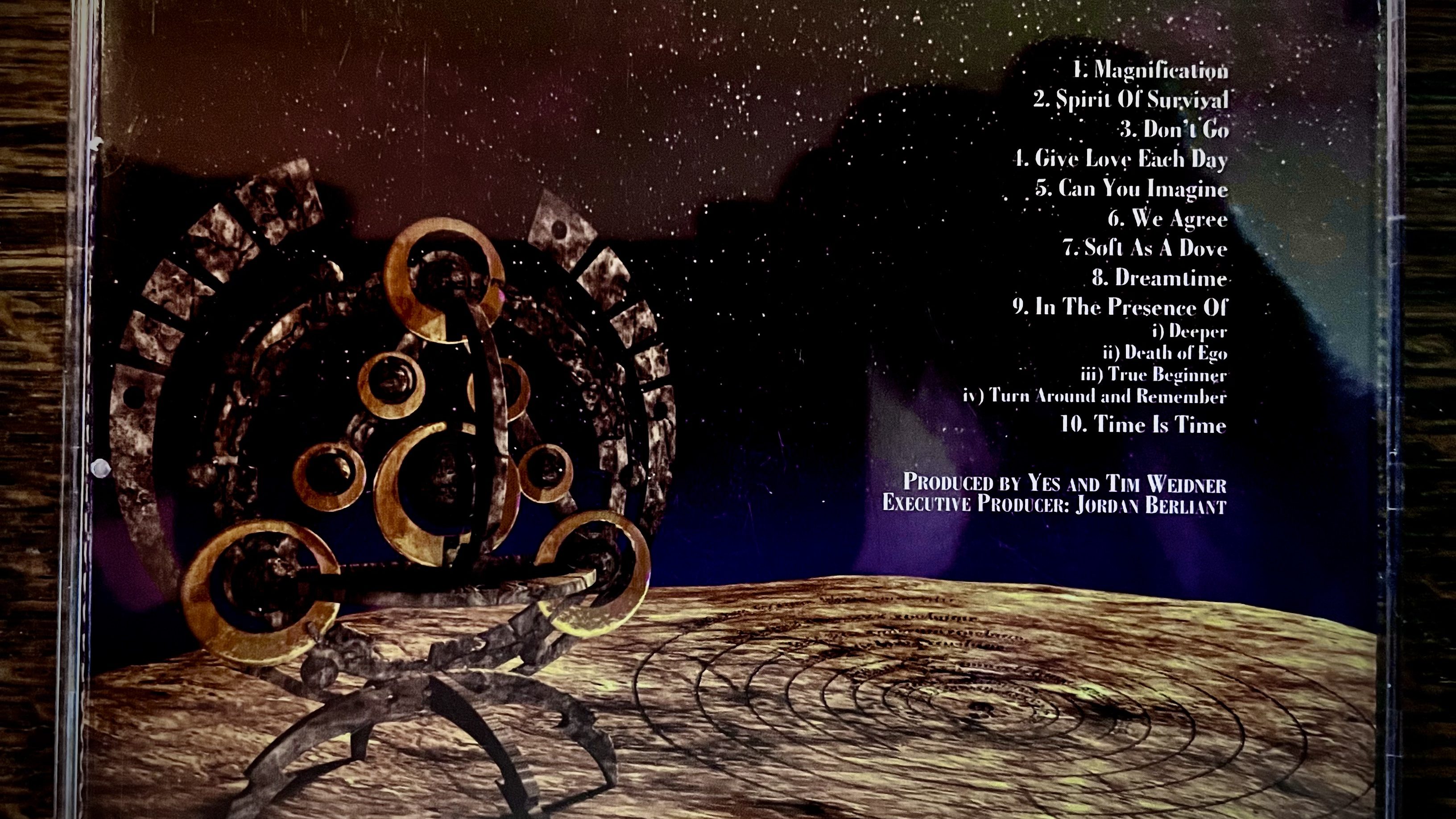
As noted in my previous post, these days when I go to record stores, I’m combing the racks for prog cds. This is often frustrating, as most of the music I’m interested in is a bit too esoteric for the typical used record store buyer to take a chance on, or there were few enough of a particular album pressed that they just don’t show up much.
Therefore, I bought my copy of Yes’s Magnification online, which is fine, as I think it unlikely that I would find a used copy.
Writing about music is challenging for me, as there are only so many hours in the day for music in my life, maybe only one or possibly two hours in a typical weekday. I have minor audio processing issues, so it’s hard for me to sort out two different audio sources at the same time, especially when it comes to music. It never fades into the background for me, which makes it difficult to focus on anything else, especially if the music has a lot of movement, or strong emotions, or lyrics that need to be focused on. If I’m listening to music, I can’t also be writing. I have to pick one or the other. It’s just the way my quirky brain works.
As a result, I don’t have the encyclopedic knowledge your average music writer is expected to have, and it’s hard to speak with authority about a band’s work if you don’t know all of it, if you don’t know biographies of the various musicians involved, or their connections to other bands, etc. This is especially true of a band like Yes, who have been active for well over 50 years, who seem to rotate members in and out every album or two, and when they have, at this point, 23 studio albums, multitudinous solo albums by various members past and present, and other bands that various members have played in either before, during, or after their time in Yes…
I’ll pause here to note that lineup changes are such a constant that there are no original members still recording and touring with Yes at this point. The closest is Steve Howe, who has been with the band on and off since their third album, and having been out of the band for pretty much all of the 1980s. Sendond longest-standing member of Yes currently is Geoff Downes, whose first album with the band was Drama (1980). It’s probably worth discussing whether or not the current band calling itself “Yes” is really Yes, Since nobody there now was there when the band was named. Maybe I will sometime.
Magnification is their nineteenth album, the last one to feature the majority of Yes’s creative main lights. Singer Jon Anderson, guitarist Steve Howe, and bassist Chris Squire are all on this CD, as is Alan White, their longest-standing drummer, who came into the band when Bill Bruford moved on after their fifth album Close to the Edge. Magnification is the only Yes album to not have a keyboard player, and their second to utilize an orchestra, the other album to do so being Time and a Word, their second album. The orchestrations on Magnification are by Larry Groupe, and they both serve as a replacement for a keyboardist, and also stand on their own as orchestrations with their own identity.
The space that the orchestrations take in the recordings present a problem, making the sound a bit muddy – too many of the strings and winds occupy the same tonal space as instruments already in the band, the way that they recorded the orchestra gives each of the acoustic instruments too much presence. Guitar lines get lost in the mix, Squire’s normally bright, spritely bass lines are dulled because the instrumentation is so extra that they have to minimize the punch that is so much a trademark of the Yes sound. I believe that this is also a criticism laid on their previous orchestral record, though it was original guitarist Peter Banks and organist Tony Kaye that were pushed to the side then.
To my mind, Magnification harks back to Time and a Word, back to the fundamentals of the band, yet marks the years of the band’s growth. I like both Magnification and Time and a Word, the performances themselves are up to the Yes standard, and the songs on each are emotive, complex, yet more concise than the band’s most expansive work. Another treat here is that Chris Squire sings lead on “Can You Imagine,” which will remind the true Yes fan of Squire’s one solo album Fish Out of Water (my favorite of all of the myriad solo albums by Yes members) which, incidentally, is another rare example of orchestral Yes-related music.
There are still a few of the latter-day Yes albums that I haven’t gotten around to, and others that just aren’t that great in my opinion. Magnification’s songs are engaging, and for once, sixty minutes of new material created with the extra expanse of a CD in mind doesn’t cause me to pine for the more concise albums of the vinyl era.
I think Magnification, while not without its problems, ranks in the upper echelons of the band’s recorded output and therefore gets spun regularly during my valuable listening time.
 Broadcast From the Brain Radio
You must be logged in to post a comment.