Object 9: Yes — Magnification CD

Jon Anderson’s last album with the band
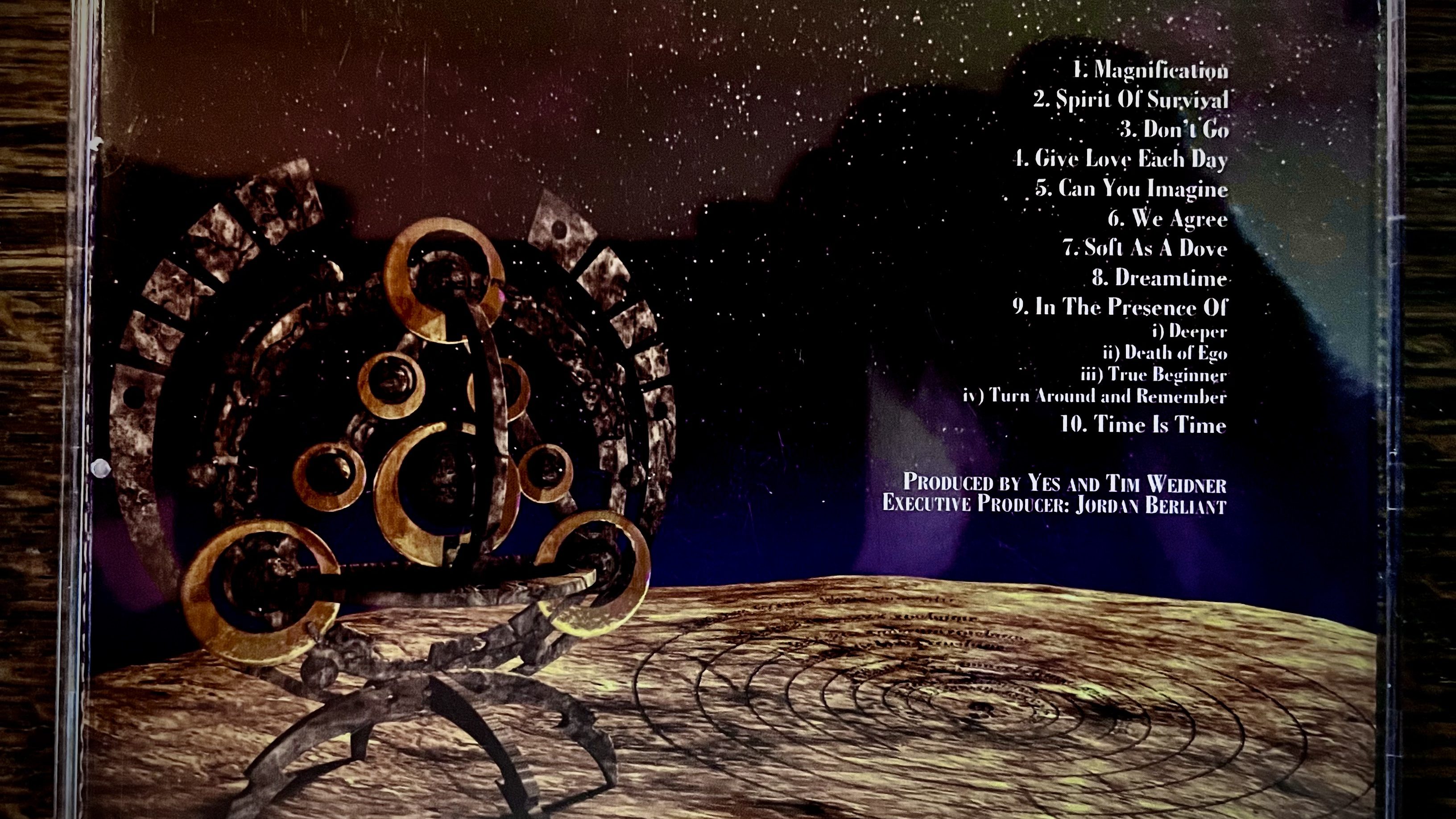
As noted in my previous post, these days when I go to record stores, I’m combing the racks for prog cds. This is often frustrating, as most of the music I’m interested in is a bit too esoteric for the typical used record store buyer to take a chance on, or there were few enough of a particular album pressed that they just don’t show up much.

Therefore, I bought my copy of Yes’s Magnification online, which is fine, as I think it unlikely that I would find a used copy.

Writing about music is challenging for me, as there are only so many hours in the day for music in my life, maybe only one or possibly two hours in a typical weekday. I have minor audio processing issues, so it’s hard for me to sort out two different audio sources at the same time, especially when it comes to music. It never fades into the background for me, which makes it difficult to focus on anything else, especially if the music has a lot of movement, or strong emotions, or lyrics that need to be focused on. If I’m listening to music, I can’t also be writing. I have to pick one or the other.  It’s just the way my quirky brain works.

As a result, I don’t have the encyclopedic knowledge your average music writer is expected to have, and it’s hard to speak with authority about a band’s work if you don’t know all of it, if you don’t know biographies of the various musicians involved, or their connections to other bands, etc. This is especially true of a band like Yes, who have been active for well over 50 years, who seem to rotate members in and out every album or two, and when they have, at this point, 23 studio albums, multitudinous solo albums by various members past and present, and other bands that various members have played in either before, during, or after their time in Yes…

I’ll pause here to note that lineup changes are such a constant that there are no original members still recording and touring with Yes at this point. The closest is Steve Howe, who has been with the band on and off since their third album, and having been out of the band for pretty much all of the 1980s. Sendond longest-standing member of Yes currently is Geoff Downes, whose first album with the band was Drama (1980). It’s probably worth discussing whether or not the current band calling itself “Yes” is really Yes, Since nobody there now was there when the band was named. Maybe I will sometime.

Magnification is their nineteenth album, the last one to feature the majority of Yes’s creative main lights. Singer Jon Anderson, guitarist Steve Howe, and bassist Chris Squire are all on this CD, as is Alan White, their longest-standing drummer, who came into the band when Bill Bruford moved on after their fifth album Close to the Edge. Magnification is the only Yes album to not have a keyboard player, and their second to utilize an orchestra, the other album to do so being Time and a Word, their second album. The orchestrations on Magnification are by Larry Groupe, and they both serve as a replacement for a keyboardist, and also stand on their own as orchestrations with their own identity.

The space that the orchestrations take in the recordings present a problem, making the sound a bit muddy – too many of the strings and winds occupy the same tonal space as instruments already in the band, the way that they recorded the orchestra gives each of the acoustic instruments too much presence. Guitar lines get lost in the mix, Squire’s normally bright, spritely bass lines are dulled because the instrumentation is so extra that they have to minimize the punch that is so much a trademark of the Yes sound. I believe that this is also a criticism laid on their previous orchestral record, though it was original guitarist Peter Banks and organist Tony Kaye that were pushed to the side then.

To my mind, Magnification harks back to Time and a Word, back to the fundamentals of the band, yet marks the years of the band’s growth. I like both Magnification and Time and a Word, the performances themselves are up to the Yes standard, and the songs on each are emotive, complex, yet more concise than the band’s most expansive work. Another treat here is that Chris Squire sings lead on “Can You Imagine,” which will remind the true Yes fan of Squire’s one solo album Fish Out of Water (my favorite of all of the myriad solo albums by Yes members) which, incidentally, is another rare example of orchestral Yes-related music.

There are still a few of the latter-day Yes albums that I haven’t gotten around to, and others that just aren’t that great in my opinion. Magnification’s songs are engaging, and for once, sixty minutes of new material created with the extra expanse of a CD in mind doesn’t cause me to pine for the more concise albums of the vinyl era.

I think Magnification, while not without its problems, ranks in the upper echelons of the band’s recorded output and therefore gets spun regularly during my valuable listening time.

Proggin’

I’ve been moderately obsessed with prog music lately. Genesis, Yes, Rush, Gentle Giant, Transatlantic, Wobbler, and Porcupine Tree have been my most constant musical companions of late.

my copy

One of the things that’s drawing me to this particular style of music is that I have no interest in playing it. It’s just music I can listen to and appreciate without feeling the urge to pull out my guitar and start learning it, because I am otherwise focused creatively and learning prog songs would take up far more free time than I have. So I’m free to just appreciate it.

I admire the amount of effort that goes into making good prog rock. The rap on prog is that it is full of tuneless, mindless noodling. I strongly disagree. I find prog music — the best stuff, at least — to be inventively melodic, passionate, intelligent music.

Genesis has been the greatest surprise of this phase of my music listening. I have never really “gotten” Genesis. The closest I have until recently has been a sincere appreciation for Peter Gabriel’s first for solo albums and a passing interest in The Lamb Lies Down on Broadway. At this point, I’d say my favorite Genesis album is Selling England by the Pound, although I really have a great fondness for Trespass, Nyrsery Cryme, and Foxtrot as well. I love Peter’s voice, but I have to say that though he has a timbre very similar to Peter’s I seem to have some resistance to Phil Collins’s voice. He was too prevalent in the pop culture at a certain point, and I can’t get past the annoyance I felt at his ubiquitousness. Even Trick of the Tail, which I can hear is musically on a par with Selling England, leaves me somewhat cold. I think of Trick of the Tail is the trio doing the quintet’s sound. I know Steve Hacket was there, but he was a player much more than he was a composer on that record. The vast majority of the material came from Collins, Banks, and Rutherford.

Other older bands have made their way back into my current rotation. In the past I’d stopped with Moving Pictures by Rush, Drama by Yes, and The Wall by Pink Floyd. I haven’t gotten any farther with Floyd, but I have spent a fair amound ot time with a few later albums by each of the other two. I have a new copy of Signals by Rush in my CD player right now, but I have also recently picked up Roll the Bones and Presto. None of the three quite compares with the first eight albums, although none of them are bad, by any means. I hope to spend more time with them. Yes, on the other hand, has given me a late-period album to compare with their earlier catalobue in Magnification, which I’ve been quite impressed with. In the matter of later-period Floyd or Roger Waters solo, let’s just say I haven’t been motivated to seek them out, really. If I want something newer that hits those Pink Floyd buttons, I am much more likely to go to Porcupine Tree.

A few years ago, I started a series of posts where I would listen to Porcupine Tree’s albums chronologically and write about each next album on Facebook. I never made it past Signify, but not because of the quality of the music. It was more a matter of my wandering mind. I actually quite like Signify, as a representative that early part of their catalogue. It’s transitional: they started to have their own sound on it. I might have been excited if I’d continued through to some truly great albums like Fear of a Blank Planet and In Absentia. I also have The Incident, which is a fascinating record. I love that it’s a long CD and an ep. The 4-song ep is particularly good. The hour-long “main” CD is some sort of concept album or other, very distinctively structured.

Two other more “modern” prog bands I’ve taken a liking to are Transatlantic and Wobbler. Transatlantic is a modern-prog “supergroup” with members of Marillion, Spock’s Beard, the Flower Kings, and Dream Theater. I’m currently trying to sort out whether or not I think Transatlantic is too squeaky-kleen for me, but I think the answer to that dilemma is probably “no, they are not too squeaky-kleen for me.” They’re very sincere and very good. Their playing is super clean, but doesn’t squeak. I have three of their albums: SMPTe, Whirlwind, and two verions of their last one, The Absolute Universe.

My friend Butch, when I introduced him to Wobbler, said “Oh, yeah, kinda like Yes meets Gentle Giant.” and that’s accurate. Absolutely ferocious playing throughout the two CDs of theirs that I own, Dwellers of the Deep and From Silence to Somewhere.

It’s been great to hook my ears into this music. I’ve found that music which doesn’t require my full attention isn’t really worth my time, and I’ve found all of the above music to reward deeper listening, to not have truck with anything resembling “postmodern irony,” — I am SO done with irony for irony’s sake — and that it requires so much dedication to play prog well that there is no way to fake it.

I’ll have more to say on this subject in the future.

My All-Time Top-Ten Favorite Albums, Until I Decide Differently

As of 10/22/23

1.) The Beatles — Revolver
2.) The Anthology of American Folk Music
3.) Yes — Fragile
4.)Siouxsie and the Banshees — Juju
5.) The Beatles — s/t (The White Album)
6.) Sex Pistols — Never Mind the Bollocks, Here’s the Sex Pistols
7,) George Harrison — All Things Must Pass
8.) John Lennon — Plastic Ono Band
9.) Yes — Tales From Topographic Oceans
10.) Buzzcocks — Another Music in a Different Kitchen

Honorable Mention:
Pink Floyd — Saucerful of Secrets
Paul and Linda McCartney — Ram

This is me trying to give my life-long top ten. I’m still exploring, so this is still subject to change. So many Beatles thingies on this list…

I am in a proggy phase right now, hence all the Beatles and the Yes stuff. Maybe at some point I will post an all-time favorite Prog albums, which I think the Beatles may not appear on (well, maybe Revolver will show up, because I think that is the original prog album!)

Object 4: Yes: Tales From Topographic Oceans

There are times when I think Tales From Topographic Oceans is the best thing that Yes ever did.

A long-after-the-fact reassessment

My very favorite Roger Dean album cover art.

It’s January 1974. Let’s say you’re a high school kid with Christmas bucks to spend. You have ten bucks, so you can buy two single albums ($4.99 ea.) or a double ($8.99) at your local record store. Do you drop your whole sawbuck on the Yes album?

Maybe I should try to convince you that you should…

But no, I think you need to go with Quadrophenia, to be honest. But maybe you have a friend or a sibling who also has ten bucks. Maybe you try to convince them to buy the Yes, and you’ll trade them back and forth. They’ll likely tell you you’re crazy and buy the new Paul and the new Zeppelin instead. Dang! Sorry, Tales From Topographic Oceans.

And yet… Here we are, just 50 short years later. Have time and cooler heads allowed the transcendent beauty of it to cause Tales From Topographic Oceans to rise to the top of anyone else’s pantheon? I looked on Pitchfork, and they have one Yes article, a single digest review of their first 9 albums, through Tormato. They give Fragile an 8.8 out of 10, Close to the Edge gets a straight 9.0, and then Tales gets 2.2 (don’t bother with that review, it’s ridiculous.) Elsewhere online, I’ve read the claim that Tales From Topographic Oceans is the album that killed prog rock.

Did it? Did it really?

Don’t tell King Crimson, who had a steam of mindblowingly great prog records and released Starless and Bible Black and Red in Tales‘s wake, and then more when a new lineup started playing in 1980, and who toured just last year, or Genesis, who released the four-sided The Lamb Dies Down on Broadway later that year, to much acclaim. Don’t mention Godbluff. Obviously that’s a secret. Van Der Graaf is another band that just recently toured. And let’s not forget that Yes is still touring and releasing new music to this day (though I think there’s one person from the band that recorded TFTO still standing on that stage.)

So maybe Tales only made prog rock say, “ow?”

My own assessment places Yes’s sixth near the top of the ouvre, though it took me a good long while to come to that opinion. But it’s true: I think that record is gorgeous. I think they were trying to both update their sound and stretch themselves in new ways. They opened up their sound, slowed the tempos, added more jazz and folk elements, focused on groove, with long solo sections. On the whole they made a stunning album, though side two, “The Remembering: High the Memory” and side three, “The Ancient: Giants Under the Sun” are somewhat less compelling that sides one and four.

In 1972, Yes was as close to the top of the music world as they ever got. That year they released Close to the Edge, considered by most to be their magnum opus, as the end of a string of three classic albums (The Yes Album, Fragile, and Close.) In the wake of that last album, they began looking around for their next project.

Steve Howe suggested the then-zeitgeist-y book Autobiography of a Yogi by Paramahansa Yogananda, as a basis for their next material, and he and Jon Anderson began composing based on the book. Howe and Anderson wrote my two favorite movements (first and fourth), Squire gets a writing credit on the third movement, and the whole band gets credit on the second movement.

They began the process of making this piece — which Jon Anderson described at the time as “4 Close to the Edges.” Could they pull it off? Time would tell.

The recording sessions dragged on for 5 months. Their process had always been nitpicky enough that it had alienated original drummer Bill Bruford enough that he left after Close to the Edge, to be replaced by Alan White, who had worked as a session drummer for the Beatles. Rick Wakeman left in the middle of the project to go make a solo record: he was gone for 6 weeks, but came back to finish the project and support it on tour.

And time did tell. They packaged their work as a double album: a single piece of music in 4 album-side-long movements. A whack of music, which they played in its entirety, as a single piece, on the following tour.

People booed the new stuff and screamed for the hits. At a Yes concert, they screamed for the damn hits.

Close to the Edge, has, to date, earned double platinum record sales. TFTO has only earned gold in the fifty years since its release, so essentially, Tales From Topographic Oceans bombed. People hated it. And when Wakeman’s Journey to the Center of the Earth (the album he’d left the Tales sessions to make) went to #1 on the album charts, He called Jon Anderson that very day and quit Yes.

Winter 73/74 was actually replete with highly-regarded classic rock albums. Band on the Run was on the racks that same year, so were Dark Side of the Moon, Houses of the Holy, Quadrophenia, Goodbye Yellow Brick Road, Alladin Sane, All the Young Dudes, Goat’s Head Soup, and Selling England by the Pound by Genesis and Passion Play by Tull (which was a number one album in the US.) TFTO had some serious competition.

In that field, if an album that didn’t immediately reveal its charms, wear them like rhinestones on its lapels and sleeves, it was doomed, and Tales was built for deep, repeated listening, not for heavy rotation on pop radio.

I’ll take a moment here to grouse about the albums design, which was quite inept. That Roger Dean cover is gorgeous, but the inside of the gatefold is clunky, a series of blurry photos that really don’t meet the standard for Yes’s beautiful cover art, and an unreadable lyric sheet, done in white serif type face on a dark-blue background. That’s a rookie mistake that may be one of the real causes of TFTO‘s poor reception.

I first came into contact with Tales well after the fact, maybe as late as 1980. I knew one guy who’d heard it, and he told me he didn’t like it. I went looking for info about it at the library, and it had a whole raft of bad reviews (indeed, you could have built a raft out of all of the magazines and newspapers who had published negative reviews of the thing,) so I weighed how much I loved that cover art, and how much bad press that I had read about it, and bought something else. I think I did eventually get it for, like, $3 used. At the time, I thought it was boring and, tbh, rough. As most people did.

But here’s the real mystery, and why I’m writing this. I don’t know why I thought that record wasn’t the most polished thing they’d ever done to that point, because it is. The album is laced with references to their previous music, and to my ears at the time, the repeated quotations of other Yes songs suggested a lack of inspiration. Now, though, I hear how those references relate to the theme of the piece, the moments of a life, the highs, the lows, our memories of those peak experiences that become peaks themselves. I decided that I liked “Ritual: Nous Som Du Soleil” best, but it didn’t make its way to my turntable often.

These days, there are times when I think Tales is the best thing Yes ever did. It’s their downtempo album. meant for winter 73/74. It’s a very summery album, ironically… sun soaked and danceable, pastoral in vibe, very Green Man (tell me Yes isn’t a seelie (Summer Fae. Ask me about that sometime…) band… go on, try…) And the album’s virtues are all on display in the first section of the album, “The Revealing Science of God: Dance of the Dawn.” There’s less of the almost atonal angularity of earlier records (and which came back on their next album) and more slow, sensuous groove.

I think it misses the zeitgeist by being a little bit too pagan/hippie/pastoral, when rock was becoming more of an urban thing, generally. That may have been one of the things that made it hard for me to latch an ear to at first, because at the time I discovered it, I was far more motivated as a fan to seek out music played by people in leather jackets and knees-out jeans. And, of course, I was reading a lot of rock music press, and the consensus against it affected how I heard it.

Now, I live in a country farmhouse, wake up in the dawn light, and the pace of my life is slower than it was. Also, this record is so aurally interesting. I love the harmonics of it. The band plays with overtones in performance and then enhances that with their recorded process, especially in their vocals, shading from bright to dark and playing those shades against each other. There’s a sweetness here that prog hardly ever achieves.

Tales From Topographic Oceans is the work of a band trying to grow, to expand their definition even of their own identity. It’s sweet and soulful, trying its best to move your booty along with your mind, and while it didn’t succeed at the time, it’s certainly working for me these days.

The version of Tales From Topographic Oceans I own is the 2003 Rhino remaster, which includes two extra tracks, live runthroughs of “Dance of the Dawn” and the third (and in my opinion weakest) track, “Giants Under the Sun.” both are nice to have, though neither adds much to the full recordings. The lyric booklet reproduces the terrible original; it’s still hard to read, but following along with it helped me get the shape of each of the four tracks, and appreciate them better as a result.

The Donnas — American Teenage Rock ‘N’ Roll Machine

Just kids!

I popped Rush’s Feedback CD into the box right after this twenty-some minute blast. The source material is from a different era, but I can hear the two sets as though in conversation with each other. Rush was playing a set of cover songs from their youth: The Donnas wear their influences so much on their sleeves that you can spot many quotes, even though the record is a set of ten originals. I hear the Ramones here, of course, from the power-chord guitar, to the band naming themselves in a Ramones-like way, to the chant of “Rock! Rock! Rock ‘n’ Roll!” halfway through the very first track. I hear a very strong Joey Ramone influence in Donna A.’s singing, as well.

The whole record is infused with holler-backs to the Ramones, the Runaways, and even the New York Dolls. There are so many nods to other bands that it caused me to seek out Feedback, because at first blush, that’s the level of nostalgia this album exudes.

But this record is made by kids in their fledgling moment, a second album and possibly their first foray into a “real” studio, looking forward more than they are backward in time. That they’re stiff and a little awkward is testament to their youth, that they’re going at it full-force is testament to their ambition.

I have to admit, though, that it is a little bit jarring to hear a band so committed to the Rock ‘n’ Roll Dream™ at the very late date in which this album came into being. They seem sincere, though, not weighed down with post-modern irony. And the subject matter isn’t flights of fancy about them becoming huge stars, it’s about their daily — or rather nightly — existence. It’s about partying and playing music right where they are.

These kids’ honesty and immediacy is the saving grace of the project. Where Rush is escaping into a more innocent era, The Donnas are in their moment, living, not reliving, even as they hark back to their influences.

[ED]