
Rama Lama Whippity Ding #1

I met with an agent

AI slop

Recently, I had a speed date-style Zoom meeting with a generalist/genre book agent. It was an interesting and informative experience. I’d even say that on the whole it was a good experience. But it was also awkward and distant, and a little bit depressing. I’m clearly not the author this agent wants to represent, that’s the first thing to say. And I’m OK with that. As with any speed dating sort of situation, you’re looking for something to click.

When it became clear that this wasn’t going to be a thing, I asked a couple of biz questons and they were open and honest with their answers. Helpful. Cheerfully so.
more AI slop

I asked about how it is out there for trans authors these days. I was told that trans adult fantasy authors can pretty much do what they want, it doesn’t seem to matter. But kidlit is getting hit pretty hard, lots of bannings, lots of pushback.

I guess we’ve found the actual canaries in the coalmine. If you’re a trans-inclusive YA or middle grade author, you’re having a rough go right now. I don’t think that points to a winner in the contest, but it does make it clear that it IS a contest. There’s a war being fought out there. And if the trans kid’s authors lose, I’m next.
further AI slop

What the agent kept repeating when asking me to talk about my project is “What are the stakes? What’s the thing I can’t walk away from?” This caused me some cognitive dissonance because the whole idea of my novel is the protagonist walking away, over and over. And it’s not that my main character is an anti-hero. Sometimes Rose walks away from things by choice, sometimes she walks away because she’s forced to. Sometimes she’s kidnapped. Sometimes a disaster happens, either on a large or a small scale. Sometimes it’s her fault. Sometimes she’s a victim. Sometimes it’s a sacrifice she makes. And that’s a story too. It’s a story I feel personally, because it’s how my life has been.

My perception of the general run of fantasy novels these days — and I’d have to say that most everything I’ve read in the genre for the last ten or so years fits into this formula — is that you start with an action sequence, it sets up a conflict and some tension, the bulk of the book is the main character on the run and under the gun based on the conflict/tension, but also there’s some guy or girl who is very very annoying until they’re not, then there’s an aha moment when the protagonist figures out what’s really going on and consequently how to win, and then there’s a huge high-stakes battle, like a multiple orgasm of crash! bang! pow! as big as whatever the author can imagine, then a few pages of happy every after.
Such AI, much slop

Whose life is like that? Having read a hundred iterations of that, who needs it again? I think this is a problem, and it’s not something I want to “create” the next iteration of, although I will say the story I’m working on actually does follow that formula to some extent, though it doesn’t have that ratchet-up, ratchet-up, and ratchet-up-again thing going on.

At some point during the interview, I began to imagine the novel I would write to meet the standards of this era of fantasy fiction. The title would be “Rama Lama Whippity Ding #1” and the first sentence would be “How do you like your steaks?” I bet I could get a few thousand words out of riffing on that.

Clearly, I wasn’t made for these times.
last bit of AI slop… for now.

Please consider liking and commenting on this post. Subscribe if you can – it costs you nothing and helps this site thrive – and share this post with those you know who might appreciate it.
A 500-Word History of a Lost Civilization That Stood for Over a Thousand Years

No one can accurately depict this much history in so small a space, but hey! I tried.

In 293, The Emperor Diocletian created the Tetrarchy. He split the Roman Empire in two, west and east, in 286 CE. He found that he needed a second-in-command to help administer each half of the empire. In the west, he appointed Maximian as Augustus with Constantius as Caesar under him. In the east, he appointed himself Augustus and Galerius as Caesar. The Roman Empire had been in danger of falling apart and in this way, Diocletian saved it for a time. The Tetrarchy collapsed after he abdicated, due to rival claims to power from Maxentius, the son of Maximian and Constantine, the son of Constantius. There was a civil war and at the end of it in 324 Constantine was the Roman Emperor and Christianity had become the state religion.

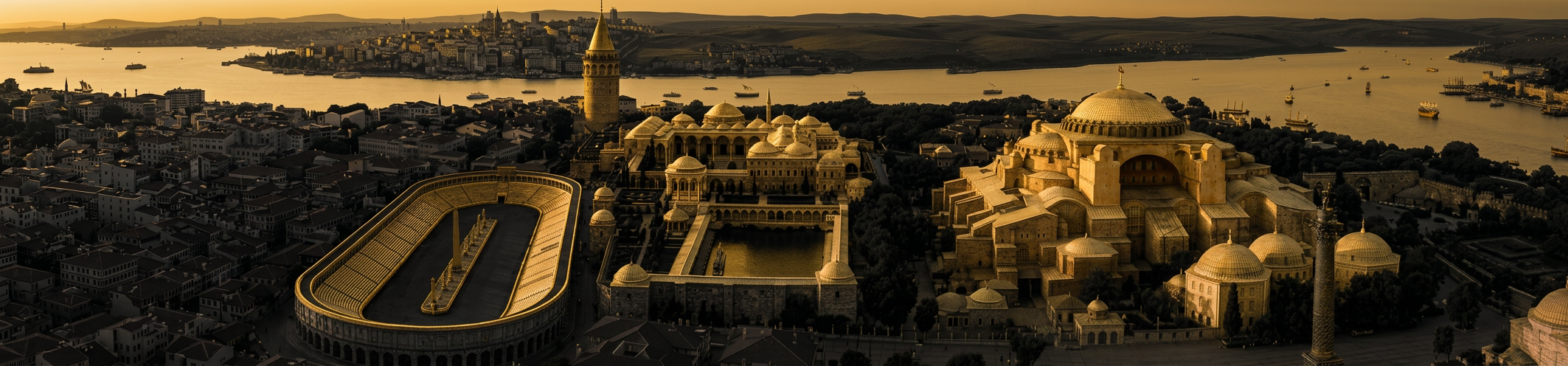
AI slop. This configuration is not correct. The palace was across that square from the Hagia Sophia, and the hippodrome was next to the palace. The Galata tower was across the estuary known as The Golden Horn, in… ummm… Galata. Tip of the hat to John Mendelssohn who devised this color scheme.

He founded the city of Constantinople in 330 and made it the capital of the empire, which it continued to be for 1123 years, barring the 57 years the Latins held the city in the 13th century. The division of the empire continued, however, and the last western emperor, Romulus Agustulus, was deposed in 476. The German who deposed him proclaimed himself the King of Italy, ending the western empire.

The Eastern Roman Empire survived for many complex reasons. To vastly oversimplify, many of the emperors were good statesmen. A higher percentage of Romans were literate than in any other kingdom in Europe. They benefitted from advanced technology, such as Greek Fire and compound bows. Constantinople itself was situated in such a way and defended so well that it survived many sieges.

In the 7th century a new and charismatic religion appeared in the world, known as Islam. The Romans lost much of their territory – all of their holdings in northern Africa and much of their territory in Asia – to the Caliphate, at that time rulers of the Muslim world. The empire struggled, lost some of their power and prestige, but survived and came to thrive again.

In 1025, one of the empire’s greatest Emperors, Basil II, died without an heir. Afterwards, the Empire entered a period of decline, with a revolving door of 14 Emperors succeeding each other over a period of 50 years. During this time the Imperial coffers were drained, the Army was destroyed beyond recovery at the Battle of Manzikert, and internal strife took a major toll on the empire’s wellbeing. In 1081, the young general Alexios came to power. His army was the first to sack Constantinople. Still, he ruled for 38 years and is considered the last truly great emperor among the Romans. Every ruler of the empire to come after him was his relative or direct descendant.

But the power of the empire had been broken beyond recovery. The empire continued to decline, though it took another 350 years to die. In 1453, Mehmet II laid siege to Constantinople and after two months of fighting, entered the city and sacked it for the 4th and final time. The last Roman Emperor, Constantine XI, disappeared in the fighting at the Theodosian Wall and was never heard from again. The Eastern Roman Empire became a memory, receding into history.