Craft Reflection: A Scene From Robert Galbraith’s The Cuckoo’s Calling

I swore I was done with these when I finished my MFA

Part 4, Chapter 1, pp. 249-266
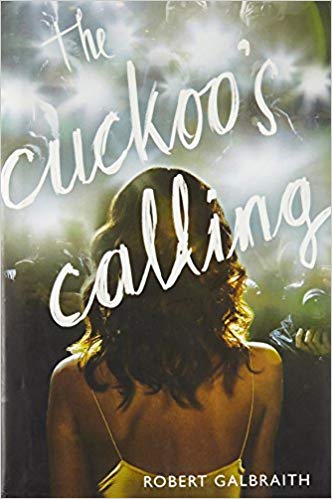
Cuckoo's Calling

I generally prefer fantasy and science fiction when I read for pleasure. Mystery is a genre that I have never gravitated towards, though I watch enough of it on television.

So it should come as no surprise that when I make one of my exceedingly rare forays into reading a detective novel, the writer would be someone who has gained much of their renown for their work in my “home” genre. Robert Galbraith is the lightly-worn pseudonym of JK Rowling, in case you are one of the three or four people on the planet whom I assume must exist who hadn’t come across this bit of information yet.

It occurs to me, having just finished this bit of the first Cormoran Strike novel, that scene work is one of the most fundamental aspects of the detective novel. How else, then, should a detective gather information than via interviews with the various people who knew the victim? One can google, I suppose, and Cormoran Strike and his temp assistant Robin Endicott both spend quite a bit of time doing web searches and reading articles for information, but ultimately, the best source of information in research is a primary source. Thus the need to do what is called “legwork”.

I could spend some time talking about the significance of that term in relation to the particular character of Strike, but that would be a different craft reflection.

The scene between Strike and Guy Somé excited me, because I enjoyed watching these two characters — strangers, very different on many levels — discover someone they could respect and appreciate over the course of an interview around a very difficult topic: the death of Somé’s friend and muse, supermodel Lula Landry, which Strike is investigating.

Throughout the scene, as this is just past midway through the book, other players in the story are discussed, and Somé offers sharp observations about each. We don’t know how many of these insights Strike finds novel, because he doesn’t want to influence a subject: Strike has shown throughout the course of the book that he is a gifted and disciplined detective. He keeps his opinions to himself, while working to bring out the viewpoints and knowledge of the people he interacts with professionally in as pure a form as he can.

There are three people in this scene: Somé and Strike, plus Trudie, Somé’s recently-hired and much put-upon assistant. As an aside, I suspect that part of Trudie’s purpose in this scene is to remind us of Robin Endicott, though Robin is never mentioned. Another aspect of Trudie’s purpose is to reveal some aspects of Somé’s character.

The subtext in this scene fairly sings, as both of the major players in it thrive on reading subtext. At least one attribute that defines Somé as a brilliant entrepreneur is his ability to read people. He’s also abrupt and sharp in his unvarnished takes on those around him, and those takes are without fail poignant and pithy. He is also cagey in how he uses those insights. He is familiar with Strike, basically through certain aspects of Strike’s background. Somé has dressed Strike’s father, aging but still a-list rock star Jonny Rokeby. Strike avoids the limelight, it’s not his world, and he and his father barely know each other.

As overtly as Strike is working to understand who Somé is, and what he adds to the overall contextual world of the dead woman he is investigating, Somé is working just as hard to figure out the person across the desk from him, because that is what Somé does. Somé keeps subtly probing Strike, trying to gain clues as to who he is and what his motivations might be. Part of the tension in the scene early on is Strike working to keep from being the subject of Somé’s own desultory investigation.

The turning point in their relationship comes with this exchange:

“…How come,” said Somé, swerving suddenly off the conversational track, “Jonny Rokeby’s Son’s working as a private dick?”

“Because that’s his job,” said Strike, “Go on about the Bristows.”

Somé did not appear to resent being bossed around; if anything, he seemed to relish it, possibly because it was such an unusual experience. (p. 258)

Somé’s general tone does not change. He seems to use frankness as a kind of offensive weapon, and the edge in his conversational style does not, at first go away. In fact, one of the first things that shows that Somé’s attitude has changed is a brief fit of pique. But then two pages later in the scene he lets his birth name slip, and before the end of the scene, he cries openly in front of Strike over the death of Lula, whom he considered family.

I love the understatement of that moment: the simple bluntness of Strike’s reminder of the business they were conducting, his demonstration of his professionalism struck a chord with Somé, and earned his respect. This was perhaps the third or fourth foray into Strike’s personal business, each time rebuffed similarly. But the nature of Somé’s character is to reason out whatever response he gets and to contextualize it; Somé is, as stated previously, a detective of sorts himself: a paragon of street wisdom.

The best part of the scene comes at the very end.

As Somé led Strike back down the spiral stairs and along the white-walled corridor, some of his swagger returned to him. By the time they shook hands in the cool tiled lobby, no trace of the distress remained on show.

“Lose some weight,” he told Strike, as a parting shot, “and I’ll send you something XXL.”

As the warehouse door swung closed behind Strike, he heard Somé call to the tomato-haired girl at the desk: “I know what you’re thinking, Trudie. You’re imagining him taking you roughly from behind, aren’t you? Aren’t you, darling? Big rough soldier boy,” and Trudie’s squeal of shocked laughter.

In zingers aimed at both Strike and his assistant, he shows his respect for each of them. We learn that whatever tension there is between Somé and Trudie, they understand and appreciate each other. A couple of other moments that we might have misread earlier in the scene are more properly illuminated by this exchange. We also see that, while Somé can’t really help himself from taking a jab at Strike, there’s respect and even generosity towards him mixed in. I both imagine Strike smiling to himself as he walks away (never stated in the book) and Rowling herself smiling as she completed this beautifully constructed scene.

Things One Can Do With Language

Order dinner
Find a bathroom
Listen

Make a phone call
Write a blog
Talk to the press

Interview a subject
Deny
Affirm

Tell the truth
Tell a lie
Create a web of lies

Come out of the closet
Be your true self
Hide from yourself

Fall in love
Marry
Divorce

Tell your grandkids
What it was like
In the good old days

Break the law
Write the law
Change the law

Be a slave
Own a slave
Outlaw slavery

Run for President
Start a war
Stop a war

Invent God
Follow God
Refute God

Chant
Sing
Write

From the Corner of My Eye, part 3

Note: This should have been posted days ago. Sorry about that, but here it is!

You can read part 1 here and part 2 here.

How does a reasonably intelligent, well-educated person, interested in and accepting of science, who views themselves as rational (whether it’s true or not) and mindful, come to an experience like this one, and what do I (being the person described above) take away from it? How do I process and interpret it?

Here’s another question: how can I write about this experience and not completely destroy my credibility? If I’m being honest, I have to start by admitting that for some people’s purposes, I can’t. A true skeptic is going to want far more than my say-so, and I don’t have more than that to offer. I have my eyewitness account, which is not objective proof of anything.

I’ve spoken to Matt about it since. He remembers that day but not clearly. He remembers that I told him I saw a pixie, and that I agree with his friend that there may be fairies in those woods, but not that a damselfly followed us. As time goes on, the incident lives only in my memory, though it remains vivid.

Now, I wouldn’t say I’m a skeptic, though I wouldn’t describe myself as credulous, either. I’m willing to examine or to re-examine any idea and I don’t believe most things in this world don’t have have clear-cut “yes” or “no” answers.

Are there fairies? Probably not.

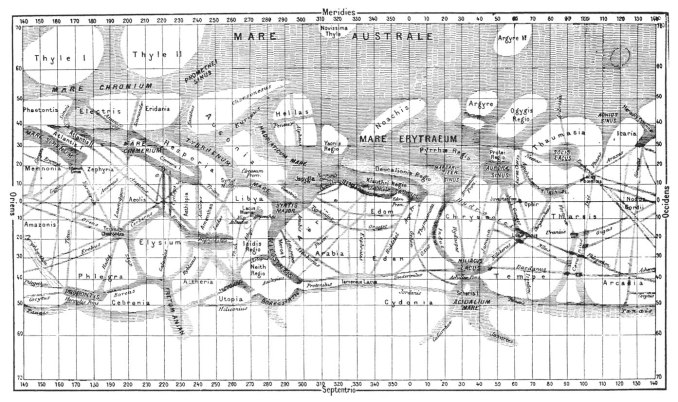
Giovanni_map_mars

Is there other intelligent life in the universe? I’d say that there must be, almost certainly. In this century, we have discovered hundreds of exoplanets – planets beyond our solar system – in our nearby galactic neighborhood. We’ve even begun to find the little, Earth-like worlds that might bear life similar to our own, though we haven’t yet found that life.

Is Schrödinger’s cat alive or dead? Yes. My understanding of the uncertainty principle is not that the unseen cat in the box is both alive and dead, but that because we don’t know one way or the other, we have to include in predictions we make involving the cat in the box both possibilities, with the knowledge that the cat certainly is in a single state, alive or dead. Until we know one way or the other, both might be true.

Is Schrödinger’s cat undead? We have no prior example of this condition available, so the probability of a zombie cat inside Schrödinger’s box is pretty much nil.

But in my memory is a clear image of a five-inch-long, quite handsome, fierce little blue man with gossamer wings.

Maybe I’m a little bit like Percival Lowell the astronomer, in that I’m captivated by a romantic notion. Lowell took something he misunderstood and turned it into his life’s work, and swayed not only generations of young dreamers, but got the University of Arizona, among other bastions of respectability and learnedness, to support his search.

The Italian astronomer Giovanni Schiaparelli, using a new, higher-powered telescope developed in the late nineteenth century, spent a great deal of time studying Mars at a closer level of detail than had previously been possible. He made a number of discoveries about the surface of the planet, including a seasonal change in the coloration of some regions of the surface, a darkening that seemed associated with the warmer temperatures of Martian summer. He discovered the immense Martian sandstorms that can cover the entire surface of the planet for weeks at a time. He also noticed some deeper channels cut into the surface of Mars that ran in straight lines for long distances. He called them “canali,” marking them on the beautiful hand-rendered maps he made of the Martian surface.

Lowell, an American planetary astronomer of some renown, saw Schiaparelli’s maps and became obsessed with the notion of the Canals of Mars, envisioning them as immense artificially-created waterways, marvelous feats of engineering created in an effort to conserve water by an ancient and advanced civilization, purposed towards saving a desertified, dying world.

Schiaparelli, learning of Lowell’s enthusiasm, wrote to him, explaining that “canali” was the Italian word for “channel,” referring to striations observed on the Martian surface without any inference of intelligent purpose intended or necessary, and furthermore that he had seen nothing to suggest that the canali were, in fact, evidence of intelligence, much less the advanced engineering marvels Lowell was busy convincing himself and others that they were.

No matter. Lowell continued to pursue his obsession, to the point of getting the Lowell Observatory at Kitt Peak in Arizona built with the intention of exploring the surface of Mars as closely as possible.

Over time, the dream of Martian canals has faded and died, though it burned brightly for a time in the popular imagination. From Lowell’s misinterpretation of Schiaparelli, we have been gifted with enduring adventure classics like H. G. Wells’ War of the Worlds, Edgar Rice Burroughs’ A Princess of Mars and ten more books featuring the former Civil War Captain John Carter, and the contemplative Robert A. Heinlein’s Stranger in a Strange Land, the story of a human infant, sole survivor of a failed Martian expedition who is raised by ancient and mysterious Martians, who comes back to Earth to become a prophet for the modern age. The book was controversial and influential in its time, and would not have existed but for Percival Lowell’s misreading of Giovanni Schiaparelli’s work.

Lowell was wrong, we know that for certain. In fact, it was known at the time that Lowell’s ideas were probably fanciful. But it’s also true that his fancies have left a mark on reality. If I’m like him, it’s in my willingness to entertain an idea that holds little objective merit, for reasons of my own. I’m different from him in that I don’t have any particular ambition to convince people that my fanciful ideas are real.

I actually hope what I saw never proves to be real. How disappointing it would be to have the existence of pixies, unicorns, or other such creatures confirmed by science: perhaps more disappointing than if someone were able to prove the negative, that fairies are, indeed, mere products of fertile imaginations and romantic hearts like mine.

From the Corner of My Eye, part 1

First of three parts

You can read part 2 here and part 3 here.

Lyra

Say you’re out in the country. It’s a cold, clear, still night: the best kind of weather for stargazing. You look up and see such a multitude of stars that it shocks you, especially if you’re an urban dweller and don’t often get away from the ever-present glow of humanity. If it happens to be a moonless night, you can see the Milky Way like a glowing cloud across the sky. You might see planets, perhaps one or more of the next three out from the sun: Mars, Jupiter, and Saturn, the three of the visible five most often seen once the sun’s glow has completely faded from the sky.

Mercury almost never rises high enough to be seen past the last remnant of sunlight. Venus does, at times. When visible, it’s the second brightest object in the sky after the Moon. When ahead of the sun in processing across the sky, we call it the Morning Star. When it trails behind, it’s the Evening Star. When you wish upon a star, most often you will – either knowingly or unknowingly – pick Venus: beautifully white and pure, never twinkling even on the windiest night, brighter than any other star in the sky. I’ve wished upon the Evening Star many times.

If you’re lucky enough to live where the ambient light is low, and if you love the night sky enough to develop some intimacy with it, to know where the planets are to be seen at any given time, to know constellations like Orion, Cassiopeia, Pegasus, Ursa Major (the Big Dipper), and Ursa Minor (the Little Dipper, which includes Polaris, the North Star), you may see other objects in the sky. Some are always there if you know where to look, and some appear only briefly.

I’ve seen a supernova. When I was sixteen, a star in the late-night summer sky appeared in the constellation Lyra where there hadn’t been one visible before. Over the course of a night or two, it became the brightest light in the sky other than the Moon, surpassing the Evening Star. Then in a couple of weeks it faded to invisibility.

I’ve seen meteor showers: the Perseids in August, the Leonids in November. The Perseids are so named because they seem to generate from a point in the constellation Perseus, and the Leonids from the constellation Leo. Once, I saw a bright light streaking across the sky, a fireball that left a glittering ribbon trail long enough that I couldn’t quite cover it with the width of my hand held at arm’s length. I watched it travel all the way across the night sky. In the news the next day I learned that it was a Russian satellite that had re-entered the Earth’s atmosphere in a blazing fireworks display that I’d marveled at along with many others who happened to look up that night.

I’ve seen the northern lights: Aurora Borealis. I’ve seen the comet Kohoutek and Halley’s Comet. Comets are objects that are best seen using averted gaze, meaning to deliberately see out of the corner of your eye.

Other objects you can see with averted gaze are deep-sky objects, far beyond our solar system. Some are visible with the naked eye, and others you can see only with a telescope. The brightest and most well-known of these were catalogued in the late eighteenth century by the French astronomer and comet-spotter Charles Messier.

The brightest and most famous object in Messier’s catalogue is perfect for teaching yourself how to use averted gaze. In the late summer and autumn sky there is a large, bright rectangle of stars that represent the constellation Pegasus. Trailing away from one point of the rectangle is a double strand of stars that make up the constellation Andromeda. Old celestial maps often showed Andromeda riding Pegasus, and the trail of stars has sometimes been depicted as Andromeda’s hair. In Andromeda’s hair is an adornment, like a jeweled barrette, that Messier included in his catalogue as M31, and which most of us know as the Andromeda Galaxy.

If you can find this object in the night sky, visible at 9 pm near its highest point in November, try this: locate the little cloud of light in Andromeda. It won’t be particularly bright, but it won’t be too hard to find on a clear night. Look a little bit to the left or right of it, not too far, maybe the distance of a couple of finger-widths at arm’s length or less, but focus your attention on the faint, fuzzy cloud of light. It should reveal itself as a larger, more vivid, lens-shaped object.

Averted gaze works because it brings a different part of the retina into use than that part more accustomed to receiving all of the light you focus on in a day, in all of your days, and which your brain is used to translating into sense and meaning. A less-used part of your eye will be more sensitive, but your brain will be less able to filter out things it interprets as nonsense. The light your eye takes in through averted gaze will not be as focused and clear, but with practice you can sharpen your acuity for this way of seeing. Astronomers of Messier’s time made beautiful drawings of the planets, revealing startling details while peering through low-powered telescopes, using this technique.

–To Be Continued

Books I Like #9

At Home in the Heart of Appalachia by John O’Brien

Anchor Books New York 2001

Appalachia

Here’s a wonderful book-length personal essay that resonates with me on a number of levels. Although O’Brien never names it, it’s clear to me that he suffers with ADHD: all the hallmarks are there, and he frankly discusses some of those markers.

He writes about his home in West Virginia, about many different aspects of life there, with an astute eye and a gift for clear, beautiful prose. Ultimately, It’s a perfect marriage of person and environment, exploring how much of West Virginia is a part of who he is, and drawing the parallels back between his own life and how that is reflected in different aspects of what this place is.

It’s a beautiful book that I just happened to pick up at a Barnes and Noble once, but it has stuck with me. I point to it as an influence in my journey from an exclusively genre reader to someone who likes various sorts of nonfiction: history, biography, memoir, essay, and journalism.