
I’m working my way through the Jethro Tull catalogue, one record at a time in chronological order. This Was was a shock to me, because it sounded like a different band entirely. All they changed, on the most physical level, was to switch out their guitar player. On a policy level, Tull became Ian Anderson’s baby. That narrowing and defining of leadership led to a huge expansion of the band’s artistic territory.
I can’t know this for sure, but I suspect that Mick Abrahams left Jethro Tull under a cloud. In the context of the band, he needed to be saged out of the space. Not to keep anyone in suspense or anything, but they 100% accomplished their goal. MA is pretty much a footnote in the Tull story, an early fork in the road. They become Tull as we know them on Stand Up.
In fact, by the third song on side one, the Brubeck-inspired “Bouree,” we’re already so far beyond the blues rock of what’s-‘is-name that the clock can never be turned back, and it becomes completely unfair of me to link everything that happens here to that guy.
But even though a listener who only had This Was as a reference point would feel his absence throughout, one would also hear the future. A great future. This album led to Benefit, and Benefit led to Aqualung, and everything that followed.
And Mick Abrahams could never have been the guitarist for Stand Up or any record that was made by Jethro Tull afterward. Martin Barre blows him out of the water, all while acknowledging that Ian Anderson is the boss. Where Abrahams wrote about half of the previous record, all of the songs here are Anderson’s, and collectively an upgrade from what had come before.
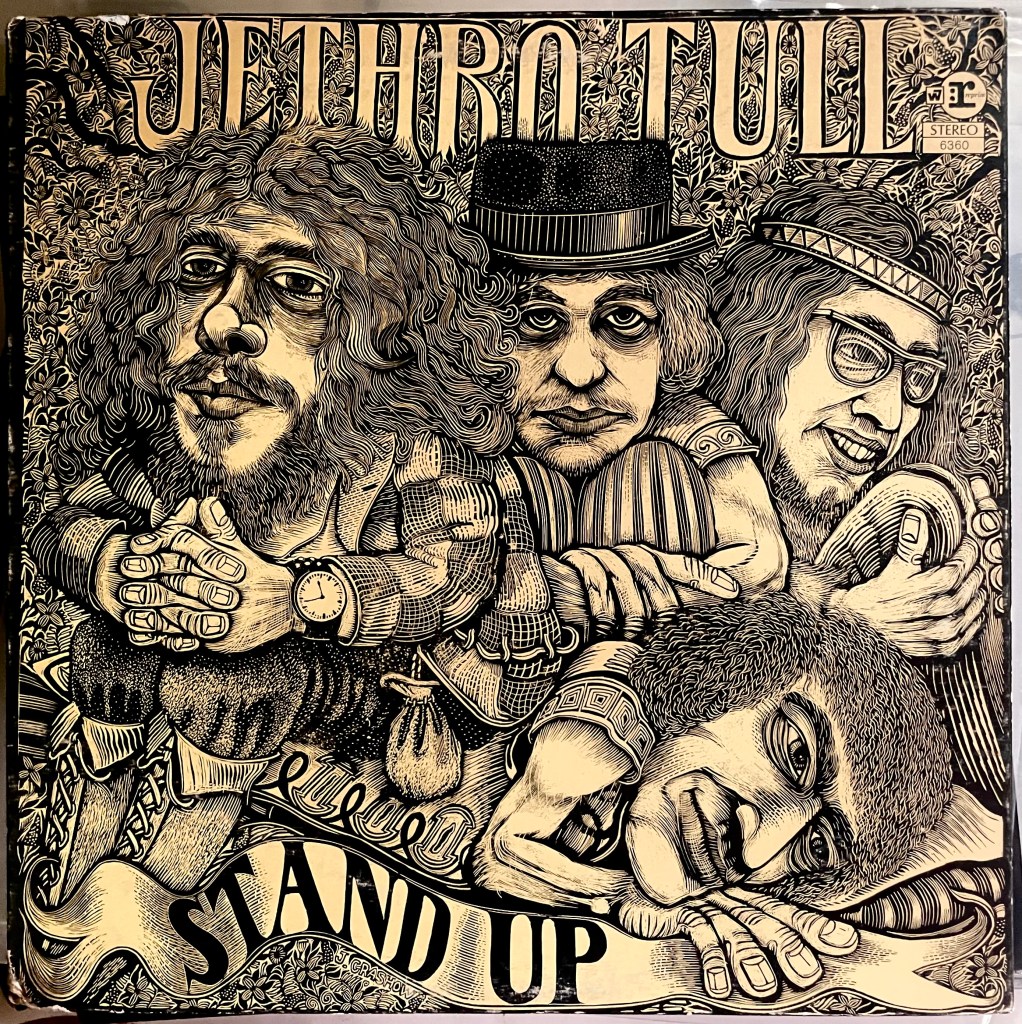
While the Ghost of Mick hangs over this record, by the end of it, the listener is only looking forward, not backward. The band virtually never went back to the blues rock well from which This Was sprang.
And that’s what I like most about that time in rock music, bands grew and developed. Each new album was a chapter in the larger story arc. Taking a big chance such as completely redefining a band’s approach could be either a horrible disappointment or a thrilling expansion of what a band could be. It may be true that in most cases it would be the former, but in this case, it’s absolutely the latter.
So many bands went through these changes around that time. Yes booted Peter Banks in favor of Steve Howe. Genesis lost Anthony Phillips but added Steve Hackett and got Phil Collins in the bargain. In the larger context, the music was changing, but this round of changes seems to have codified things in such a way that they began to become stagnant. Less than a decade later, all of these revisions up in quality became an unassailable status quo which necessitated a revolution.
From this decades-later standpoint, one can see that things were both gained and lost amidst all the changes… as they always are.
Here’s to change. We all need it, from time to time.
Please consider liking and commenting on this post. Subscribe if you can – it costs you nothing and helps this site thrive! Also, do be a dear and share this post with those you know who might appreciate it!

 Broadcast From the Brain Radio