Jethro Tull’s Second Album

In which The Ghost of Mick Abrahams is exorcised.

I’m working my way through the Jethro Tull catalogue, one record at a time in chronological order. This Was was a shock to me, because it sounded like a different band entirely. All they changed, on the most physical level, was to switch out their guitar player. On a policy level, Tull became Ian Anderson’s baby. That narrowing and defining of leadership led to a huge expansion of the band’s artistic territory.

I can’t know this for sure, but I suspect that Mick Abrahams left Jethro Tull under a cloud. In the context of the band, he needed to be saged out of the space. Not to keep anyone in suspense or anything, but they 100% accomplished their goal. MA is pretty much a footnote in the Tull story, an early fork in the road. They become Tull as we know them on Stand Up.

In fact, by the third song on side one, the Brubeck-inspired “Bouree,” we’re already so far beyond the blues rock of what’s-‘is-name that the clock can never be turned back, and it becomes completely unfair of me to link everything that happens here to that guy.

But even though a listener who only had This Was as a reference point would feel his absence throughout, one would also hear the future. A great future. This album led to Benefit, and Benefit led to Aqualung, and everything that followed.

And Mick Abrahams could never have been the guitarist for Stand Up or any record that was made by Jethro Tull afterward. Martin Barre blows him out of the water, all while acknowledging that Ian Anderson is the boss. Where Abrahams wrote about half of the previous record, all of the songs here are Anderson’s, and collectively an upgrade from what had come before.
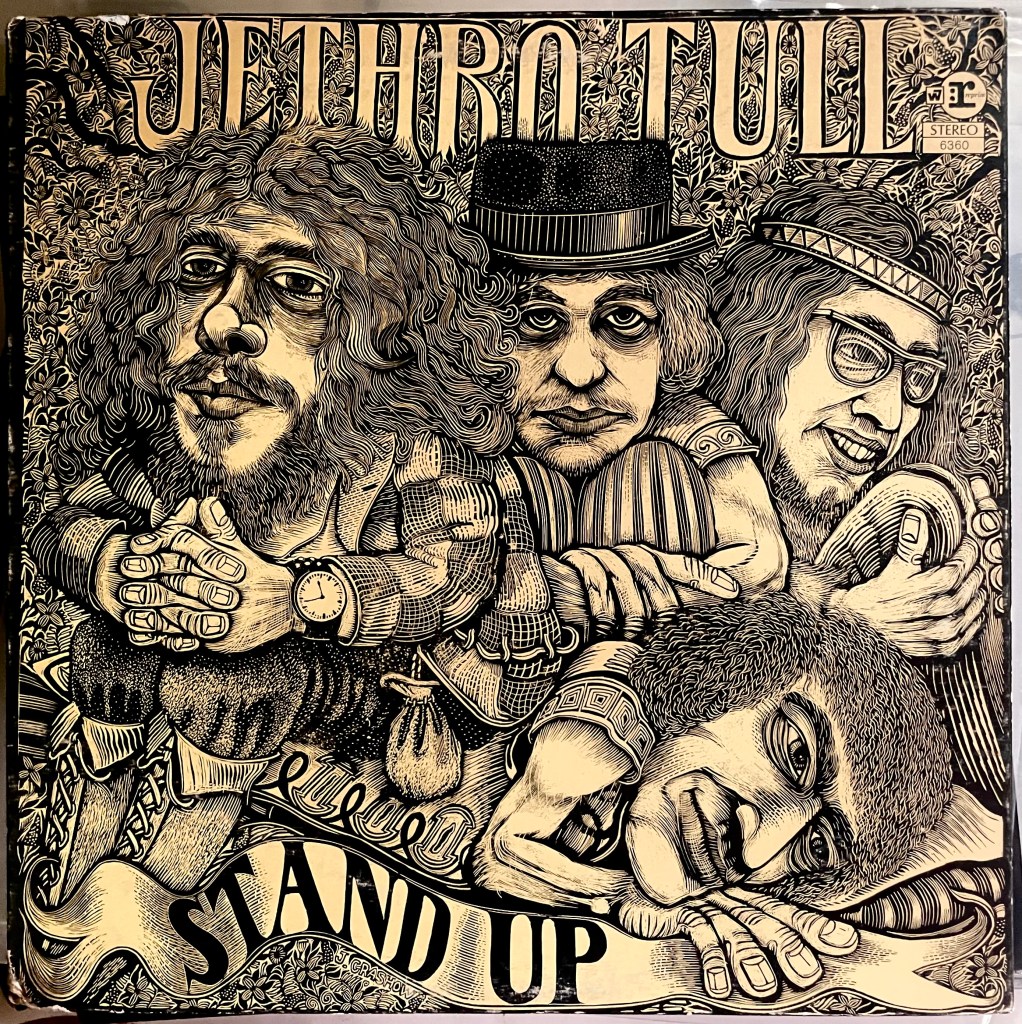
That’s Martin Barre in the middle, making eye contact with you. Hi, Martin! Photo of my copy of Stand Up by me.

While the Ghost of Mick hangs over this record, by the end of it, the listener is only looking forward, not backward. The band virtually never went back to the blues rock well from which This Was sprang.

And that’s what I like most about that time in rock music, bands grew and developed. Each new album was a chapter in the larger story arc. Taking a big chance such as completely redefining a band’s approach could be either a horrible disappointment or a thrilling expansion of what a band could be. It may be true that in most cases it would be the former, but in this case, it’s absolutely the latter.

So many bands went through these changes around that time. Yes booted Peter Banks in favor of Steve Howe. Genesis lost Anthony Phillips but added Steve Hackett and got Phil Collins in the bargain. In the larger context, the music was changing, but this round of changes seems to have codified things in such a way that they began to become stagnant. Less than a decade later, all of these revisions up in quality became an unassailable status quo which necessitated a revolution.

From this decades-later standpoint, one can see that things were both gained and lost amidst all the changes… as they always are.

Here’s to change. We all need it, from time to time.

Please consider liking and commenting on this post. Subscribe if you can – it costs you nothing and helps this site thrive! Also, do be a dear and share this post with those you know who might appreciate it!
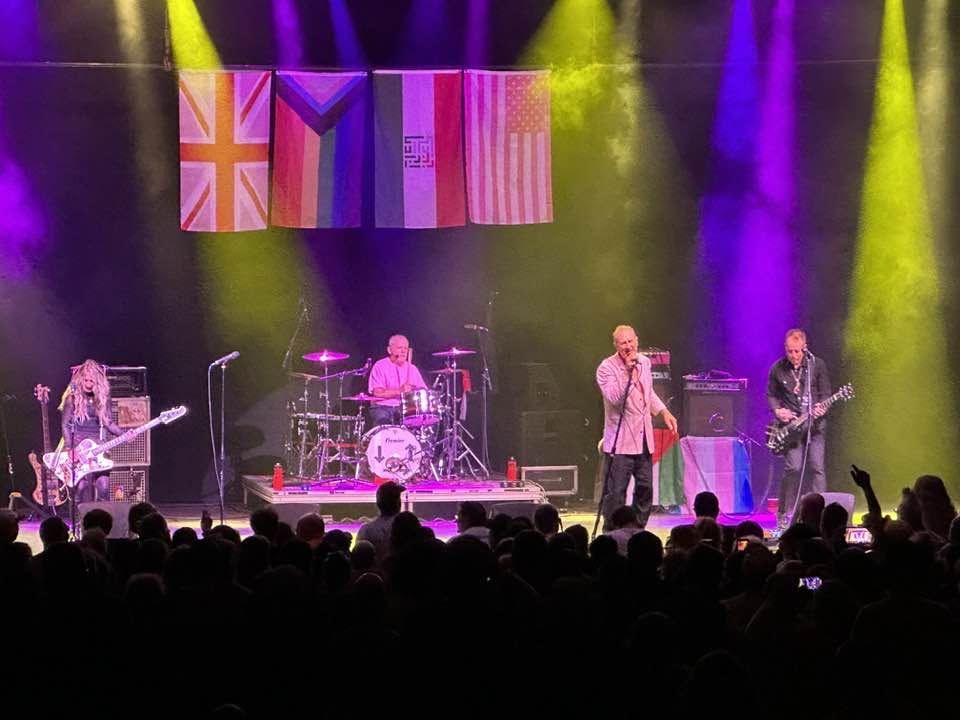
Gang of Four at the State Theater in Portland, Maine

A rock show for this time, playing music that sends a message across the decades.

I have to start by saying that the State Theater is one of the worst-sounding music venues I’ve ever been in. Opening band The Downtown Boys, who I really wanted to like (and probably would on any other night) were absolutely unlistenable in that room. Pure sonic mud. They were passionate and political and clearly having fun up there on that stage (their saxaphonist/keyboard player is a hoot!) but if you played me one of their songs today and didn’t tell me who I was listening to, I’m about 90% sure I wouldn’t be able to tell you who they were. It was that bad. I apologize for not having the ability to form more of an opinion about their performance. I suppose I should make an attempt to learn more about them, and I will certainly try to do so at some point.

Regular readers (hah!) of this blog will know that most of the music I write about here fits under the “prog” umbrella, but it should be noted that I have had lots of years of music listening, and my tastes are quite broad. I have both obsessed about and reacted against more different music than most people hear in a lifetime, and in the fullness of time, I have probably both loved and hated almost every sort of music.

Gang of Four at the State Theater in Portland, Maine. Photo by Landi Michaels.

So when I tell you that this first-gen obsessively hard-left post-punk band, Gang of Four, hit the stage the other night, I about lost my mind. I LOVE Gang of Four. I am not rational about it (except, of course, that I have lots of thoughts about them, and have sorted through them at length) and I couldn’t help abandoning everything and just hopping up on to my spindly old pegs and DANCING as soon as they began their set. Their energy did not let up, nor did mine. Start to finish, they were amazing.

I found myself thinking about how, with four albums and a couple of EPs to their name, this band could play a full set that sounded like a high-level greatest hits comp, and they absolutely did! They didn’t play anything from their final album Hard. Frankly, that was no great loss. Give me those first three albums and the interstitial EPs and I’m all set.

And speaking of greatest hits: I know it’s a standard set piece, but Jon’s very rhythmic whacking of a microwave oven with a baseball bat was extremely satisfying. In fact, that was one of the many moments of cultural resonance that came with the set in general. There was a feeling in the air that what Gang of Four was offering from the stage was medicine, that every note and nuance was there to counteract the effects of fascist evil. It was a utopian moment in time for that very reason.

And it was also the band saying goodbye. Original band members Jon King and Hugo Burnham have said that they won’t be bringing the band out on tour again, that they’re closing the book on headlining tours. I’m grateful that I got to see them. I haven’t been able to get to any of their shows before, no matter how much I love them, but this moment seems like the most impactful time to have come to their positive, warm, anti-fascist performance. It is fuel, which I suspect is what they want their music to be.

Finally, I want to shout out Ted Leo and especially Gale Greenwood who did a great job of filling giant shoes. Gale especially was having a great time on that stage, bouncing around and clowning and holding down that very heavy beat along with Hugo. She was a great addition to the show. (I just learned that my friend Linda Bean Pardee played bass with Gang of Four before Gale! Hey, Mikey!)

Also, Hugo took a few moments at the end of the night to shill for Graham Platner, which I greatly appreciated.

Please consider liking and commenting on this post. Subscribe if you can – it costs you nothing and helps this site thrive – and share this post with those you know who might appreciate it.

Vol. I & Vol. II

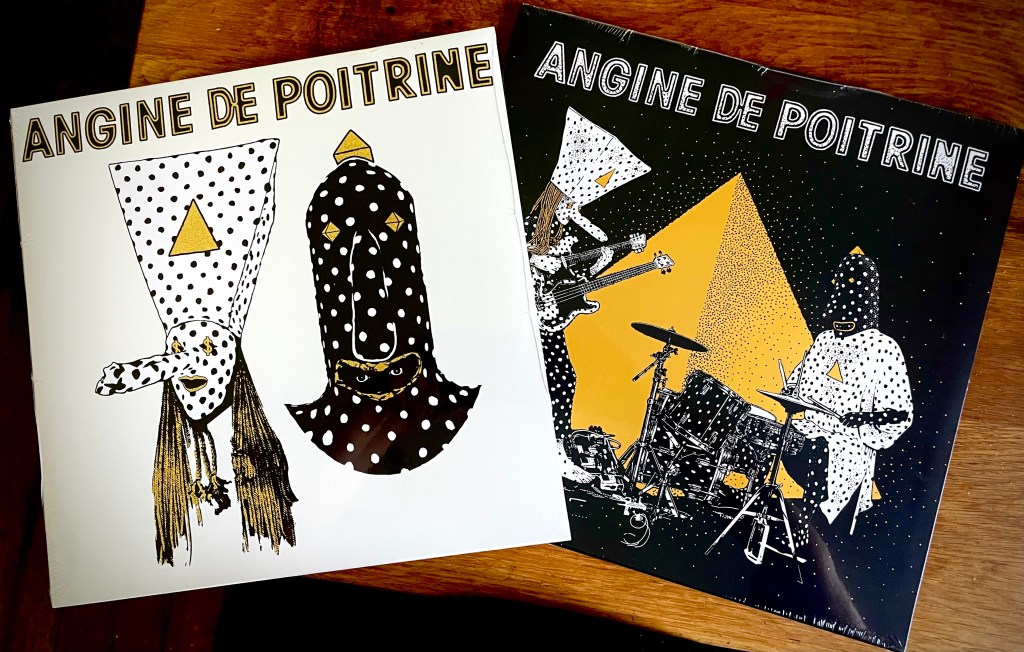
I finally acquired these two beauties…

Photo by me, art design by Fabien Peterson (Vol.I) and Arielle Corbeau (Vol. II)

Like many other fans of this band, I’ve been waiting for MONTHS to get my hot little hands on these two beauties. I’ve seen many pictures of these records on my social media feeds, and it makes me happy that we all have our little grails. But what of the actual objects? Were they worth the wait?

It’s worth noting that both albums have been available to us online. We have been able to turn on the interwaves and find all 12 of these tracks (6 per disc, 3 per side) any time we wanted, for the price of whatever we’re paying for our internet hookup anyway. Then we can stream them for “free,” meaning you might have to deal with ads or perhaps a subscription price. Youtube also has many audience recordings of their current ongoing tour, so any of these tracks that they’ve brought to the stage, you can most likely see a shaky hand-held cam video of with muddy-ass sound as an added bonus.

And yeah, I’ve done that a bunch. Short of turning this exercise into a defense of buying physical media in an age when all of this stuff is RIGHT THERE IN FRONT OF YOU ON THE CENTRAL SCRUTINIZER, I can only tell you that I’m happy to have these particular objects in my posession, in the context intended by the makers of this music. YMMV.

I can also tell you that I have seen these 2 albums listed on eBay for a grand.

Vol. I includes two songs titled after foods the band has been known to throw into the crowd at shows. In each case, I find them to be the weaker tunes on the album. Tohogd (hot dog) sounds like an early effort, something the brothers made when figuring out how to do this act. Sahardnieh (sardines) sounds a bit more fully realized, but sits between two tracks I find more interesting and more complete. Side one has what I think is the best song on the record — Sherpa — but overall, side two is the stronger set. By overreaching extension, I derive the impression that this band has far more to offer us than its baser, more novety-ish impulses.

But then, I feel a little presumptuous in trying to separate out intentions I’m not privy to. And I will remind that the first thing that made me perk up and listen was their stage presentation — the very gimmickiness that I set at the base of their approach. Still, between Ababa Hotel and Sahardnieh, I’m absolutely going to point you to the former as a fine demonstration of what this band can do, and Sahardnieh as a slightly lesser, but still vital representation of what the band identity.

Side 1 of Vol. II is the high point of their recorded work, in my opinion. It’s like a combination of Eno and “Pleasant Valley Sunday” with a bit of krautrock flavor mixed in. It’s also very precise and funky af. Again, and not for the last time… AdP are very good players. These songs are structured brilliantly, the humor is fully present. As I listen through these three songs — “Fabienk,” “Mata Zyklek” (My favorite Angine de Poitrine song,) and “Sarniezz” — I feel a thrill at brilliant new music that I haven’t felt in a good long while. Each new track makes me want to dance, makes me smile, makes me glad I’m here to experience this young band who have found new ways to bring out these responses in me.

And the music holds up without the costumes. That may be the best thing that comes from listening to the vinyl. Without the extra stimulus of those whacked-out (but very cleverly designed) outfits, the experience is just the players — Khn and Klek — and the aural environment they create. Khn uses the microtonality of his instrument(s) in an absolutely tasteful way. The “extra” notes are never just extra — they are an augmentation, an extension of the possibilities available.

One of the most impressive passages here, the end of the first section of “Utzp,” the side 2 opener, is a layering of harmonies, each new layer incorporating microtonality as each new part comes in and keeping things consonant and propulsive as Khn surprises us each time things come around again.

And side 2 of this album doesn’t disappoint, even though I think they rightly chose side 1 as the bulk of that KEXP live set that everybody saw (myself included) and turned them into the most exciting thing in rock music in 2026. The ideas keep flowing, the execution is in all cases flawless and fun.

Please consider liking and commenting on this post. Subscribe if you can – it costs you nothing and helps this site thrive – and share this post with those you know who might appreciate it.

Sitting Up With The Dead by Pamela Petro

I bought Pam’s book off of the author table in the Marran Gallery at Lesley University the week I graduated. She had been my thesis advisor and the semester had gone well, so I was excited to read some of her work. This was the only book of hers they had, so I picked it up.

It’s a travel book about southern storytellers. In each chapter, Pam talks about a particular storyteller and frames them geographically, temporally, and in the course of her journey, including a story by them. Its outermost framing is four road trips that took place over the course of the summer of 1999, so the book has the feeling of a road journal. Each chapter is different, some having a formal story set in a different typeface intermingled with or slighty set off from Pam’s text in a separate font. This allows her the ability to interject observations or comments in the flow of the story, and have them easily identified. There’s one fascinating chapter where she juxtaposes three different versions of the same story against each other, two in identifying fonts, one described in Pam’s text. It’s a fascinating exploration of the folk process.

That’s only one chapter in the book: every experience with a storyteller is different, and every chapter of this book takes its own shape. There’s gorgeous writing — both in Pam’s descriptions and in the stories she collects. David Holt’s story “Ross and Anna” is horrific, heartbreaking, and gorgeously told. There are several trickster stories, including a faithful telling of The Tar Baby from the Brer Rabbit stories, and a Jack story (of Jack & the Beanstalk fame) as told by Orville Hicks. Orville’s Uncle Ray gets an entire section of the book, deservedly. Another favorite of mine is Annie McDaniel’s “My First Encounter With a Flush Commode”, a recalling of a childhood memory which tells us about the south’s journey into modernity, and how recently things we now take for granted and consider necessities were new and alien. There’s history in these stories that goes back hundreds of years (at least two stories are about Kings) and there are ghosts lurking around almost every corner, both within the stories and around them.

The book pairs up nicely in my mind with Harry Smith’s “Anthology of American Folk Music”, mining the same territory, though the time frame is different. Instead of inhabiting what Greil Marcus describes as the “Old, Weird America” of the pre-electrification south, Pam collected these stories in the penumbral pre-shadow of 9/11. As such, the book has historical value as a journey through a part of the world that has undergone changes since. For instance, the Pre-Katrina levee at the south end of the Mississippi River stands as a backdrop in one chapter. I think Sitting Up With the Dead is a great book. I don’t feel qualified to capitalize those words, but in my mind, they ought to be. It drips cultural significance, and I can’t think of another like it.

It’s also a wondrously good read.

Goth quotient: 72

Rating: 11 stars.